Purpose of this Blog...

You may have noticed that not all books are equal in capturing children's imaginations and in cultivating those innocent, tender souls. My goal is to help you find the ones that do!
(Painting by Mary Cassatt: "Mrs Cassatt Reading to her Grandchildren" -1888)


Friday, May 18, 2012

Curious George's Most Dramatic Adventure


Escape from Paris by Allan Drummond shows the Reys fleeing the city in 1940.

Courtesy Houghton Mifflin Company
Did you know that Curious George was originally known as "Fifi" and that he had a narrow escape from the Nazis with his creators -- on their bicycles??

May 16th marked the day Margret Rey was born to Jewish parents in Hamburg, Germany in 1906.  She is best known for co-creating the beloved Curious George books, illustrated by her husband Hans ("H.A.") Rey.  In 1935, her job as a reporter and advertising copywriter took her to Rio de Janeiro, Brazil. While there, she came in contact with Hans, also originally from Hamburg - whom she had met years before.

They married and moved to Paris, where their first children's book, Cecily G. and the Nine Monkeys, was published in 1939.  In that story, one of the monkeys — "Jimmy, the brave monkey" — is standing next to his brother, Fifi.  It is Fifi who would later become known as "Curious George".


Margret and her husband were living in Paris when the Nazis invaded, and the couple fled the city on bicycles just hours before the German Army arrived. In their luggage was the manuscript of the first Curious George book. Eventually the Reys reached the United States, along with the unpublished story featuring their mischievous little monkey protagonist.

source
I've included a link to the fascinating interactive timeline: "Margaret and H.A. Ray's Life in Paris and Narrow Escape", here.

There is also a biography about the Reys, in picture book format, The Journey That Saved Curious George: The True Wartime Escape of Margret and H. A. Rey, by Louise Borden and illustrated by Allan Drummond.  (You can click on Amazon's "Look Inside" feature to see inside the book.)


The Reys became naturalized citizens in 1946.  H.A. Rey died on August 26, 1977. The couple had been married for 42 years, but never had any children of their own. Margret continued with her career in writing after her husband's death. When she turned 90 in 1996, Margret gave $1 million to the Boston Public Library and its branches to improve their Children's Rooms. She also gave $1 million to Beth Israel Hospital for its Center for Alternative Medicine for Research, which studies nontraditional therapies. She died on December 21, 1996 in her home in Cambridge, Massachusetts.

source: Greenville Public Library page

Tuesday, May 15, 2012

BEACONS OF LIGHT

Remember the whimsical scene "Brazzle Dazzle Day" from the 1970's Disney movie, Pete's Dragon?  Pete, an orphan boy, is helping Lampie (Mickey Rooney) - an old lighthouse keeper - and his daughter Nora (played by Helen Reddy) - clean up the lighthouse, Disney-style: dancing all the way.


I recalled this scene during our recent trip to Hawaii, where we stopped by a beautiful lighthouse on the island of Kauai.  This Kilauea Lighthouse has been standing sentry out on a point as a lone beacon to ships since May, 1913.
Kilauea Lighthouse on Kauai.
The old (which needs refurbishing)
 and the modern new signal light.
The grounds around this lighthouse are home to many species of birds, including the "Wedge-tailed Shearwaters", which make their nests by tunneling down into the dirt, below the ground cover plants that are all around the point.  We saw many of them nesting along the pathways...


CHILDREN'S BOOKS ABOUT LIGHTHOUSES:
There is something safe and hopeful about lighthouses, that children really relate to. Below I've shared two of our family's favorite books about lighthouses.  The first is a picture book and the second a historical easy-read chapter book...


The Little Red Lighthouse and the Great Gray Bridge, by Hidegarde H. Swift, illustrations by Lynn Ward. This lovely book about a "fat and red and jolly" little lighthouse and a great gray bridge was first published in 1942.
source here
Interesting true story about this particular lighthouse:
In 1921 it was relocated from Sandy Hook New Jersey (where it had been built in 1880) to Fort Washington Park, on the New York bank of the Hudson, where it became "Jeffrey's Hook Lighthouse" - the only one on the island of Manhattan.  When the George Washington Bridge opened in 1932, the lighthouse was decommissioned.  In 1951 public outcry prevented it from being sold at auction, and it was given instead to the city of New York.  It eventually fell into disrepair and its light was left dark. It was restored in the 1980s and was designated as a city landmark in 1991. Then in 2002, marking the sixtieth anniversary of the publication of this book, the lighthouse, dark since 1947, was outfitted with a new lens, allowing its beacon of light to shine across the waters of the Hudson River again.

Keep the Lights Burning, Abbie, a well written and nicely illustrated "Beginning to Read" book by Peter and Connie Roop, illustrated by Peter E. Hanson. This simple but true story brings new meaning to the concept of duty. It's about a courageous young girl - Abbie - who is determined to keep her father's lighthouse lamps burning while he is away on the mainland.  She is resolute about her responsibility, despite of the fact that a terrific storm threatens to sweep her family's little house into the sea, the fact that her mother is in bed sick and must be kept warm, and that even the fate of their chickens is in her hands. (Based on a true story of an 1856 storm off the coast of Maine.)

Sunday, May 13, 2012

THE READING MOTHER


Suzanne Marsh - source


 I had a mother who read to me 
 Sagas of pirates who scoured the sea. 
 Cutlasses clenched in their yellow teeth; 
 "Blackbirds" stowed in the hold beneath. 
 I had a Mother who read me lays 
 Of ancient and gallant and golden days; 
 Stories of Marmion and Ivanhoe, 
 Which every boy has a right to know. 
I had a Mother who read me tales 
 Of Gelert the hound of the hills of Wales, 
 True to his trust till his tragic death, 
 Faithfulness lent with his final breath. 
I had a Mother who read me the things 
 That wholesome life to the boy heart brings- 
 Stories that stir with an upward touch. 
 Oh, that each mother of boys were such! 
You may have tangible wealth untold; 
 Caskets of jewels and coffers of gold. 
 Richer than I you can never be -- 
 I had a Mother who read to me.
-by Strickland Gillilan (1869-1954) 

Friday, May 11, 2012

LETTING GO OF DISTRACTIONS

Lately I've seen more and more parents on their phones checking and sending text messages when they're with their kids - at the park, at restaurants, at the library, at home...
source here
Last night I came across a blog post from Hands Free Mama, poignantly titled, "How to Miss a Childhood".  This mom enumerates the damaging ingredients for lost moments, as she offers: "All it takes is one child and one phone and this tragic recipe can be yours."

One of her tips in following this Recipe for Missed Moments?  Keep your phone turned on at all times of the day.  Allow the rings, beeps, and buzzes to interrupt your child midsentence; always let the caller take priority.


But then she recommends another recipe, "How to Grasp a Childhood". (It's very easily followed if you just put down your phone.)

One of her steps for this Recipe: Take time to be with him -- really be with him by giving your full attention...The gift of your total presence is love to your child.

I've linked to this not-to-be-missed post, here.

Happy Mother's Day and happy reading with your children. I hope you pick up a book and put down your phone!


Wednesday, May 9, 2012

HAWAIIAN MISSIONARIES, FLOWERS, AND QUILTS

Our dear friends who hosted us during our stay on Kaui have quite a family history with Hawaii:  they are descendants (have you seen the movie with George Clooney?) of some of the first missionaries that ventured forth from the East Coast of the United States to the"Sandwich Islands" back in the 1840's!

Dr. James W. Smith (a great-great? grandfather of our friends) was the first Western-trained physician on the island, who arrived as a missionary with his wife, Melicent.  They raised a family while struggling to save a remnant of the Native Hawaiian population from the ravages of Western epidemics, which the Native Hawaiians had no immunity to.

I've been engrossed with their story from the book, 100 Years of Healing: The Legacy of a Kauai Missionary Doctor, researched and written by Evelyn E. Cook.

Missionaries first began arriving in the "Sandwich Islands" in the 1820's, bringing Christianity and some other influences to the Hawaiian culture, including melodic music and...quilts!

Before the missionaries arrived, Hawaiian women had always made bed coverings from kapa, a cloth made from the inner bark of native trees. Strips of this bark were beaten and felted together to make it into a cloth that was smooth and soft to the skin. The top layer of kapa was dyed and stamped with an overall design.  Women of higher status had the leisure time to decorate more extensively.

As cotton fabric became more available with the westernization of Hawaii, it was possible for the missionaries to help the native women create durable and beautiful bed coverings with applique on solid fabric: quilts.  These appliqued quilts had a single design radiating symmetrically from the center covering the whole quilt.  The pattern was made much like we might make a cut paper snowflake, but with fabric.  These traditional Hawaiian quilts were made with only two solid colors, one for the background and one for the appliqued design pattern.


I found a beautiful shop where these two-colored "Hawaiian Quilts" are sold.  And I found a picture book by Georgia Guback about a young Hawaiian girl named Luka, whose "Tutu" (grandmother) wants to make her a special traditional Hawaiian quilt.
Luka's Quilt by Georgia Guback

From the book jacket:  Luka and her grandmother Tutu are best friends. They spend lots of time together and enjoy each other's company. But everything changes when the quilt comes along. The traditional Hawaiian quilt Tutu makes as a gift for Luka isn't at all what her granddaughter expects. Luka is disappointed, Tutu is hurt, and they don't feel like they can be friends anymore. When Lei Day arrives, Tutu suggests putting aside their differences so they can enjoy the festivities. The celebration makes them feel better--and also sparks the compromise that will make Luka and Tutu best friends again. 


I was a little disappointed in the ending, given that the grandmother puts forth such a great effort to make amends, but Luka never apologizes to her about not being grateful for the quilt gift and all the hard work her Tutu had to do in making it.

But the author reveals a lot about the cultural detail of traditional Hawaiian quilts through the beautiful paper cut illustrations.  Luka anticipated a colorful "garden" quilt, and is disappointed that her grandmother has pieced it with only two colors.  I think the book could have greatly benefited from a little more explanation and a historical note about the history of traditional Hawaiian bed covers, "Kapa Moe".
Inspiration for many of the designs on these quilts comes from the natural beauty of flowers and leaf patterns of the Hawaiian Islands.  Here are some of the beautiful flowers that we saw on Kauai and Maui...


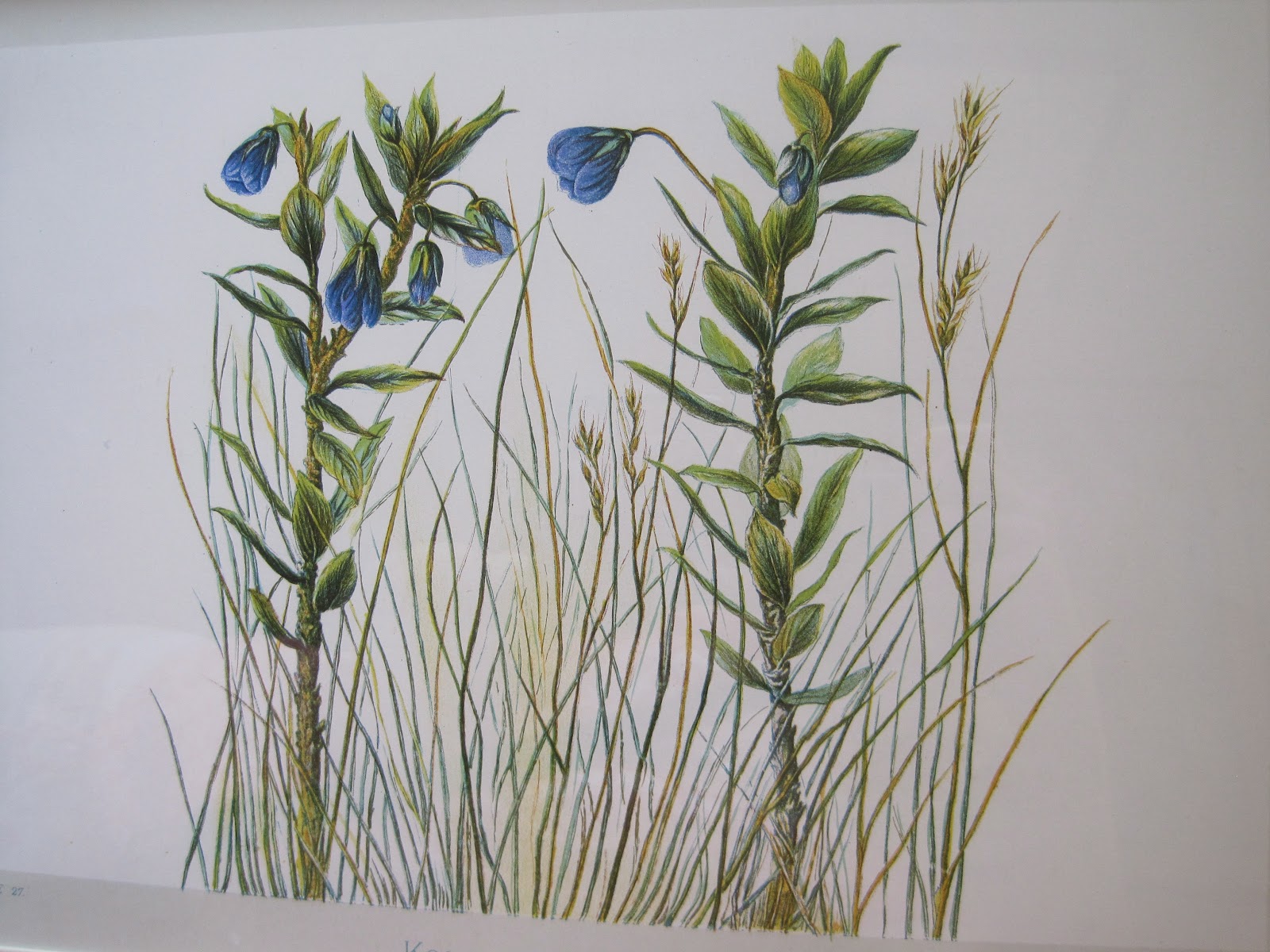
I also came across a beautiful vintage flower journal in a little museum we went to.  I would absolutely love to have an old book like this, so that I could frame the color plate pages!

Indigenous Flowers of the Hawaiian Islands
by Isabella McHutcheson Sinclair.


Here's a link to the whole collection here, on Flickr, if you are interested. Isabella Sinclair moved to Hawaii after marriage to her husband in 1863 and engaged herself in collecting botanical specimens, painting watercolor sketches of the plants and preparing a collection that eventually became a book. She documented the authenticity of her 44 colored plates, sending specimens of each plant to the Royal Botanic Gardens at Kew, England.  The director encouraged her to publish her work and assisted her in this when she and her husband came to London in 1885.  Reviewers commented that although Mrs. Sinclair did not profess to be a botanist, she was a keen observer and gifted artist as evidenced not only by her drawings but by the written descriptions that accompany them. -Digitized by Michael B. Thomas. 2008. University of Hawaii, Joseph F. Rock Herbarium.

Wednesday, April 25, 2012

Tuesday, April 24, 2012

THE SECRET INGREDIENT: LEARNING (& FUN!)

Most children enjoy helping their parents with cooking. Especially when kids are just starting to read, cooking is not only a good family bonding experience, but a great learning activity too. Cooking involves math, science, thinking skills and...reading!

Watch for this new children's picture book biography
    about Julia Child,  coming out in May 22,  2012!

So grab an apron and a cookbook! You can point out words in the recipe, while you explain to your child how the words correlate to what you're doing as you measure and bake. Grocery shopping is also a great way to help kids get involved in reading - they can help you read labels as you search for the recipe ingredients!

Playing with your food...
I recently blogged about food-themed books - you can find "My Top Ten Picture Books About Food" post here.  What about book-themed food? Here are some fun ideas:

Eric Carle's Hungry Caterpillar lunches...
from My Food Looks Funny

from Nurture Store
A pretty Princess and the Pea Cake...
from Family Fun
Pigeon Cake...
From an Edible Books Festival
Cloudy with a Chance of Meatballs...
from Parents Magazine (photo Tara Donne)

Here's a short trailer for the brand new book titled Funny Food, by Bill and Claire Wurtzell.  It's got 365 "fun, healthy, silly, creative breakfasts" for you to make with or for your kids.  You won't believe some of the creations!


 Another unique book is Once Upon a Recipe, by Karen Greene...More than fifty delicious, healthy recipes with cooking tips and  allusions to works of children's literature. For instance: Babar's Carob French Toast, Shakespeare's Breakfast Sandwiches, Rumpelstiltskin's Pillow, and Bambi's Salad Bowl.
As Julia would say: "Bon Appetit!"