Purpose of this Blog...

You may have noticed that not all books are equal in capturing children's imaginations and in cultivating those innocent, tender souls. My goal is to help you find the ones that do!
(Painting by Mary Cassatt: "Mrs Cassatt Reading to her Grandchildren" -1888)


Thursday, October 4, 2012

Steampunk Lit For Kids? Elementary, My Dear!

What is exactly is "Steampunk"?  I like this quote from author Caitlin Kittredge:

source
“It’s sort of Victorian-industrial, but with more whimsy and fewer orphans.”

According to steampunk.com: Steampunk has always been first and foremost a literary genre, or least a subgenre of science fiction and fantasy that includes social or technological aspects of the 19th century (the steam) usually with some deconstruction of, reimagining of, or rebellion against parts of it (the punk).

Not Quite Steampunk:
Steampunk moving towards the mainstream? Ya think?

As happens with trends, Steampunk seems to be everywhere all of a sudden, and often a bit over-done and misunderstood - as you can see from this funny Youtube video:


Jules Verne: Before Steampunk was Hipster
Jules Gabriel Verne (February 8, 1828–March 24, 1905) a French author and visionary, is often called the "Father of Science-fiction", as a pioneer of the science-fiction genre. Born out of his own love for travel, Verne's books are about cosmic, atmospheric, and underwater travel before air travel and submarines were commonplace and before practical means of space travel had been devised.
Jules Verne, with some of the amazing inventions her imagined.
Courtesy of the Smithsonian Libraries

Did you know that Verne's Around the World in Eighty Days was based on a true story?  In 1870, U.S. railroad magnate George Francis Train declared in the middle of his Presidential candidacy that he would travel around the world in 80 days or less. It ended up taking him almost double the time.

Verne never acknowledged George Francis Train (that couldn't have been his real name!) as the inspiration for his book. Train lived until 1904 and made three more round-the-world trips, beating his record each time, finally achieving 60 days. He once told an English journalist: "Remember Jules Verne's Around the World in Eighty Days? He stole my thunder. I'm Phileas Fogg. But I have beaten Fogg out of sight."  source

Other sci-fi books by Jules Verne: 20,000 Leagues Under the Sea; Journey to the Center of the Earth

Modern day author/illustrators who've introduced kids to a fantastical Steampunk world in their books:


Graeme Base - An alphabetical search and adventure book full of alliteration, Animalia was published in 1986 and has been a hit ever since. Each page features a short poem utilizing the feature letter of each page for many of the words. The illustrations are intricate, embedded with riddles and secret objects. The author has even hidden a picture of himself as a child on every page.


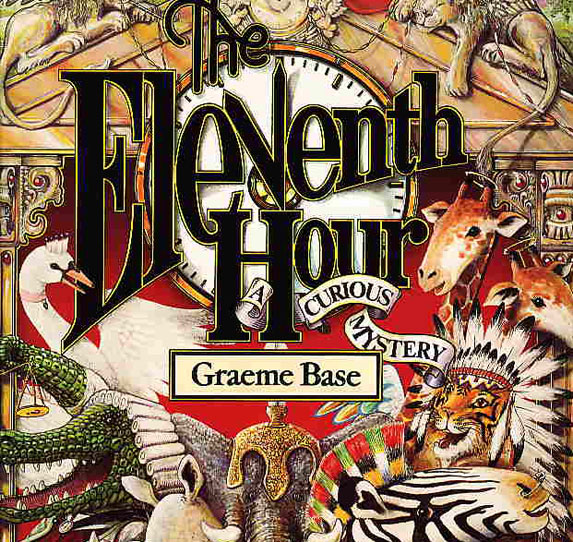
The Eleventh Hour is another award winning mystery picture book by Graeme Base. Set on the grounds of Horace the elephant’s elaborate mansion, Horace hosts a dress-up party for his eleventh birthday, inviting all of his friends; swans, alligators, rhinos, pigs, mice and more, to feast on a lavish spread, which regrettably, mysteriously disappears.

James Gurney
, author of the Dinotopia series. In the year 1860, biologist and explorer Arthur Denison and his son, Will, set out on a sea voyage of discovery and adventure. When a powerful typhoon wrecks the ship in uncharted waters, Arthur and Will are the sole survivors. Washed ashore on a strange island called Dinotopia, they are amazed to find a breathtaking world where cities are built on waterfalls, people have found new ways to fly, and humans and dinosaurs live together in harmony. With new discoveries at every turn, Arthur and Will embark upon their own separate journeys to unearth the mysteries of Dinotopia. (You can find James' wonderful blog, here.)


William Joyce's The Guardians of Childhood picture books and chapter books develop fantasy "origin stories" for childhood figures such as Santa Claus, The Tooth Fairy, and the Man in the Moon. Ultimately, the series will consist of 13 books - six picture books and seven novels, for older kids.  Pure imagination - childhood folklore and mythology at its best (and beautifully illustrated!)

Balloons lost on earth often floated up to the moon, carrying
the hopes and dreams of the children who lost them.


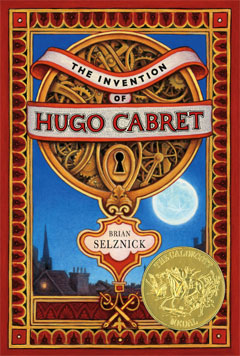
Brian Selznick, The Invention of Hugo Cabret website is here.  The movie, directed by Martin Scorsese, has more of a Steampunk look than the book, but there is definitely a steampunk aspect to this story: the mysterious drawings, notebooks, keys, secret messages, and oddball contraptions (including an automaton) come togehter for a great adventure!)

And lastly:
Two classics, with some Steampunk style... 
The Voyages of Dr. Dolittle
Doctor Dolittle heads for the high seas in perhaps the most amazing adventure ever experienced by man or animal. Told by nine-and-a-half-year-old Tommy Stubbins, crewman and future naturalist, the voyages of Doctor Dolittle and his company lead them to Spidermonkey Island. Along with his faithful friends, Polynesia the parrot and Chee-Chee the monkey, Doctor Dolittle survives a perilous shipwreck and lands on the mysterious floating island. There he meets the wondrous Great Glass See Snail who holds the key to the greatest mystery of all.
book by Hugh Lofting
film version
Chitty Chitty Bang Bang, by Ian Fleming
Commander Caractacus Pott is an inventor who buys and renovates an old car after gaining money from inventing and selling whistle-like sweets to Lord Skrumshus, the wealthy owner of a local confectionery factory. The car, a "Paragon Panther," was the sole production of the Paragon motor-car company before it went bankrupt. It is a four-seat touring car with an enormous bonnet (the car can also function as a hover craft). After the restoration is complete, the car is named for the noises made by its starter motor and the characteristic two loud backfires it makes when it starts.
book by Ian Fleming (yes the James Bond author)
Car from the movie

Wednesday, October 3, 2012

"Straight on Till Morning"

{source}

"Second to the right, and straight on till morning." 

That, Peter had told Wendy, was the way to the Neverland; but even birds, carrying maps and consulting them at windy corners, could not have sighted it with these instructions. 

Peter, you see, just said anything that came into his head. 

At first his companions trusted him implicitly, and so great were the delights of flying that they wasted time circling round church spires or any other tall objects on the way that took their fancy... 

Sometimes he poised himself in the air, listening intently, with his hand to his ear, and again he would stare down with eyes so bright that they seemed to bore two holes to earth. Having done these things, he went on again. His courage was almost appalling. 

"Would you like an adventure now," he said casually to John, "or would you like to have your tea first?" 

Wendy said "tea first" quickly, and Michael pressed her hand in gratitude, but the braver John hesitated. 

"What kind of adventure?" he asked cautiously.

{from Peter Pan and Wendy, Chapter 4, "The Flight"}

Don't miss this amazing website, Neverpedia.  You can read online: Peter Pan in Kensington Gardens (originally published in 1902 as chapters 13-18 of J.M. Barrie's novel The Little White Bird) and Peter Pan and Wendy (Barrie's 1911 novelization of his famous play, Peter Pan, or The Boy Who Wouldn't Grow Up -1904).

Looking for the best version of Peter Pan?  Look no further: The Annotated Peter Pan...

Anita Silvy recommends:
"I am absolutely delighted that The Annotated Peter Pan has been published. So much valuable material has been brought together in this volume that it is worth having—or giving as a gift—for any fan of Peter Pan.

Tatar masterfully re-creates Barrie’s life. With an even hand, she explores Barrie’s marriage and his relationships with the five sons of Arthur and Sylvia Llewlyn Davies, who provided both the inspiration for Peter Pan and an audience for early renditions. Certainly Barrie’s psyche, which produced a saga about the boy who never grew up, provides a great deal of material for any writer. Rather than aiming for the sensational, or even the speculative, Tatar uses impeccable scholarship to ground the book in what can be learned from primary documents found at the Beinecke Library at Yale.

She rounds out her analysis with fascinating photos and materials such as a reproduction of Arthur Rackham’s artwork for Peter Pan in Kensington Garden. Barrie’s early rendition of the story, The Boys Castaway of Black Lake Island, created for the Llewlyn Davies boys, has been included in its entirety. Pictures from the Walt Disney animated movie and even shots of Johnny Depp, portraying Barrie in the film Finding Neverland, round out the book. Rarely has such an extensive body of archival materials been pulled together to celebrate a cultural icon."

Monday, October 1, 2012

book or treat 2: into the woods

2002 Broadway Revival Poster [source]  
Last October, I got such a great response for my "Book or Treat: Literary Pumpkins" post, I thought I'd delve into the world of literature again this year for some fun fall celebration ideas.  So step "Into the Woods" with me for some not-so-scary Halloween/Fall Woodland Party inspiration, costumes, and pumpkins.

Woodland Red Riding Hood Party
Inspiration: James Marshall's Red Riding Hood book.
So many choices - dress up as Red Riding Hood,
the wolf, or the Grandmother. [source:birds party blog]
Red Riding Hood and the Wolf
costumes [source: martha stewart]

Woodland Gnome Sweet Gnome Party
Inspiration: Wil Huygen's Gnomes book

Woodland Party table [source: nikkiikkin]

This fall birthday party is totally adaptable as a Halloween party
[source: tradewind tiaras blog]
Better Homes and Gardens Halloween issue 2012


Woodland Forest Children and Owls Party
Inspiration: Elsa Beskow's Children of the Forest book
(More Owl books here. Click here for more books by Elsa Beskow.)


Woodland Party table [source: simplified bee]

Toadstool cupcakes [source: parents.com]

"Mrs. Owl taught them the language of all that squeaks, swims, flies, or
runs.  She taught them to listen to the message of the wind, and to see
the approach of spring even before the first snowdrop".

Give a Hoot craft, made with cardboard t.p. tubes and
cupcake liners. [source: parents.com]
Owl Pumpkins [source: hostess with the mostess]

Woodland Friends Flower Party
Inspiration: Elsa Beskow's The Flowers' Festival book
(More Fairy books here. Click here for more books by Elsa Beskow.)


Better Homes and Garden's Special Interest fall issue 2012
fairy costume here

Leaf Fairy costume [source: martha stewart]
Rose Fairy costume [source: martha stewart]

lily of the valley costumes [source: martha stewart]


Acorn cookies: Hershey's kisses, mini Nilla Wafers,
and itty bitty peanut butter morsels [source: design dazzle]
Fairy Pinecone craft [source: red ted art's blog]
Pumpkin Fairy House [source:good housekeeping]
Looking for literary themed Halloween party ideas for preteens and teens?  Stay tuned...

Friday, September 28, 2012

The Litany of Laundry (and other ordinary things)

 Etsy

Housework or "home-making" can seem tedious: the daily ritual of chores that once completed, only needs to be done again and again.  For parents, "making a home" is the never-ending work of meeting the needs of others.

Laundry.
Cooking.
Dishes.
Making beds.
Dusting.
Cleaning bathrooms.

"When considered in terms of their enormous life-giving importance, the feeding and clothing of a family and maintaining of a household can be undertaken in the contemplative spirit. They become, like prayer and worship, acts of love that transform us and, in turn, the larger world around us."
-Kathleen Norris, The Quotidian Mysteries

Just as the sun comes up every morning and sets every evening, housework, too, is repetitious and has to be done over and over, but it certainly does not need to necessarily equate monotonous or futile drudgery.

Mother and Daughter Wash Day, 1870 [source]

No matter how busy our schedules are, many of these daily tasks, "quotidian mysteries", can be enjoyable and fulfilling.  Haven't we all experienced the satisfying feeling of walking into an orderly room, with the bed made and clothes put away? And who doesn't look forward to the aroma of freshly baked bread? Or the crisp feel of clean sheets, just brought in from the clothesline (okay, maybe towels, warm and soft - straight from the dryer - are more your style)?


Housekeeping may seem mundane, but it's not simple!  Industrialization did not eliminate or reduce "women's work", it vastly increased the productivity of women working at home. Doing the important things (providing healthy meals and a clean - not immaculate - home, reading aloud to your children), and not being constantly led to the point of distraction by the urgent things (telephone calls, emails, unplanned interruptions, etc.) can be challenging.  Sometimes the important and urgent intersect.  We need to take time management seriously and set priorities for the different seasons of our family life.


Another challenge with keeping house can be one's expectations.  Pinterest is fun and helpful (I even have a practical "Quotidian: Daily Care of Home and Family" Board), but this current fad can also be a source of distraction and unrealistic expectations - which can lead to procrastination.  Margaret Kim Peterson, in her book Keeping House, notes:
"There has surely always been a gap between the way people keep their houses and the way they would like ideally to keep them.  But many of us, I suspect, are demoralized by the task of keeping house in part because we know that our houses, no matter how well kept, will never look like the palaces in the dream house publications.  And so we give up, preferring unattainable ideals to less than perfect realities."

Realistic?  No - Architectural Digest Home Library [source].

Her answer to avoiding this temptation?  Humility and gratitude for what we have, and willingness to create in our homes and habits "enough order and tidiness to promote convenience and peace and hospitality."

What's got me thinking about all this?  My soon-to-be-born grandchild and a new, old-fashioned restaurant...


I've enjoyed watching my daughter, Mary, wash and meticulously fold all the newborn baby boy clothes her sister-in-law recently passed down her.  I could hardly wait to present Mary with my baby-smell-in-a-box-secret:  Ivory Snow.  She's been gleefully doing laundry ever since, busily nesting while she awaits the arrival of her little one.


Speaking of waiting, after eight weeks of being on bed rest to avoid pre-term labor, my daughter is up and around now (and due in two weeks)!  Yesterday we went out (we made our beds first, of course) for a visit to her hospital and an enjoyable late morning breakfast at a new restaurant/bakery I've been excited to take her to: Le Pain Quotidien (literally "Daily Bread").

Le Pain Quotidien, Newport Beach
Amazing, right?  We had a frittata and fruit, too.
Mommy Mary and Baby Peter are doing great!

Kids can learn a lot about the joys of hospitality and home-making from books: Laura and Mary were constantly helping Ma and Pa with chores and cooking in the Little House series by Laura Ingalls Wilder. And I love this picnic scene from The Wind in the Willows --

“... he got out the luncheon-basket and packed a simple meal, in which, remembering the stranger's origin and preferences, he took care to include a yard of long French bread, a sausage out of which the garlic sang, some cheese which lay down and cried, and a long-necked straw-covered flask wherein lay bottled sunshine shed and garnered on far Southern slopes.” ― Kenneth Grahame, The Wind in the Willows


Books about Housekeeping and Laundry:
The Quotidian Mysteries, by Kathleen Norris (for Moms)

The Tale of Miss Tiggy-Winkle, by Beatrix Potter (for kids)

We Help Mommy, illustrated by Eloise Wilkin (Little Golden Book)

Knuffle Bunny, by Mo Willems (lost bunny at a laundromat!)


Books about Baking Bread:
Sun Bread, by Elisa Kleven. Winter's gray chill has set in and everyone misses the sun-especially the baker. So she decides to bring some warmth to the town by making sun bread. And as the bread bakes, rising hot and delicious, everyone comes out to share in its goodness. Everyone, including the sun itself. With a lilting, rhyming text, colorful illustrations, and a recipe for baking your own sun bread
 
The Woman and the Wheat, by Jane Meyer.  An excellent choice for teaching children about the mystery of the bread that becomes food from heaven, in Holy Communion.  And Jane has an excellent blog about baking - see my past post about her books and website/blog, here.


You might also enjoy my past post about cooking/food/books:  The Secret Ingredient: Learning (& Fun!)