
Richer than I you can never be --
I had a Mother who read to me.
-Strickland Gillilan (1869-1954)
My Top 10, in no particular order:
"Marmee" from Little Women (Louisa May Alcott)
 |
| Illustration by Jessie Wilcox Smith |
"Money is a needful and precious thing--and when well used, a noble thing--but I never want you to think it is the first or only prize to strive for. I'd rather see you poor men's wives, if you were happy, beloved, contented, than queens on thrones, without self-respect and peace."
-Marmee
-Marmee
 |
| Garth Williams, illustrator |
Ma was trembling, and she began to laugh a little. “To think,” she said, “I’ve slapped a bear!”
Mrs. Darling, from Peter Pan (J.M. Barrie)
 |
| source |
(Mrs. Darling was, after all an example to Wendy, who tried her best to be a Mother to the Lost Boys - telling them stories and making them take their medicine.)
Mrs. Darling first heard of Peter Pan when she was tidying up her children’s minds. It is the nightly custom of every good mother after her children are asleep to rummage in their minds and put things straight for next morning, repacking into their proper places the many articles that have wandered during the day. If you could keep awake (but of course you can’t) you would see your own mother doing this, and you would find it every interesting to watch her. It is quite like tidying up drawers. You would see her on her knees, I expect, lingering humorously over some of your contents, wondering where on earth you picked this thing up, making discoveries sweet and not so sweet, pressing this to her cheek as if it were as nice as a kitten, and hurriedly stowing that out of sight. When you wake in the morning, the naughtiness and evil passions with which you went to bed have been folded up small and placed at the bottom of your mind and on the top, beautifully aired, are spread out your prettier thoughts, ready for you to put on.
-J.M. Barrie
Mrs. Darling first heard of Peter Pan when she was tidying up her children’s minds. It is the nightly custom of every good mother after her children are asleep to rummage in their minds and put things straight for next morning, repacking into their proper places the many articles that have wandered during the day. If you could keep awake (but of course you can’t) you would see your own mother doing this, and you would find it every interesting to watch her. It is quite like tidying up drawers. You would see her on her knees, I expect, lingering humorously over some of your contents, wondering where on earth you picked this thing up, making discoveries sweet and not so sweet, pressing this to her cheek as if it were as nice as a kitten, and hurriedly stowing that out of sight. When you wake in the morning, the naughtiness and evil passions with which you went to bed have been folded up small and placed at the bottom of your mind and on the top, beautifully aired, are spread out your prettier thoughts, ready for you to put on.
-J.M. Barrie
The Mother Rabbit in The Runaway Bunny (Margaret Wise Brown)
 |
| Clement Hurd, illustrator |
Once there was a little bunny who wanted to run away.
So he said to his mother, "I am running away".
"If you run away", said his mother, "I will run after you. For you are my little bunny".
So he said to his mother, "I am running away".
"If you run away", said his mother, "I will run after you. For you are my little bunny".

"I must get something for my baby bird to eat!" she said. "I'll be back."
The egg jumped and jumped...out came the baby bird!
"Where is my mother?" he said...
"You are not my mother! You are a SNORT!"
The egg jumped and jumped...out came the baby bird!
"Where is my mother?" he said...
"You are not my mother! You are a SNORT!"
(The baby bird, to our great relief, is finally reunited with his mother by end of the story!)
The Inuit Mother in Mama, Do You Love Me? (Barbara Joosee)
 |
| Illustrated by Barbara Lavallee |
"Mama, do you love me?"
"Yes, I do, Dear One."
"How much?"
The Brave Mother in Heckedy Peg (Audrey Wood)
 |
| Illustration by Don Wood |
The mother kissed her children good-bye and said, "Be careful, and remember -- don't let a stranger in and don't touch the fire."
(This story is about seven children named Monday, Tuesday, Wednesday, Thursday, Friday, Saturday, and Sunday; a witch who intrudes on the peace of their cottage; and a spell only the children's mother can break.)Mrs. Molly Weasley from the Harry Potter books (J. K. Rowling)
 |
| Harry Potter and the Chamber of Secrets |
Howler: (from Mrs. Weasley) "RONALD WEASLEY! HOW DARE YOU STEAL THAT CAR? I AM ABSOLUTELY DISGUSTED! YOU'RE FATHER'S NOW FACING AN INQUIRY AT WORK, AND IT'S ENTIRELY YOUR FAULT! IF YOU PUT ANOTHER "TOE" OUT OF LINE, WE'LL BRING YOU STRAIGHT HOME! And Ginny, dear, congratulations on making it into Gryffindor. Your Father and I are so proud." [From Harry Potter and the Chamber of Secrets]
-Dumbledore [From Harry Potter and the Sorcerer's Stone]
Mrs. Murry from A Wrinkle In Time (Madeleine L'Engle)
And of course, we have to give honorable mention to Lily Potter - Harry's Mother - even though she has already died in the books...
“Your mother died to save you. If there is one thing Voldemort cannot understand, it is love. Love as powerful as your mother's for you leaves it's own mark. To have been loved so deeply, even though the person who loved us is gone, will give us some protection forever.” -Dumbledore [From Harry Potter and the Sorcerer's Stone]

"No, Meg. Don't hope it was a dream.
I don't understand it any more than you do, but one thing I've learned is that you don't have to understand things for them to be."
I don't understand it any more than you do, but one thing I've learned is that you don't have to understand things for them to be."

Mama looked at me.
"Is no account”, she said. “In all my life, I never been inside a bank.”
"Is no account”, she said. “In all my life, I never been inside a bank.”
And when I didn’t – couldn’t answer, Mama said earnestly: “Is not good for little ones to be afraid – to not feel secure.”
"HAPPY MOTHER'S DAY!" and thanks to all my Facebook followers who posted their favorite literary Moms. Here are a few more that I had to give "honorable mention" to: Charlotte the Spider, from Charlotte's Web (E.B.White); Mrs. Rabbit - Peter Rabbit's mother (Beatrix Potter); Little Bear's Mother (Else Holmelund Minarik); Mama from All-of-a-Kind-of-Family (Sydney Taylor); Frances the Badger's Mother (Russell Hoban); Mrs. Moody from the Little Britches series (Ralph Moody); Max's mother from Where the Wild Things Are (Maurice Sendak); Critter's mother (Mercer Mayer); Betsy, Tacy, and Tib's moms (Maud Hart Lovelace); Mrs. Hamley from Wives and Daughters (Elizabeth Gaskell); Dowager Duchess of Denver - Lord Peter Wimsey's mother (Dorothy Sayers); Aunt Betsy Trotwood, who adopts David Copperfield (Charles Dickens); and of course Marilla Cuthbert, who adopts Anne of Green Gables (L.M. Montgomery).
One more adoptive "Mother" - Horton the Elephant from Horton Hatches the Egg (Maysie is probably one of the worst literary mothers!) and Horton Hears a Who (Dr. Seuss).
What about Mother Goose? Go here.




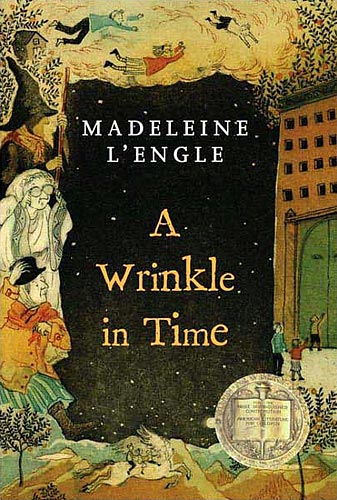


![[source]](http://en.wikipedia.org/wiki/File:A_wrinkle_in_time_digest_2007.jpg)
![[source]](http://en.wikipedia.org/wiki/File:Wrinkle_In_Time_Cover.jpg)
![[source]](http://en.wikipedia.org/wiki/File:WrinkleInTimePBA1.jpg)