Purpose of this Blog...

You may have noticed that not all books are equal in capturing children's imaginations and in cultivating those innocent, tender souls. My goal is to help you find the ones that do!
(Painting by Mary Cassatt: "Mrs Cassatt Reading to her Grandchildren" -1888)


Showing posts with label Russia. Show all posts

Friday, April 19, 2019

Psst...Pascha Giveaways


Giveaway #1 - A Child's Guide to Confession.  This wonderful book (companion to A Child's Guide to the Divine Liturgy) is a great little volume to tuck inside a child's Easter basket! Perfect size for young hands, with lovely and colorful illustrations.
From Ancient Faith Publishing: 
This 100-page, easy-to-use aid will help a child understand and prepare for confession. Designed for both younger and older children, this book assists the child with brief, inspirational thoughts followed by prayers and an age-appropriate self-examination based on 1 Corinthians 13 (the "love chapter").  Available from AFP, here. 
Leave a comment (by 4/23/19) at the end of my post telling me you'd like a chance to win this book - be sure to leave your email so I can contact you!

Giveaway #2 - Spyridon's Shoes by Christine Rogers. Your kids (especially boys!) are in for a treat with this chapter book.  Spyridon's Shoes is a fun read, and Christine Rogers has done an amazing job in introducing young readers to the special-ness of having a relationship with the saints gone on before.
From Ancient Faith Publishing:
Young Spyros spends his days fishing, octopus hunting, and dreaming of attending school like his best friend, Niko. When he encounters an elderly man on the beach after an accident, his whole life begins to shift and change. But who is this mysterious, saintly man, and why is his friendship so important? Take a short trip back in time to the Greek island of Corfu and discover the real reason for the mystery surrounding Spyridon's shoes.  Available from AFP, here.
Leave a comment (by 4/23/19) at the end of my post telling me you'd like a chance to win this book - be sure to leave your email so I can contact you!

Before seeing "The Durrells in Corfu" series on PBS, I had never heard of the Greek Island on which St. Spyridon lived. Both the television series and Gerald Durrell's entertaining account of life on Corfu, My Family and Other Animals, mention a comedic, rather than mystical, encounter with St. Spryridon's relics. I highly recommend the book (which by the way, is child friendly, whereas the TV series is not) as a read aloud to kids who love animals and nature. (Not part of my giveaway.)
The youngest of the family’s four children, Gerald, whose love of animals drove him to become a famous zoologist, wrote in his 1956 book how the family stayed for five years in this Mediterranean paradise until the onset of World War II. ‘Living in Corfu,’ he concluded of the hilarious adventures he recounted, ‘was rather like living in one of the more flamboyant and slapstick comic operas.’ [source]

Giveaway #3 - The Resurrection of Christ, translated by Fr. John Hogg from the Russian, by Elena Trostnikova with colorful iconographic illustrations by Olga Podivilova.  
Fr. John has recently started a publishing company, Exaltation Press, so that he can begin publishing good quality Orthodox books in English that he's translating from other languages as he works with Orthodox publishers from other countries.

This is the Paschal book from the series “Scriptures and Feasts for Children” (books are all pictured at the top of this post). This book goes through the events of Holy Week — the Entrance into Jerusalem, the Mystical Supper, the betrayal, crucifixion, Death, burial, and Resurrection of Christ.  Each scriptural evenT is explained in a clear and simple way that is suitable for the very youngest children.
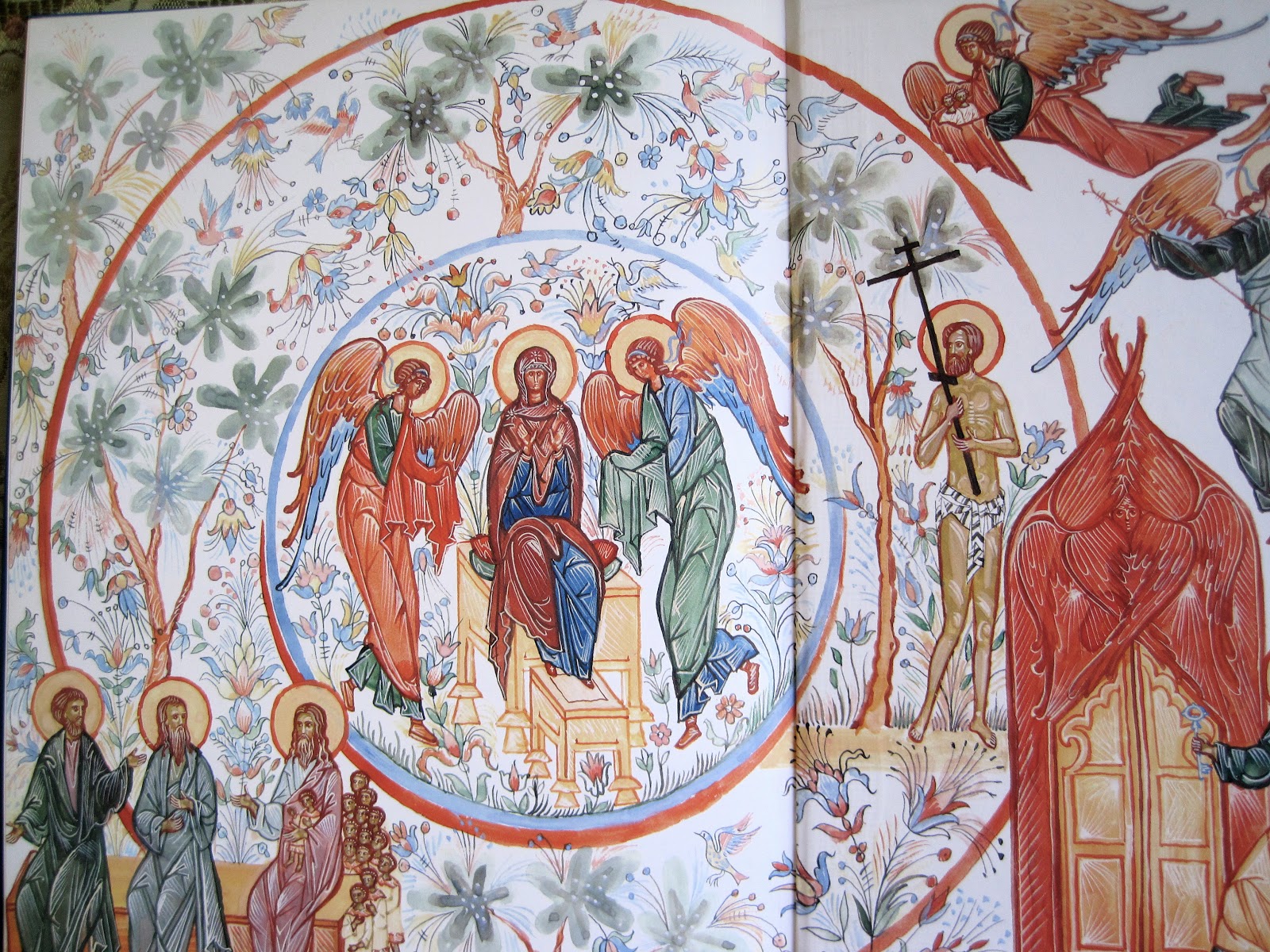
The illustrations are gorgeous!  Look at the end covers...
At the end of the book is a glossary and "How to Tell Children about the Resurrection" section that goes into a more detailed explanation of the events for parents.  (One thing to note is that since the books are translated from Russian, some of the traditions mentioned in celebrating Pascha - "kulich", cheese Pascha, and pussywillows (for Palm Sunday) - may or may not be unfamiliar to readers from Antiochian or Greek Orthodox traditions.)

Fr. John has done a series of three books, "Scripture and Feasts for Children". All these beautiful books are available from Exaltation Press, here.
Leave a comment (by 4/23/19) at the end of my post telling me you'd like a chance to win this book - be sure to leave your email so I can contact you!

PASCHA 2019 GIVEAWAY RULES:
1 - Leave a comment telling me which book (or books) you'd like a chance to win for your children (or grandchildren, godchildren, nieces, or nephews!) 
2 - There will be three winners, with one book per winner.
3 - Be sure to include your email so I can get in touch with you.  If you are uncomfortable leaving it in the comment section, just send an email to me:wendyb1963@sbcglobal.net.
4 - You must leave a comment by midnight on Tuesday April 23, 2019.  Closed for comments after that time.


Monday, January 15, 2018

Back in Print: Sweet Picture Book Adapted from a Winter Tale by Leo Tolstoy

Martin the Cobbler. I'll never forget the first time I read Leo Tolstoy's poignant short story "Where Love Is, God Is", in an anthology of Russian literature that my mom had passed along to me.

A few years later, I was super excited when my sister discovered a wonderful picture book adaptation for kids ages 4-8, titled Shoemaker Martin.  But sadly it was out of print, and we could only find used paperback copies from an online store.


Then a couple of weeks ago, my sister informed me that it is now back in print - in hardcover! Available online and in bookstores.  Hurray!  

First published in 1986, Shoemaker Martin has been re-designed in celebration of 50 years of NorthSouth Books working with Bernadette Watts, one of Europe’s most recognized and beloved fairy-tale artists. This story is sure to win over new fans as well excite old ones!

It's a tale about a cobbler named Martin, who lives and works in a basement room in a small Russian village. 

One winter evening, while reading his Bible, Martin wonders what he would say and do if he were visited by Christ. Woken suddenly in the middle of the night, he hears a voice call his name.  The voice tells him to watch for Him...tomorrow!  

In the morning, Martin looks excitedly out his window - eagerly awaiting the visit of this special stranger.  But by sundown, Martin is disappointed.  He has only been visited by three people in need from his village.

Opening his Bible once again, and reading a scripture from a page that it had fallen opened to, he realizes Jesus truly had visited him that day.

This story of compassion by Tolstoy is as relevant today as when it was first conceived.  Bernadette Watt's warm and cozy illustrations portray the quiet simplicity of Martin's Russian Orthodox faith, through details like a hand carved cross on the wall of his basement room and an icon above his bed.

"For I was hungered, and ye gave Me meat: I was thirsty, and ye gave Me drink: I was a stranger, and ye took Me in.
Inasmuch as ye have done it unto one of the least of these my brethren ye have done it unto Me."
- from the Gospel of Matthew, Chapter 25

Thursday, May 30, 2013

Saints of Russia

Can the Church "make" a saint? The answer is no. Only God can do that. 
We glorify those whom God Himself has glorified, seeing in their lives true love 
for God and their neighbors. The Church merely recognizes that such a person 
has cooperated with God’s grace to the extent that his or her holiness is beyond doubt.  -Fr. Joseph Frawley [source]

Saints are an important part of Russian Orthodox culture!  As a follow up to my last post on the Romanov family -- yes, Tsar Nicholas II and his family are canonized as saints in the Orthodox Church.
source
For those of you not familiar with how it is that certain devout men, women, and children come to be called "saints" by the Orthodox Church today, here is a quick explanation...

Orthodox theologians classify the saints in six categories [source]:
  • The Apostles, who were the first ones to spread the message of the Incarnation of the Word of God and of salvation through Christ. 
  • The Prophets, because they predicted and prophesied the coming of the Messiah. 
  • The Martyrs, for sacrificing their lives and fearlessly confessing Jesus Christ as the Son of God and the Savior of mankind. 
  • The Fathers and Hierarchs of the Church, who excelled in explaining and in defending, by word and deed, the Christian faith. 
  • The Monastics, who lived in the desert and dedicated themselves to spiritual exercise, reaching, as far as possible, perfection in Christ. 
  • The Just, those who lived in the world, leading exemplary lives as clergy or laity with their families, becoming examples for imitation in society.
Tsar Nicholas and his family were glorified by the Russian Orthodox Church Outside Russia (ROCOR) in 1981 for martyrdom, but this was a hotly debated decision [source].
Tsar Nicholas, Olga, Tatiana, Maria, Anastasia, Alexi. [source]
Both within and outside of Russia there were those who claimed that Nicholas' reign was weak and prone to extravagance and indifference to the plight of Russia's needy. On the other hand, there was widespread popular devotion to Tsar Nicholas among those who claimed that he was called of God to lead his people at a difficult time in history and did so to the best of his abilities. The religious devotion and piety of the family is well documented and not seriously contested by anyone.

On August 14, 2000, after some 8 years of study, the council of Bishops of the Russian Orthodox Church (inside Russia) voted unanimously to recognize Nicholas, Alexandra and their five children as saints. They were not named as martyrs, since their deaths did not result immediately from their Christian faith; instead, they were canonized as "passion bearers" (see the last category above).
The holy Passion Bearers.
Icon painted by the sisters of the New Tikhvin Monastery. [source]  
According to a statement by the Moscow synod, they were glorified as saints for the following reasons:
In the last Orthodox Russian monarch and members of his family we see people who sincerely strove to incarnate in their lives the commands of the Gospel. In the suffering borne by the Royal Family in prison with humility, patience, and meekness, and in their martyrs deaths in Yekaterinburg in the night of 17 July 1918 was revealed the light of the faith of Christ that conquers evil. [source]

There is a beautiful children's book about Orthodox saints that I'd like to highlight today -- A Child's Paradise of Saints, by Nun Nectaria McLess, with illustrations by Elen Stefarova.  It's available here.

Product description:
A treasury of saints for the young. Presented in a warm, informal style, suitable for reading aloud, here are stories of the struggles and triumphs of holy Fathers and Mothers from throughout the world. 15 exquisite watercolors by a Russian iconographer bring these beloved saints to life. Each saint story is 3-6 pages in length, taking 5-15 minutes to read aloud.  Ages 5 and up. (You can also hear an audio review here, from AFR).

There are several Russian saints in this book, including beloved St. Herman, a Russian monk and missionary who brought Orthodox Christianity to Alaska and the Aleuts!
St. Herman of Alaska, from
A Child's Paradise of Saints

Another Russian saint in the book is St. Xenia of St. Petersburg. Basically, the story of Xenia is that as a young woman she married an officer, who died suddenly while at a party.  Xenia mourned not only his sudden unexpected death, but the fact that her husband had not been able to go to Confession or receive Holy Communion before he died.  She was dreadfully worried about his soul.

Young Xenia disappeared from society for a long time.  When she returned, she had given away everything she owned (including her house) and was wearing her husband's old army uniform.  She also told everyone to call her by his name, "Andrei".

She went all over the city doing good deeds (many in secret) for others in her husband's name - hoping that her deeds and prayers would honor him in the eyes of God.
St. Xenia, from A Child's Paradise of Saints

Many people thought she was a bit crazy!  Xenia had become very holy and had many spiritual gifts, which were mostly unnoticed because people were so distracted by her strange dress and the fact that she had given away all her money and belongings, basically living a life of homelessness.

There is one story that St. Xenia would spend even the coldest winter nights in the Smolensky Cemetery. There was a church being built there, and she would secretly carry heavy bricks in the middle of the night, to stack them where they were needed the next day.

The workers wondered how the bricks got there, so one night they secretly kept watch.  Xenia finally appeared, climbing up and down the walls of the half-finished church with her loads of bricks!

My husband and I visited Smolensky Cemetery during our visit to St. Petersburg, and we saw the church that St. Xenia helped build...
I took this photo in the Smolensky Cemetery as I looked toward the church that
- according to tradition -  St. Xenia helped build.   
The azure colored church is at one end of the cemetery, and a pale green chapel built over St. Xenia's burial site and dedicated to her memory is at the other end.
St. Xenia's chapel
As we entered the Smolensky Cemetery, we felt as if we'd walked right into an icon of St. Xenia!
During the times of communism in Russia the faithful were not allowed access to the little chapel that was built over the site of Xenia's burial; so visitors wanting to come and pray would lean their heads against the outside of the chapel, or against the Soviet-built fence that was eventually put around the chapel.
Since then, the tradition has been preserved. We saw several worshippers going around the outside of the chapel praying, leaning their heads against or kissing the outside walls before entering the small sanctuary.

The church is restored beautifully inside and out - and many Orthodox Christians make pilgrimage there, to pray, light a candle, and ask St. Xenia for her intercessions. We were blessed to be among them.
I hope you've enjoyed coming along for some "armchair travel" with me to St. Petersburg, Russia!

Remember, today - May 30 - is your final chance to enter my MAY GIVEAWAYS. The Giveaways end at midnight tonight.

How to enter: Comments left HERE on this post (or on any of my "Russia blogs" posted between May 12 and May 30, 2013) will enter you for a chance to win one of the giveaways! Enter as many times as you like.

Winners announced: I'll pick three people who will each win one of my three "Matryoshka Madness"giveaways (three because I'm celebrating three years of blogging!)  I'll announce the winners tomorrow, May 31, 2013.  

Wednesday, May 22, 2013

Maytryoshka Giveaways


Don't forget to leave a comment on any of my Good Books blogs posts between now and May 30th to enter my May Giveaways! Winners chosen on May 31, 2013.
Source: Bake Greek

I hope you've enjoyed reading my posts about lacquer art and Russian folk tales for children. Go here for details about the three things I'm giving away at the end of the month.
Isn't this Hello Kitty Matryoshka cookie adorable???
More Russia posts coming up...


Wednesday, May 15, 2013

Alexander Pushkin and Russian Folklore

When my husband and I were in St. Petersburg, Russia, we made a side trip to the town of Pushkin (named for the poet), which surrounds the Tsarskoe Selo ("Tsar's Village") estates.  I'll be sharing photos of the estates soon in another post; today I'd like to talk a little bit about Pushkin and Russian folklore.
Monument of Pushkin, founded on the 26th of May 1899, on the 100th anniversary of the poet's birth. 
Pushkin was educated at the Lyceum of Tsarskoe Selo.
Alexander Pushkin (1799-1837) is generally recognized as Russia's greatest poet. He was born into an aristocratic family with a long and distinguished lineage, and attended an exclusive school for the nobility in Tsarskoe Selo, outside the capital city, St. Petersburg.

Pushkin was also a novelist, but part of his literary heritage is his "fairy tales", which were loosely based on Russian folklore (and on some French fairy tales - because of this his tales were criticized, called "artificial flowers" - source).
Pushkin's Fairy Tales,  with Palekh Painting
I honestly didn't know a lot about Russian folklore or Pushkin's tales, so I did some research and found out two interesting facts...

FACT # 1 - Pushkin's tales have always been favorite subject matter for  the painting school of Palekh, a famous old center of icon-painting and lacquer miniature boxes.  (More about this fact in my next post!)

FACT #2:  There are no fairies in Russian folklore, so they should really be referred to "folktales" - they have also been called "wondertales". (Thanks to Masha Gedilaghine Holl's website, which was my source for much of the information you'll find below!)

What is, then, a folktale? It's a story. First and foremost. In Russian, it is called SKAZKA. The word is from the same root as the verb "to say" -- skazat. Therefore it, quite simply, "that which is told" -- a tale, or story. But by implication, it is fiction, not news, something someone came up with: Entertainment. 

Up until the close of the eighteenth century most everyone from tsar to peasant delighted in the folktale.  After that time, the tales were more a part of the culture of the lower class.  Also of note is that the early Russian folk tales were traditionally told only after dark - when young children were asleep - they were typically not subject matter for children (too scary).

THERE ARE FOUR BASIC TYPES OF RUSSIAN FOLK TALES:
1 - Magical tales with a female hero.
2 - Magical tales with a male hero.
3 - Animal tales (with animals as main characters, with or without the participation of human characters).
4 - Tales about everyday life.

1, 2 - The first two categories are related. Both male and female heroes will embark on some kind of a quest. It may be a trip to the forest to gather firewood, mushrooms, or berries; or it may be a journey into a far-away kingdom. Similar characters appear in both types of tales, and they usually end with a marriage, and maybe fortune as well.
--The magical tales in which the hero is female (usually a girl) center around her ability to perform certain tasks. These tasks are usually practical and test the heroin's household skills: cleaning, cooking, spinning, weaving, and of course her knowledge of the proper behavior. These tales also test her ethics: she must not lie, although telling less than the truth is allowed; she must not steal, but taking something from an evil character, after she was allowed to do so by someone from that household, is also allowed.
--Magical tales with a male hero follow a slightly different pattern. For one thing, the male hero ALWAYS leaves his home on a QUEST (the female hero may live all her adventures in her own back yard). The male hero is not expected to perform tasks, at least not by himself: he encounters magical helpers that will do his work for him, or else fix the mistakes he makes when he attempts to perform the task.

3 - The third category of tales is not magical per se, unless you count the animals' ability to speak in "people's voices" (human speech). These tales may involve the participation of humans, or not, but usually the presence of humans somewhere is acknowledged or taken for granted.
--Animal tales are not cute stories about nice furry creatures. Animal characters are strictly typecast:
"The Fox and the Wolf," watercolor and charcoal by Yevgeny Rachev [source]
  • Wolves are greedy rather stupid, and male (the Russian word for wolf is "volk," a masculine noun). 
  • Foxes are sly, calculating, and tricksters. They are also female (the Russian word for fox is "lisa," a feminine noun). 
  • Cats are opportunistic and lazy. They are male (the Russian word for cat is "kot," a masculine noun). 
  • Bears are big and lumbering (naturally), rather clumsy, and not very bright. They are male (the Russian word for bear is "medved'," a masculine noun). The Russian word that is the equivalent of "teddy bear," "misha," is also the diminutive for the name Mikhail, which is the standard "first name" of folk-tale bears. 
  • Hares are quick and cowardly, and male ("hare," in Russian, is "zaiats," a masculine noun). 
  • The goat is cunning, and female (Russian -- "koza," a feminine noun). 
  • The rooster is cocky and boastful, and male (Russian -- "petukh," a masculine noun).
4 - The fourth category of tales about everyday life includes tales about soldiers returning home who meet (and defeat) Death, or who encounter a witch, or some other kind of magical being, and who gain fortune in the end (or maybe just a bowl of soup, as in "Axe Soup," the Russian variant of "Stone Soup.")


Be sure and read this informative essay: Baba Yaga's Domain, by Helen Pilinovsky, about one of Old Russia's most famous (and complex) folklore characters.


Sunday, May 12, 2013

MATRYOSHKA MADNESS (& Three Giveaways) FOR MAY!

Happy Mother's Day!  The first time I ever saw Russian nesting dolls, or "matryoshkas", I fell in love with them.  Maybe because they look so motherly.  In fact, the word matryoshka is literally "little matron".  The dolls were originally made to symbolize motherhood -  specifically the mothers of large peasant families who are well fed - leading to the portly figure of the doll and her "family" inside of her!


Nesting dolls were first made in China in the early 1800's (traditional Chinese nesting boxes had been started there hundreds of years earlier).  In the 1890's, when a group of Russian artists began reviving native culture and folk traditions, the idea found its way to Russia.
Shop full of matryoshkas at Izmaylovo Market, Moscow

Artist Sergei Malyutin designed the first set of Russian nesting dolls, probably inspired by a Japanese example.  He made the largest doll a peasant girl with a babushka (kerchief) on her head.  The dolls, carved and turned on a lathe by a master wood-carver, were then painted in bright colors.  Many regions of Russia - each developing its own particular style - took up the art, inspired by Malyutin's first matryoshka.  Most of the dolls are maidens, but some sets have families, animals, or characters (like St. Nicholas).

3 GIVEAWAYS: To celebrate my 3rd Blog-iversary!
Leave a comment here on today's post and on any other future blogs I post about Russia throughout May to be entered to win any one (1) of the items below.  Three (3) people will be chosen.  Giveaway ends on May 30, 2013 at midnight PST. Winners announced May 31, 2013.

#1 Remember the cute little matryoshka luggage tag I posted about, here?
#2 The Littlest Matryoshka, (1999) by Corinne Demas Bliss, illustrations by Kathryn Brown. (ages 3-7) Click HERE to read all about the making of this book on Corinne's website. Go to The Littlest Matryoshka website to see activities and games related to the book!
#3 How about these cute Matryoshka Measuring Spoons?  Perfect for you and your little bakers!


TWO NOT-TO-BE-MISSED-BOOKS ABOUT MATRYOSHKAS: 

 The Magic Nesting Doll (2000) by Jacqueline K. Ogburn, illustrations by Laurel Long. Katya is given a magical nesting doll by her dying grandmother but is told that she can only use its magic three times. After entering a land of eternal winter, the young woman discovers a prince who has been turned into "living ice" through an enchantment. Aided in turn by a bear, wolf, and firebird that appear from inside the doll, Katya is able to restore the prince to his former self and destroy the villainous Grand Vizier. Gorgeous illustrations, reminiscent of Russian iconography! (Kindergarten - 3rd grade)
The Art of the Russian Matryoshka, (2008) by Rett Ertl, Rick Hibberd. (Mainly for parents, but if you have a child who's interested in these dolls, they'll love the photos!)  A MUST have for the obsessed, like me.  Hopefully you can find this at your local library (or buy it used), because it's pricey.
The Art of the Russian Matryoshka

MATRYOSHKA CRAFTS! (to make yourself!)...

Click here for a Bigu Handmade "How To" for Matryoshka bookmarks.

Want to  learn to make a Matryoshka fold-out CARD, found at Zakka Life?
I bet you can't resist crafting these mini-matryoshkas!
Sew to Speak has step-by-step instructions.

Make May "Matryoshka Month"!  Do you think you'll try any of these???  
Remember to leave a comment for a chance at one of my May Giveaways!  
And to all you Moms out there:
Poster available on etsy,  here.

Thursday, May 9, 2013

Iconography in a beautiful Russian children's book...

"Here before you, my young friends, is a curious book. It was written for children but grown-ups may also find it interesting. It wasn't meant as entertainment but it will captivate you nonetheless, and even though our narrative is serious, it contains many wonderful pictures. This isn't a book of fairy tales, legends or fables, but it will show you the way to a country that has no equal in any country on earth, for it was created by the All-Wise God in His own image and likeness. It's a wonderful place, not far from each of you, and it's called . . . your own soul."

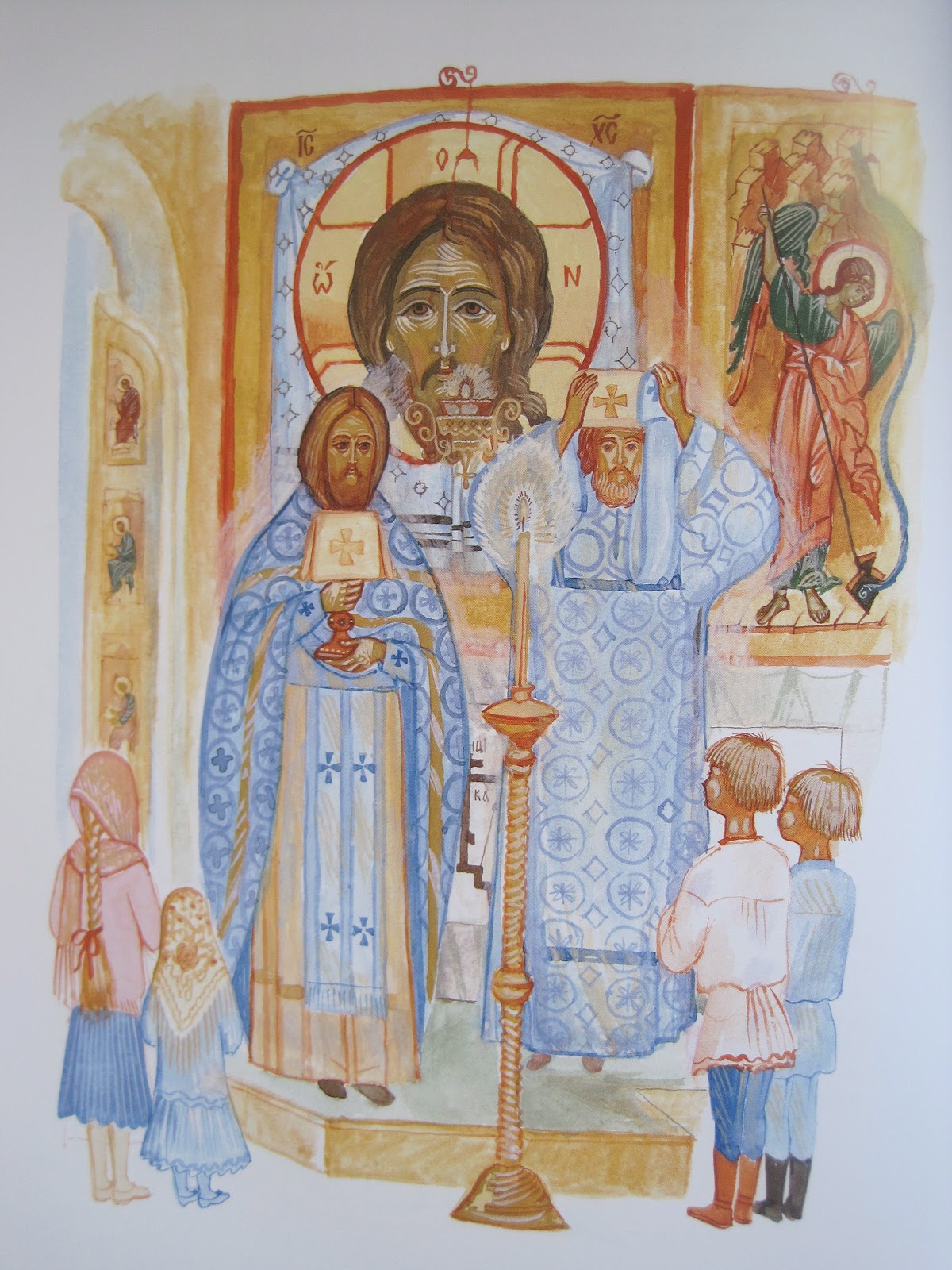
The Path to Confession by Fr. Artemy Vladimirov, pastor of All Saints Church in Moscow, is full of gorgeous watercolor illustrations, done by by G.A. Skotina in a traditional  iconographic style...


The term "icon" is derived from the Greek word "eikon" meaning "likeness" or image. In the Eastern European Christian tradition, the subjects of icons can be portraits of Christ, his Mother, or saints, but they may also be narratives about sacred events, or even depictions of liturgical hymns.  Icons are also referred to as "Windows to Heaven".


Tens of thousands of copies of The Path to Confession have been sold in the original Russian version, and now English-speakers can benefit from Fr. Artemy's gentle, yet sober introduction to confession. This book is a feast to the eyes as well as the soul.


Chapter III addresses "The Battle Against Sin": Disbelief; Pride and disobedience; Laziness and despondency; Envy, greed, lying and stealing; Intemperance in eating and drinking; Unchastity and cursing; Those who have bad manners; and Anger, irritability and fighting...


Fr. Artemy's serious, yet loving counsel about the preparation for the Sacraments of Confession and Holy Communion may in some parts of the text seem strict to our American ears and culture, so I would recommend that parents read it before deciding which parts to share with their children (age and maturity of the child, as well as parenting styles will also be determining factors in how parents will want to present the material).


How much do you know about Russian icons?  Click here for a brief history and some excellent links and resources.


Adults and teens may also enjoy this book, The Underground Struggle to Save Russian Iconography: HIDDEN AND TRIUMPHANT, by Irina Yazykova.  Go here for description and ordering info.


Thursday, May 2, 2013

Willows, Palms, Crosses, and Donkeys for Holy Week

When our children were young, during Holy Week they looked forward to hanging beautifully decorated eggs (that I collected) on our Easter Egg Tree each day.  By Easter - Pascha - the tree would be full.  I make my egg tree every year with pussy willow branches stuck into florist foam, which I nestle down into a pretty tin.


This past Sunday was Orthodox Palm Sunday, which is known as "Willow Sunday" in Russia. Since I'm blogging about Russia this month, I thought I'd share a little bit about the Russian tradition for Palm Sunday: If you remember, when Jesus arrived in Jerusalem, the celebrating people lay down palm branches in front of him. In Russia, where the climate is unfavorable for palm, palm branches have always been substituted with willow boughs...(Read more here).

© RIA Novosti. Yevgeny Yepanchintsev - source
© RIA Novosti. Alexander Kryazhev - source

In my own Antiochian Orthodox parish we use the more typical palms on Palm Sunday, holding crosses made from palm branches as we process around the church.  You can learn how to make your own palm cross here - the step-by-step instructions are easy enough for kids, from the blog Good, True, and Beautiful!


Here's something I'd never seen: a palm donkey!  My husband has an employee who is Coptic (Egyptian) Orthodox.  She gave one to him that she had made with her daughter, telling my husband, "Because Jesus rode into Jerusalem on a donkey."  Isn't it cute? (note: the palm cross behind the donkey is ours - it's not attached to the donkey. Everything starts out green, but as it dries it becomes this straw color).


Here is a lovely picture book about Palm Sunday, The Entry of Our Lord into Jerusalem, by Sister Elayne (now Mother Melania), with beautiful watercolor illustrations by Bonnie Gillis (order here from Archangels Books). It is part of "The Twelve Great Feasts" series...available here, from Ancient Faith Publishing.


I took the photo below of my daughter with my grandson at our church on Tuesday night at one of our Bridegroom services. (The name of the service is from the figure of the Bridegroom in the parable of the Ten Virgins found in Matt. 25:1-13) You can see how we adorn the icons with palm branches too.


"Behold the Bridegroom comes at midnight, and blessed is the servant whom he shall find watching, and unworthy is the servant whom he shall find heedless.
Beware, therefore, oh my soul. Do not be weighed down with sleep, lest you be given up to death, and lest you be shut out of the kingdom.
But rouse yourself, crying, Holy, Holy, Holy are Thou O God."

We sang this beautiful hymn the first three nights of Holy Week at the Bridegroom services (Sunday, Monday, and Tuesday).  You can listen to a beautiful rendition of it by clicking here.

Pascha is getting closer...tonight we have the Twelve Gospels service, then Holy Friday. Saturday morning we have a service, and at midnight we will be celebrating the "Feast of Feasts": Christ's Resurrection, Pascha!


The Three Day Pascha-series, is a set of three books (also by Mother Melania and Bonnie Gillis). It features the books Great and Holy Friday, Great and Holy Saturday, and Pascha, the Feast of Feasts.  The set is available here.