Purpose of this Blog...

You may have noticed that not all books are equal in capturing children's imaginations and in cultivating those innocent, tender souls. My goal is to help you find the ones that do!
(Painting by Mary Cassatt: "Mrs Cassatt Reading to her Grandchildren" -1888)


Showing posts with label Scandinavia. Show all posts

Friday, August 26, 2016

Last Chance for Scandi-Giveaway

Yesterday I spent a quiet afternoon out on my patio doing some bloggie "investigative research" -- perusing D'Aulaires' Book of Norse Myths in between reading chapters of The Brothers Lionheart.


Reading Norse Mythology is giving me some good insight into the strong influence Scandinavian folklore culture has had on the imaginations of creative writers like Hans Christian Andersen, Astrid Lindgren and Tove Jansson (to say nothing of J.R.R. Tolkien - who isn't even Scandinavian!)

Gnomes, dragons, trolls, feasts, gods and godesses, darkness and light.

Take for example, Astrid Lindgren's picture book The Tomten: The setting is a quiet farmstead, deep in the forest...
Here is a lonely old farm, where everyone is sleeping. All but one... 
a little gnome-like creature from Swedish folklore, a "Tomten" who guards the farm. No one has ever seen him, but sometimes his little footprints are visible in the snow. He checks on all the barnyard animals and talks to them in Tomten language (a silent little language only they can understand). He tiptoes to the house and peeks in on the sleeping children before going back to his cozy corner of the hayloft, where he dreams of the coming of summer.  

Or how about Lindgren's haunting story The Brothers Lionheart -- and her mythical land of Nangiyala, a place from "the days of camp fires and sagas"...
In Nangiyala you have adventures from morning till evening. 
That's what courageous Jonathan Lionheart tells his sick younger brother, Karl.  When both boys tragically die and are united in this "land beyond the stars", their adventures do begin. Together with a resistance group they go on a quest to lead the struggle against the evil Tengil, a black knight who rules the land with the aid of a fearsome fire-breathing dragon, Katla. (This is an engrossing, but sad book. Disclosure:  the brothers die again at the end.  For a full summary of the book, check out Read Aloud Dad's excellent review, here. I would recommend this book for kids no younger than 8 years old - but as always, use your discretion.)

I have to think Hans Christian Andersen was influenced by Norse Mythology when he penned The Snow Queen (and when C.S. Lewis thought up his White Witch) -- read the description of a beautiful maiden with an ice cold heart from the Book of Norse Myths by Edgar and Ingri D'Aulaire...
As she lifted her snow-white arms to push open the door to the hall, a strange radiance spread from them and lit up the gloom of Jotunheim...
He knew that the maiden he loved was Gymir's daughter Gerd and that he had no hope of ever winning her, for her heart was as cold as a seed in frozen ground.
(Luckily, in the Norse Mythology version her frozen heart melts.)

If you missed my post about Tove Jansson's Moomins, go here.  Unlike trolls and other monsters of dark Norse Mythology tales, Moomins are happy and kind of cute.  But similar to Norse Mythology, there are lots of magical adventures.  I have to say, I thought of the Snork Maiden losing her fringe of hair when I read the D'Aulaires' retelling of "Sif's Golden Hair".  Sif was Thor's wife.  After her beautiful hair is chopped off in the middle of the night by Loki, he promises to have the gnomes forge new hair for her - out of real gold!
  
Here's what happened with the Snork Maiden, who wasn't so lucky...
Moomintroll bent down to wake the Snork Maiden up, and then he noticed a terrible thing. Her beautiful fluffy fringe was burnt right off. It must have happened when the Hattifatteners brushed against her. 
What could he say? How could he comfort her? It was a catastrophe! 
The Snork Maiden opened her eyes and smiled. 
"Do you know," said Moomintroll hastily, "it's most extraordinary, but as time goes on I'm beginning to prefer girls without hair?" 
"Really?" she said with a look of surprise. "Why is that?" 
"Hair looks so untidy!" replied Moomintroll.

I hope you enjoyed my little comparisons.  I had fun doing the "research" reading yesterday!

Today is the last day you can leave a comment for a chance to win my Swedish Book Bundle Giveaway!  One lucky winner will receive all three of these great picture books: Per and the Dala Horse; Lucia Morning in Sweden; and D is for Dala Horse.

  • Leave a comment with your first name and last initial on my previous Giveaway Post - go here.
  • If you already left a comment there, you may comment again here (remember to include your first name and last initial) on this post for an additional entry. 
  • Giveaway ends at midnight tonight.  
  • Winner announced here on my blog on Saturday, August 27, 2016.  


Thursday, August 4, 2016

A New Book (For Me), in Which I am Introduced to a Moomintroll

What do you get from an author who 1) was born into the Swedish speaking minority of Finland; 2) spent her summers in a family cottage on an island; 3) had a father who was a sculptor, and a mother who was a graphic designer; and 4) as a young woman became so sad during WWII that she wanted to write something innocent and hopeful?  Tove Jansson's  Moomins!


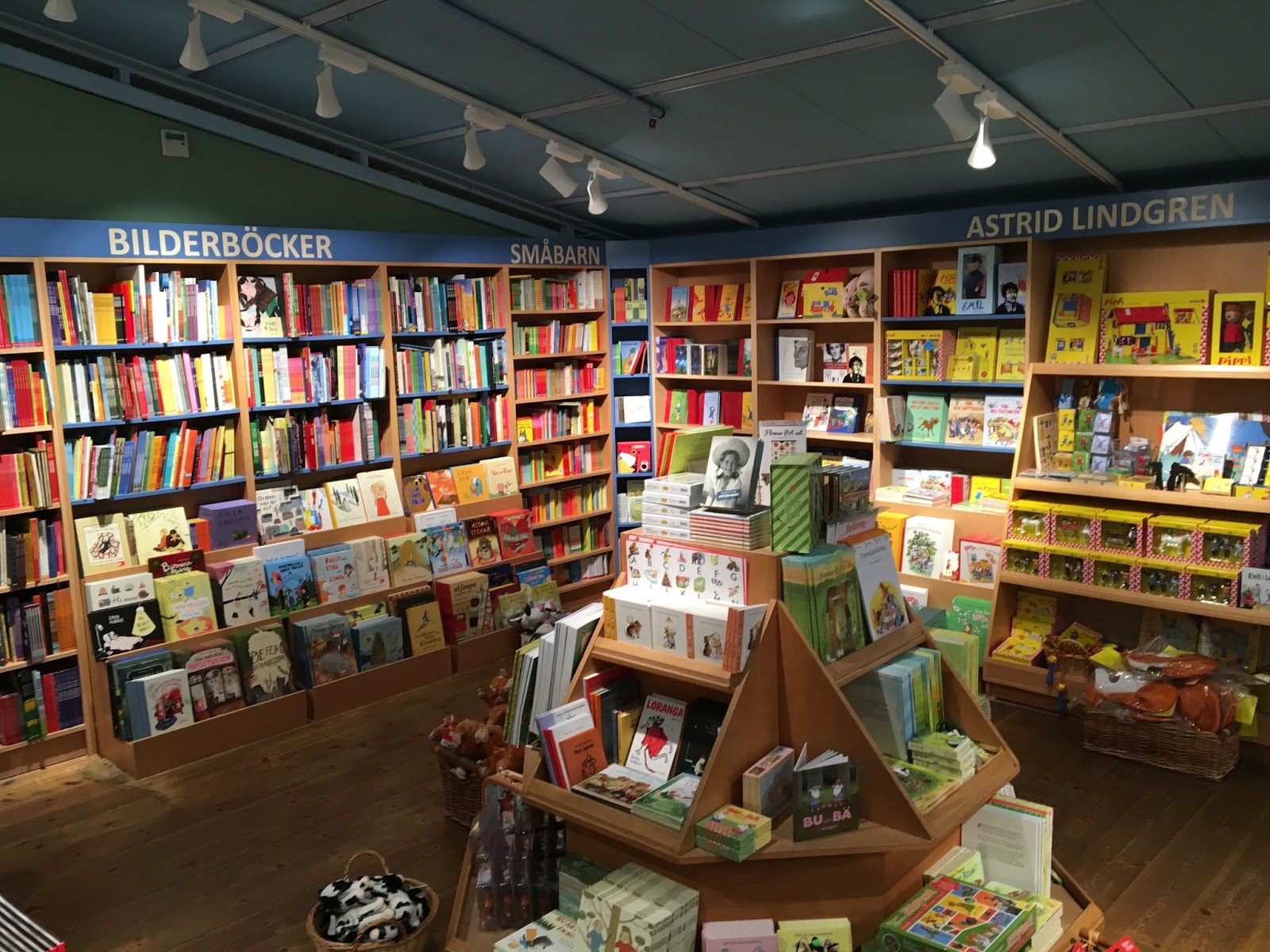
If you've been following my blog the past few weeks, you are aware that I recently returned from a tour of Scandinavia. Our tour guide's sweet wife (herself a lover of children's literature and especially Astrid Lindren - more about that later), made sure I got to make a quick stop at the largest children's bookstore in Sweden. 

The bookstore was in a museum called Junibacken, which is devoted to children's literature.


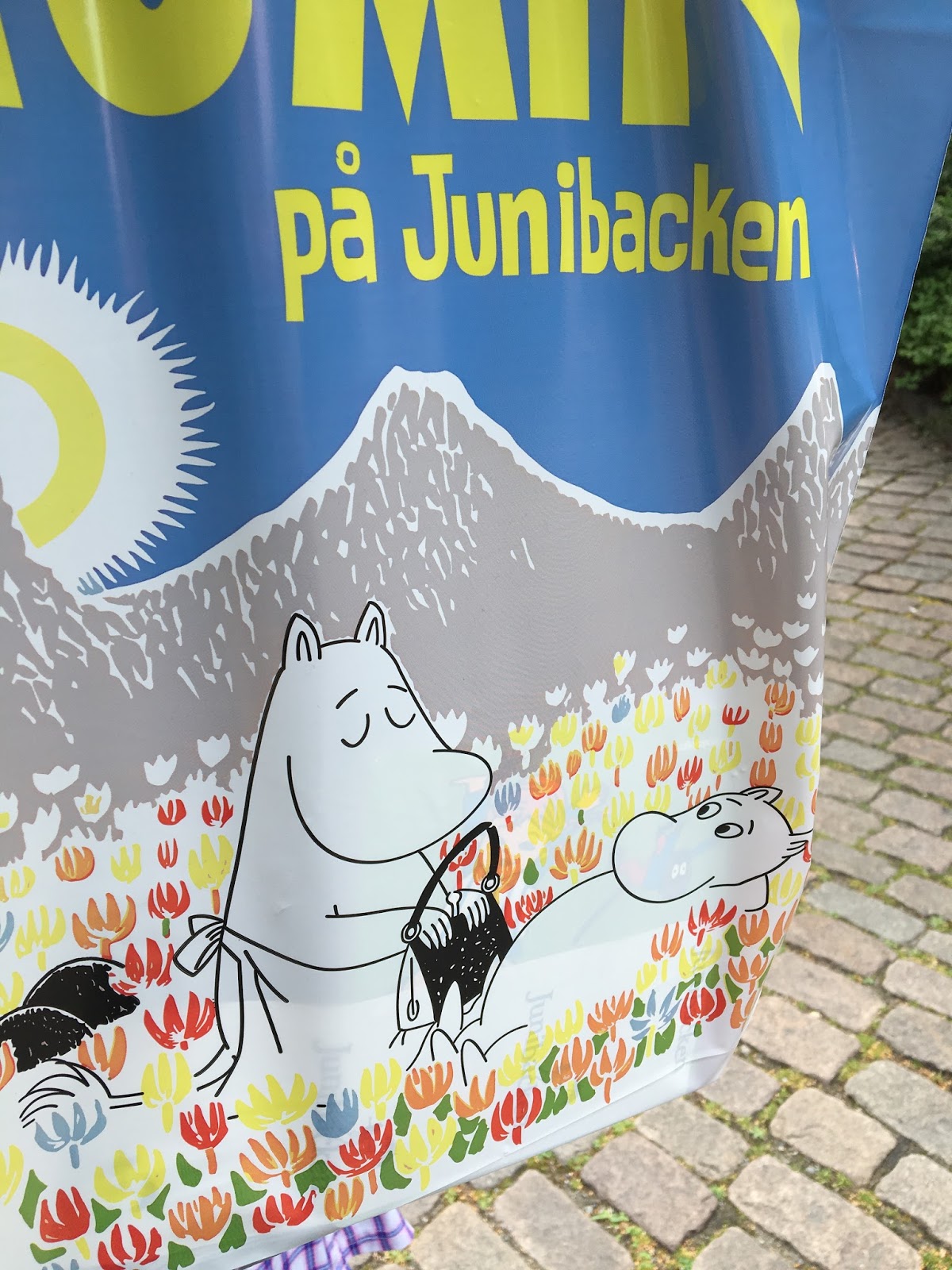
Junibacken Museum happened to have a Mumin (Swedish for "Moomin") Exhibit while we were there!  The exhibit consisted of a little themed playland with lots of fun settings from Tove Jansson's books...


Moominmamma's Kitchen


Well, truth be told, I had never read the Moomin books, but I had seen them listed on several "Best Children's Books" lists.  So I excitedly purchased my first one!


Moomintrolls.
Are they trolls, or what?
I'm not really sure...
As you can see, they are way cuter than the ugly Troll I came across at the Voss train station in Norway!


But Moomintrolls certainly seem to have stepped out of the world of Scandinavian folk-lore!

Finn Family Moomintroll is the third in the series, and the first one  ever translated into English.  I figured the English speaking world's introduction to the Moomin family was a good place for me to start!

Tove Jonsson's adorable illustrations really add to the stories.  They bring the reader along, and help us see the land and characters she has created.


(By the way, I adore the vintage book covers like the one above - see more here.  In my opinion, the new Puffin editions like mine, pictured at the top of this post, completely leave out the whimsical fairytale nature of the books.)

In Finn Family Moomintroll, the first bit of real magic happens after the Moomins have woken up from their long winter sleep and are enjoying a spring day mountain-top experience.  That's when they find a black top hat.


A Hobgoblin's Hat!  (Which they bring home.)

In the corner between the table and the kitchen door stood the Hobgoblin's Hat with the eggshell in the bottom.  And then something really strange happened.  The eggshell began to change its shape.
(This is what happens, you see.  If something lies long enough in the Hobgoblin's Hat it begins to change into something quite different - what that will be you never know beforehand.  It was lucky that the hat hadn't fitted Moomominpappa because the-Protector-of-all-Small-Beasts knows what would have become of him if he had worn it a bit longer.  As it was he only got a slight headache - and that was over after dinner.)
Meanwhile the eggshell had become soft and woolly, although it still stayed white, and after a time it filled the hat completely.  Then five small clouds broke away...

Moomintroll (Moomminpappa and Moominmamma's child) and the Snork Maiden (his friend) figure out how to fly the little clouds.  So they hop on, and away they go!  

They come across Hemulen (another Moomin), who collects stamps.


When they greet him, Hemulen says:
"That's extraordinary.  But I'm so used to your doing extraordinary things that nothing surprises me.  Besides I'm feeling melancholy just now...my stamp collection is complete"....

"I think I'm beginning to understand," said Moomintroll slowly.  "You aren't a collector anymore, you're only and owner, and that isn't nearly so much fun."

There are all sorts of whimsical (and some slightly scary) characters in Moominvalley, and they go through all sorts of non-sensical adventures.  


Think Edith Nesbit's "Psammead", from The Five Children and It, mixed with L. Frank Baum's The Marvelous Land of Oz, a little bit of of A.A. Milne's Winnie the Pooh and the Hundred Acre Wood thrown in, and you've got an idea of how fun these books are.

Have you read about the Moomins?  If you haven't, I think you and your child will really like these silly little creatures!

And please come back for more posts - I still have a Scandinavian Book Giveaway coming up! 

Monday, August 1, 2016

D is for Dalahäst!


In olden days a wooden Dala horse - "Dalahäst" - was a toy for children; in modern times it has become a symbol of Sweden itself.

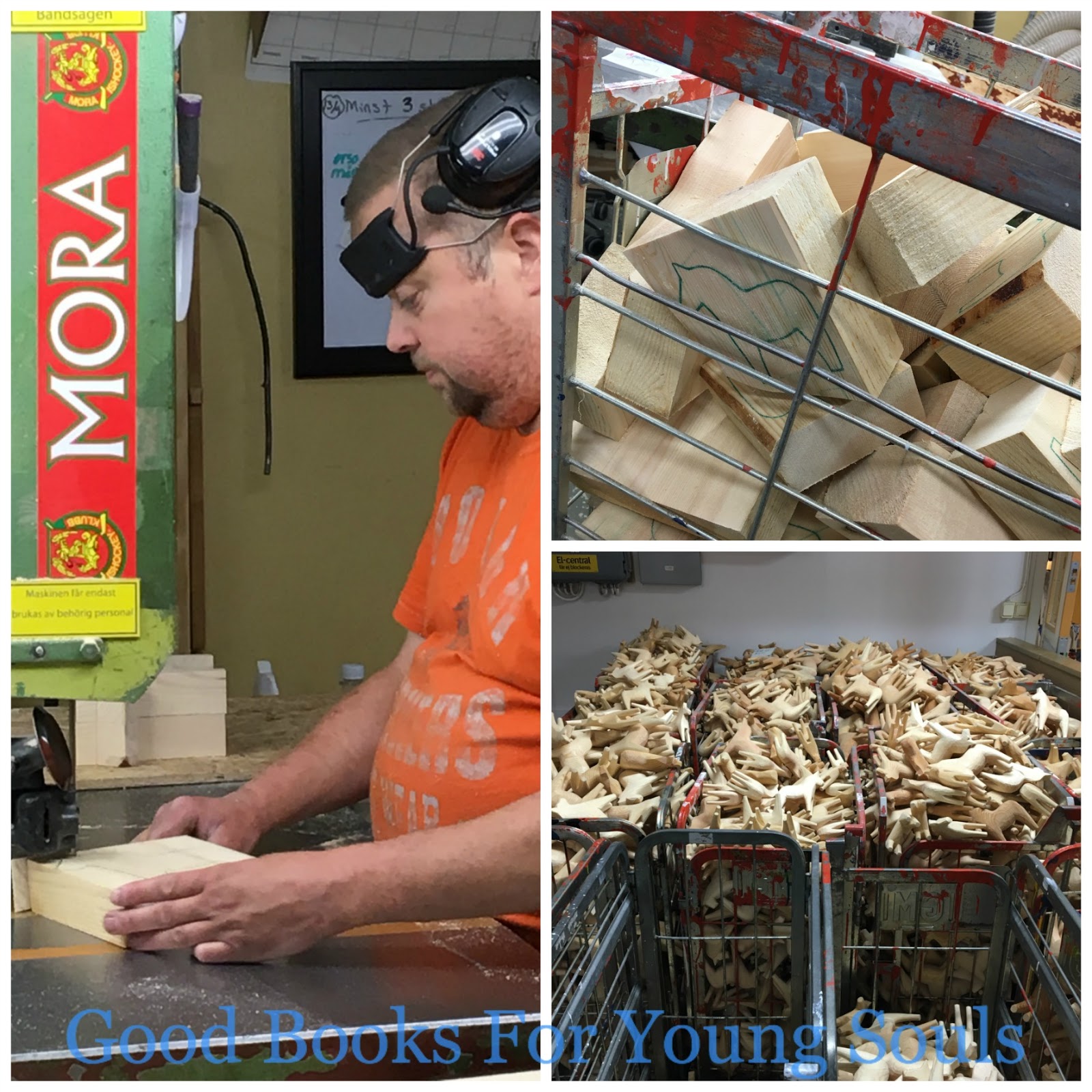
Since these red hand painted horses have been part of Swedish folkart for over 300 years, a trip to Scandinavia would be incomplete without a visit to a workshop where the popular wooden horses are still made today.  Here's what I saw...


Before the 1920's and the invention of the bandsaw, Dala horses were completely made by hand. Today they are still hand carved and hand painted, after the horse pattern is stamped onto wooden blocks and cut out with the saw.


My grandson loves the little Dala horses I brought home to add to my small collection.  He set up a whole parade going across our kitchen table, and he was fascinated by the pictures I took at the workshop.


I decided to google "Swedish Dala horse" and found a video so my grandson could watch the whole process of how they are made.  

Go here to watch this excellent video all about the Dalahäst workshop I visited.

Which brings me to today's awesome Nordic alphabet picture book, D is for Dala Horse, written by Kathy-jo Wargin and illustrated beautifully by Renee Graef (she also illustrated the first American Girl Collection Kirsten books from Pleasant Company.)


Psst...I'll be giving away this Nordic alphabet book (and more)  soon, so stay tuned to my upcoming Scandinavian Literary Travel posts!

As my grandson and I read D is for Dala Horse together, we had fun going back and forth from the cute book illustrations and descriptions for each letter to my (very!) similar photos.  The author included many of the interesting things I saw, such as...

B is for...Bunad (a Norwegian way to dress)...

C is for...Copenhagen

D is for...Dala horse

F is for...Fjords

H is for...Hans Christian Anderson

O is for...Oslo

R is for...Runestones

T is for...Troll... 

V is for...Viking ship

I've got lots more to tell you about Scandinavia in my upcoming posts. You can find D is for Dala Horse here (or wait for my Scandinavian Giveaway!)  Remember, you're always welcome here on my Good Books For Young Souls Blog...come in and stay awhile!


Saturday, December 14, 2013

An Adorable Norwegian Christmas Book

My ancestral roots and my love for St. Lucia Day get me thinking about Scandinavian Christmas books every December...So I was thrilled when I received my Chinaberry Christmas catalog in November and saw a new children's Christmas book about a little girl from Norway on their cover!!!
I knew I had to see the inside of this book, so I immediately sent off an email to the publisher and could barely wait until I received my review copy - which I am excited to be offering to you as a GIVEAWAY today! 12/17/13 Update: Giveaway over.  I'll let the photo illustrations speak for themselves:


A FAMILY PROJECT:
The Christmas Wish is a gift from husband and wife team, Lori Evert and Per Breiehagen to us and their daughter, Anja, the main character who's adorably dressed up in traditional Norwegian garb!
Anja sets out on an adventure to find Santa Claus so she can make her dream come true: to be like one of Santa's Elves and help him deliver toys to children.  Lots of woodland animals (my favorite is the polar bear) help her in her wintry endeavor - but will she succeed?  You'll have to read the book!

From the book jacket:
"Author Lori Evert is a prop, set and wardrobe stylist who loves books, nature and being Anja's mother. She was so inspired by the beauty and magic of an image of Anja with a reindeer that she began spinning a narrative about who they might be and why they were together.  Thus began the four-year family project that is The Christmas Wish.

Award-winning photographer Per Breiehagen grew up in the small mountain town of Al, Norway.  He spent his childhood exploring the dramatic landscapes near his home...Assignments for clients like National Geographic, The New York Times Magazine, and Audubon have brought Per to some of the most remote snow-and-ice-covered regions in the world...Anja's love of the outdoors and winter is a great inspiration for Per."

GIVEAWAY DETAILS:
Leave a comment here and/or on my Facebook link about this post to enter my Giveaway.  Winner announced on Tuesday, December 17, 2013. (You'll get the book in time to put it under your Christmas tree!) Updated 12/17/13 - Giveaway over.

You can order The Christmas Wish yourself here from Amazon. (Chinaberry has sold out of their copies.)


Monday, September 30, 2013

The d'Aulaires: Artists and Historians

Edgar Parin was born in Switzerland on September 30, 1898. He took his mother's name, d'Aulaire, when he became an artist.

Edgar and Ingri d'Aulaire

Edgar met Ingri Mortenson at art school in Munich in 1921. The couple married in Norway, then moved to Paris. As Bohemian artists, they often talked about emigrating to America. “The enormous continent with all its possibilities and grandeur caught our imagination,” Edgar later recalled. They immigrated to New York in 1929.

The couple collaborated on their first children's book, The Magic Rug, at the suggestion of a New York city librarian in 1931. Next came three books - the first of which is Ola - steeped in the Scandinavian folktales of Ingri’s childhood in Norway.

What a cute book!!!  source

Next they shifted their attention to books featuring American heroes such as Pocohantas, Benjamin Franklin and Buffalo Bill, before turning to the realm of mythology.


The husband and wife team eventually produced over 20 picture books for children. The D'Aulaires established the picture book biography as a valued staple of library collections. They worked as a team on both the art and text throughout their joint career.

here - from Beautiful Feet Books

Originally, the d'Aulaires used stone lithography for their illustrations. A single four-color illustration required four slabs of Bavarian limestone (one for each color), with each stone weighing up to two hundred pounds! The technique gave their illustrations a wealth of authentic detail and vibrancy. 

source

In the early 1960s, when this process became too expensive, the d’Aulaires switched to acetate sheets which closely mimicked the texture of lithographic stone. (Many of the old stones are now housed in the University of Minnesota's Kerlan Collection.)

The d’Aulaires' career spanned nearly five decades. They were working on a new book when Ingri died in 1980 at the age of seventy-five. Edgar continued working until he died in 1985 at the age of eighty-six.

Abraham Lincoln received a Caldecott Medal in 1940 and the d'Aulaires received the Catholic Library Association's Regina Medal for "distinguished contribution to children's literature." The D'Aulaire's Trolls was a New York Times outstanding book of 1971.


[sources: New York Review Books and The Children's Literature Network.]

Have you seen their picture books for young children?  Book of Animals, Too Big, and The Two Cars - here, for ages 2-5.

Or their folklore collection? Norse Myths, Trolls, The Terrible Troll Bird - here, for ages 5-12.
here, for ages 5-12


Monday, December 12, 2011

CHRISTMAS AROUND THE WORLD: SWEDEN

Greeting:  "God Jul" (Good Yule)
St. Nicholas Tradition:  The Swedish gift-giver is a Jultomten. The Jultomten, unlike Santa Claus, is believed to be a little dwarf or gnome who lives under the floorboards of the house. He might also live in the barn and guard their farm. He rides a goat, called Julbocker. The goat is a reference to the Scandinavian god, Thor, whose chariot was pulled by two goats. The Jultomten will hand out gifts from a sack to the children on Christmas Eve. Even though this pagan tradition was outlawed by both church and state in the middle ages, it persisted in private.
Highlighted Tradition: St. Lucia Procession

Four Sundays before Christmas marks the beginning of Advent, and of the Christmas celebration in Sweden. Church services are well attended, and communities start to decorate with greenery and white lights.  Most homes display a four-candle Advent candelabra, one for each Sunday of Advent.  Children enjoy counting down the days with an Advent calendar, which shows a Christmas scene in twenty-five numbered "windows" that are opened each day of December, until Christmas Day.

St. Lucia Day is celebrated on December 13, which also - according to folk tradition - follows the longest night of the year. Lucia means "light" and after long winter months with few hours of sunlight, there is certainly good reason to honor her. To read more about this 4th-century girl from Italy who died for her faith, click here. Swedish families, offices, schools, and churches choose one girl to wear a crown of candles as she represents St. Lucia in processions throughout Sweden.


Being of Swedish (and Norwegian) descent myself, I've already written several posts about Scandinavian Christmas traditions.  You can click on the highlighted titles below to read those posts:
Scandinavian Tomte (this post has a review of the book The Tomten)
Christmas in Scandinavia (this post has a link to a recipe for St. Lucia Buns)
Happy St. Lucia Day! (this post includes my reviews of books about St. Lucia)

Swedish families enjoy Christmas trees, which they decorate with candles, apples, Swedish flags, small gnomes in red hats, and ornaments made of straw.  They bake pepparkakor, or ginger cookies, and serve a smorgasbord, or buffet, for their dinner on Julafton (Christmas Eve). It might include ham, pickled pigs' feet, and lutfisk (dried codfish).  Risgrynsgrot, a special rice porridge, is served with cinnamon and sugar and a single, hidden almond.  Custom has it that whoever finds the almond in their bowl will marry in the coming year.

Early one Christmas morning in Sweden, Flicka, Ricka, and Dicka open their eyes. Soon they will have their Christmas gifts! Maj Lindman's books were originally published in the ’40s and ’50s. They were the wholesome adventures of three little Swedish girls, Flicka, Ricka, and Dicka, and three little boys, Snipp, Snapp, and Snurr. Longtime fans of the series will delight in revisiting the story, and new readers will find fun and excitement as the girls must save their friend Bertie after an ice-skating disaster. This updated hardcover edition comes with paper dolls!

A Star For Christmas, by Trisha Romance, is full of colorful Scandinavian style artwork, reminiscent of Trina Schart Hyman or Carl Larsson. A gentle old carpenter who has spent his whole life in the service of others has finally begun to build his own home in a quiet meadow, with nothing but a small reindeer to keep him company. Finishing by winter seems like an impossible task, but the carpenter reaps the years of kindness he has sown, and his neighbors return his love by helping complete his new home in time for Christmas. He has a wonderful Nativity surprise in store for them, making this Christmas one that everyone will cherish forever.

In Sweden and Finland, the Christmas season ends a week after Epiphany, on St. Knut's Day, January 13.  This is the day the tree is taken down and the ornaments are stored for the next year. St. Knut was King Knut IV, and ruled from 1080-1086.  He was know for his generosity to the poor.  This song is sung when the tree is finally taken out of the house:
Christmas has come to an end,
And the tree must go.
But the next year once again
We shall see our dear old friend,
For he has promised us so.


Source for my Christmas Around the World posts:
Mary D. Lankford's Christmas Around the World