Purpose of this Blog...

You may have noticed that not all books are equal in capturing children's imaginations and in cultivating those innocent, tender souls. My goal is to help you find the ones that do!
(Painting by Mary Cassatt: "Mrs Cassatt Reading to her Grandchildren" -1888)


Showing posts with label St. George and the Dragon. Show all posts

Monday, April 22, 2013

Learning a Lesson About Forgiving our Enemies, from a Brave Saint Named George


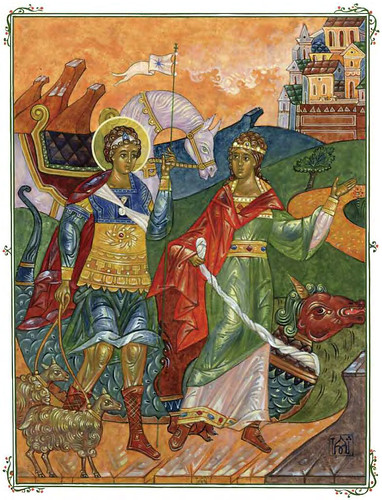
April 23rd is the Feastday of St. George! So today I'd like to recommend this book, St. George and the Dragon by Jim Forest.  Its sumptuous illustrations are by Russian iconographer and artist, Vladislav Anddreyev. (ages 4 and up)

From the book’s afterword for older readers:
True stories become streamlined into legends and legends become compressed via symbols into myths. The St. George of myth was a knight in armor who fought a dragon to save a princess, but the real George never saw a dragon nor did he rescue a princess in distress. We are not even sure he had a horse or possessed a sword. 

A Christian convert born late in the third century after Christ, George was one among many martyrs of the early Church. 

What made George a saint among saints was the completely fearless manner in which he openly proclaimed his faith during a period of fierce persecution when many other Christians were hoping not to be noticed. According to one ancient account, George went to a public square and announced, “All the gentile gods are devils. My God made the heavens and is the true God.” For this George was arrested, tortured and beheaded. The probable date of his martyrdom is April 23, 303, in the town of Diospolis in Asia Minor — today’s Turkey. His witness led to the conversion of many and gave renewed courage to others already baptized.

St George k
source
As you would expect, this dragon is fierce! Yet in Jim Forest's telling of this profoundly Christian legend, the dragon is not slain, but only wounded by George. After the battle the townspeople, whose children had been the dragon's food, are given charge of caring for their former enemy.

I recently bought this book for my friend's three-year-old son.  He was immediately engrossed with the colorful Byzantine-style illustrations and engaging story.


You can find it here or on Amazon.com.


"Prepared and alert a Scout follows the lead 
Of our Patron Saint George and his spirited steed." 
- Baden-Powell in "Scouting for Boys":  Did you know that St. George is the Patron Saint of the Boy Scouts?  Read more here...

You can also read more about dragons in children's literature in my past post, "Dragon Tales", here.

Sunday, August 1, 2010

DRAGON TALES...

"Fairy tales are more than true; not because they tell us that dragons exist, but because they tell us that dragons can be beaten."
— G.K. Chesterton

The above quote got me thinking about dragons...
Dragons can be found in stories and art from many cultures:  there are Biblical dragons, dragons in Islamic and Orthodox traditions, Asian dragons and African dragons, as well as Medieval dragons.  Mostly, they are depicted as evil and scarey, sometimes fire-breathing, often miserly.  They usually have the ability to fly and they live in or near water.   Some of literature's famous dragons are:  "Smaug", Tolkien's last great dragon of Middle Earth; Andrew Lang's fairy tale dragons; Beowolf's "Grendel"; and "Custard" the dragon, found in poetry by Ogden Nash - to name a few.


An example of this type of dragon can be found in many myths and legends.  One hero who fought an especially evil dragon was St. George.  His story shows up in several different versions.  The real St. George was a Christian who lived in the 3rd Century.  You can read his story here.  There is a medieval version of this tale that has been captured in the beautiful picture book, ST. GEORGE AND THE DRAGON, by Margaret Hodges, with illustrations by Trina Schart Hyman. (ages 7 and up).
  

Yet in children's literature, dragons aren't always represented as merciless and evil.  In fact, many are portrayed to be misunderstood, lonely creatures.  Another picture book that involves St. George is THE RELUCTANT DRAGON, (ages 8-12) by Kenneth Grahame (with beautiful illustrations by Michael Hague).  In this version of the tale, we meet a kindly dragon.


This friendly type of dragon is also portrayed in a fun series, THREE TALES OF MY FATHER'S DRAGON by Ruth Stiles Gannett, written in the 1940's. (ages 4-8).  A perfect way to introduce young children to chapter books!  Follow the adventures of Elmer Elevator (the narrator's father as a boy) as he runs away with an old alley cat to rescue a flying baby dragon on a faraway island.  Such an awesome adventure - reads like quirky epic tale for children!


My personal favorite story that involves a dragon is from THE VOYAGE OF THE DAWN TREADER, by C.S. Lewis. (ages 9-12)  Eustace Clarence Scrubb, the very unpleasant, bratty cousin of Edmund and Lucy, goes on a Narnian adventure with them.  As the story progresses, Eustace sneaks away and comes upon the lair of a dying dragon.  He steals from the dragon's pile of treasure and ends up falling asleep on it.  When he wakes up, he finds that he, himself has turned into a dragon.  He eventually makes his way back to his friends, convinces them that he is really Eustace and uses his skills as a dragon to help them.  Through this, he realizes he would rather be friendly and have friends, than be mean and lonely.  The best part is when Aslan comes and leads him to a healing pool.  With his sharp claws, Aslan helps Eustace painfully remove his scaly dragon skin, layer by layer.  Eustace becomes a changed person, on the outside as well as the inside.

illustration by Pauline Baynes

For the child who wants to know about all things dragon, there is Edith Nesbit's THE BOOK OF DRAGONS, which contains eight short stories about...dragons.  There is also HOW TO TRAIN YOUR DRAGON, the first of a series of 8 books by Cressida Cowell about dragons. Both books are for ages 8-12.