Purpose of this Blog...

You may have noticed that not all books are equal in capturing children's imaginations and in cultivating those innocent, tender souls. My goal is to help you find the ones that do!
(Painting by Mary Cassatt: "Mrs Cassatt Reading to her Grandchildren" -1888)


Tuesday, October 11, 2011

book-or-treat: literary pumpkins!

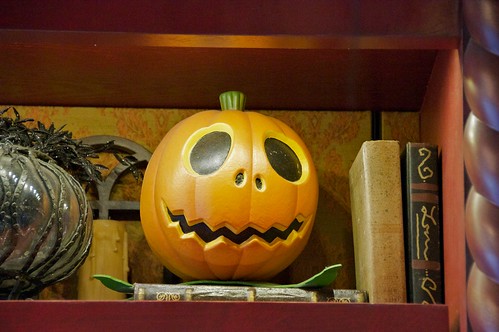
Jack Skellington pumpkin head
Jack Skellington as a pumpkinhead - source
Before Jack Skellington - the main character in Tim Burton's animated film, The Nightmare Before Christmas - there was L. Frank Baum's storybook character, Jack Pumpkinhead...

Jack Pumpkinhead first appeared in Baum's The Marvelous Land of Oz (published in 1904).  Jack, tall and lanky, with a body made from tree limbs and jointed with wooden pegs, has a jack-o'lantern for a head (hence the name).  But unlike typical jack-o'lanterns, this pumpkin still has all its insides.  In The Road to Oz, Jack has settled in a large pumpkin-shaped house near the castle of the Tin Woodman in Winkie Country. Jack spends much of his time growing pumpkins to replace his old heads, which eventually spoil and need to be replaced. (The old heads are buried in a graveyard on his property.)

In 1913, to publicize the relaunching of the OZ series after a three-year hiatus, Baum wrote a set of six short stories under the series title The Little Wizard Stories. They were each published as separate books and intended for somewhat younger children, in a style similar to today's Little Golden Books.  So children read about Jack again, in the short story, Jack Pumpkinhead and the Sawhorse of Oz.


The 23rd OZ book, Jack Pumpkinhead of Oz was written by Ruth Plumly Thompson, the writer who continued the OZ books after the death of L. Frank Baum.

So, are the similarities between the Two Jacks purely coincidental?
"...in his first scene in The Nightmare Before Christmas, Jack Skellington does have a pumpkin on his head, and looks very much like Jack Pumpkinhead. Also, the director of Nightmare was Henry Sellick who, eight years earlier, had been a storyboard artist on Return to Oz, and therefore had several opportunities to draw Jack Pumpkinhead. From another perspective, similarities can also be seen between Scraps, the Patchwork Girl of the OZ books, and Sally in The Nightmare Before Christmas, so there may be another connection there, but it's also not terribly likely."(source: The Wonderful Wizard of Oz website).
You might like my other OZ post HERE.

Want to explore some other pumpkinheads - Jack-O'Lanterns - inspired by books?  Here's what I found...
Jane Austen inspired Victorian pumpkins

How about a Sleepy Hallow(een) Pumpkin?

Fun party decor, inspired by Edgar Allen Poe's The Raven

Cinderella Pumpkin
Halloween meets Cinderella: 
from allaboutpumpkins.com: "Cinderella" pumpkins are a unique French heirloom whose correct name is "Rouge vif D'Etampes". The source of their nickname it that they resemble the pumpkin that Cinderella's fairy godmother transformed into a carriage. This pumpkin is recorded as having been the variety cultivated by the Pilgrims and served at the second Thanksgiving dinner. There is something magical about them. Cinderellas make a delightful decorative accent for the fall season, but additionally their flavor is good for any pie or winter squash recipe.
"Fairytale" pumpkins ("Musque De Provence") have high, deeply ridged cheeks that are often found in the older varieties. This one is also from France. The greenish-brown coloration of the skin makes it very decorative. It could be the biggest jack-o'-lantern on the block... also good in pies!
Fairytale Heirloom Pumpkin

Cinderella Coach Pumpkin

This cute forest cottage pumpkin reminds me of something you'd read about in one of the THE BRAMBLY HEDGE books, by Jill Barklem.


source

Monday, October 10, 2011

"DEAR LITTLE CATS", HAVING A BALL

THE SONG OF THE JELLICLES, by T.S. Eliot

Old Possum's Book of Practical Cats
Early edition illustrated by Eliot himself

Jellicle Cats come out to-night
Jellicle Cats come one come all:
The Jellicle Moon is shining bright -
Jellicles come to the Jellicle Ball.

Jellicle Cats are black and white,
Jellicle Cats are rather small;
Jellicle Cats are merry and bright,
And pleasant to hear when they caterwaul.


Jellicle Cats have cheerful faces,
Jellicle Cats have bright black eyes;
They like to practise their airs and graces
And wait for the Jellicle Moon to rise...


"Jellicle" is one of many nonsense words invented by T.S. Eliot (in the spirit of Edward Lear and Lewis Carroll). The word shows up in an unpublished poem and in a letter to his godson Tom, in which he sent a spoof party invitation "To All Pollicle Dogs and Jellicle Cats".  It's been noted that "...Pollicle Dogs was a corruption of "poor little dogs", just as Jellicle Cats are "dear little cats". (Maybe three-year-old Tom's mispronunciation?)    Source: an article in The Telegraph, that can be found HERE.

T. S. Eliot’s playful cat poems have delighted readers and cat lovers around the world ever since they were first published in 1939 as Old Possum's Book of Practical Cats, with simple illustrations by the author.  Eliot's 14 original poems were included in a series of letters written to his godson, with Eliot himself posing as "Old Possum".  My favorite edition of the book came out in 1982, with illustrations by Edward Gorey.  Gorey's merry, yet sinister, depictions of cats are perfectly paired with Eliot's mischievously charming poems.


The book inspired Andrew Lloyd Webber's legendary musical, CATS, which opened in London's West End in 1981 and on Broadway in 1982.


I still have my program from a Los Angeles production my husband and I went to see at the Shubert Theatre for our second anniversary in 1985!  If you were lucky enough to see the musical, CATS, you might be interested in reading this excellent review by Janet Karsten Larson, Eliot's Cats Come Out Tonight.  It brought back great MEMORIES for me...wink, wink.

I'll end this post with a few lines from Eliot's "THE AD-DRESSING OF CATS"

...You now have learned enough to see
That Cats are much like you and me
And other people whom we find
Possessed of various types of mind.
For some are sane and some are mad
And some are good and some are bad
And some are better, some are worse--
But all may be described in verse...
But -
How would you ad-dress a Cat?
So first, your memory I'll jog,
And say: 
A CAT IS NOT A DOG.

Thursday, October 6, 2011

PUMPKINS (AND JOE JOE'S) ARE HERE!

Look what found it's way into my shopping cart yesterday:  a mini pumpkin and a box of Halloween Joe Joe's!  If you're lucky enough to have a Trader Joe's in your area, you know that Joe Joe's are their version of Oreo's (but Joe Joe's don't contain high fructose corn syrup and the orange cream centers are flavored with real vanilla bean).

These little jack-o'lantern faced cookies are so cute.  My daughter and I did a taste test last night - they are yummy.  But  we have to admit, our favorites are still the Peppermint Joe Joe's that show up on the shelves before Christmas.

Oh, and for fun books about pumpkins, you can check out my past post, by CLICKING HERE.

Wednesday, October 5, 2011

A VAMPIRE STORY...for children?

No, this isn't a post recommending the Twilight Series for kids.  Today I'd like to tell you about a story involving a strange rabbit, humorously told from the perspective of a Dog named Harold..."I come to writing purely by chance.  My fulltime occupation is dog". 

We learn how Harold's family, the Monroes, acquire ownership of a bunny, who - according to the family's slightly paranoid Cat, Chester - has some strange vampire-like characteristics. The name of this vampire rabbit?

Bunnicula!!!!!


He is so named by the Monroes because they found him at a movie theatre where they had been watching a Dracula film.  

And what are Bunnicula's vampire-like traits that Chester-the-book-loving-Cat is so eager to convince Harold the Dog of?  

Bunnicula has sharp little "fangs",

he has a black mark on his back resembling a cape, 

he sleeps by day, 

and he sucks the juice out of vegetables 
until they turn white. 
     (gasp!)


In reality, Bunnicula, who can't even talk, is no threat to anyone whatsoever. But Chester the Cat is determined throughout the story to have Harold try and kill Bunnicula, which makes for some very comedic plot action. (And a good Halloween story!)


What makes Deborah and James Howe's 1979 vampire bunny book so popular?  He said he thinks readers of all ages are fascinated by the secret lives of animals, much like the ones he's created in his books. "I imagined that as soon as we leave the room, they start talking to each other," Howe said. "It makes it fun for the reader that the animals have this whole life that people are clueless about."
(Quote source HERE)

There are other books in the Bunnicula series, but both of my boys and I only read this first one (and we loved it).  The books are for 8-12 year olds and are great for reading aloud.  By the way, do you know who Chester the Cat is named after?

If you liked this post, you might like last year's Halloween post: A CAT IN THE DARK.

Tuesday, October 4, 2011

I DO BELIEVE IN FAIRIES, I DO! I DO!


One of the famous Cottingly Fairy photos - this one shows a gnome.
My daughter, Mary, and I recently re-watched the 1997 movie, FairyTale: A True Story. (It was first released when she was 10 years old.)  Discussing it later, we decided we liked the movie because the director went in more of a "what if" direction, than a "what really happened" direction, which makes it appealing to both kids and adults.

Sir Arthur Conan Doyle
The film is based on an intriguing and true story (quite altered for the film) about two girls who claim to have seen fairies and take photographs to prove it.  In real life, what began as a prank soon got out of hand.  The story was publicized and even Sir Arthur Conan Doyle was fooled (which was one of the main reasons the girls had a hard time admitting it wasn't true)!  It wasn't until much later in their lives that both girls admitted that the photos were a hoax. To read about the real incident, click HERE.


Fairies were a common part of legends and folklore of the Middle Ages before they ever began showing up (complete with wings) in Victorian illustration and children's stories. One explanation of the origin of fairies appears in a chapter about Peter Pan in J. M. Barrie's 1902 novel, The Little White Bird, and was incorporated into his later works about the character. Barrie wrote,


"When the first baby laughed for the first time, his laugh broke into a million pieces, and they all went skipping about. That was the beginning of fairies."
Peter's Friends by Margaret Tarrant

Many books have brought fairy stories to life.  Edmund Spencer, Shakespeare, The Brothers Grimm, and J.M. Barrie were well-know authors who helped popularize fairies with their writings; but the author/illustrator who probably contributed the most fairy books and fairy illustrations for young children was Cicely Mary Barker (June 1895 – February 1973).


Barker, a British illustrator and poet, who was a favorite of Queen Mary, wrote a series of eight FLOWER FAIRY books, published from 1923 through 1948.  


Cicely had epilepsy as a child and was educated at home.


During her lifetime the Titanic sank, World War I began, and fairies were gaining popularity.  


J. M. Barrie's Peter Pan was published in 1906. 


In 1915-16 Edmund Dulac's Fairy Book and Elves and Fairies (featuring illustrations by Ida Rentoul Outhwaite) was published, and fairies suddenly became a trend with Queen Mary. 


In 1917 the "Cottingly Fairies" were photographed, and Sir Arthur Conan Doyle wrote The Coming of Fairies (which included the photos) in 1922.


CLICK HERE to see the list and images of all Cicely Mary Barker's flower fairies - delightful!


AND HERE to see cute Flower Fairy Fabric!


Are Fairies and Fairytales good for your children?  Consider this quote by G.K. Chesterton:


"Not only can these fairy-tales be enjoyed because they are moral, but morality can be enjoyed because it puts us in fairyland, in a world at once of wonder and of war."


Growing up, I even learned some lessons from "FRACTURED FAIRYTALES" - are you old enough to remember the Rocky and Bullwinkle Show?


FAIRY PICTURE BOOKS: 
THE COMPLETE BOOKS OF THE FLOWER FAIRIES, by Cicely Mary Barker.
This volume brings together Barker's fairy illustrations and poems from the eight original Flower Fairy books.


A FLOWER FAIRY ALPHABET, by Cicely Mary Barker.

THE RUNAWAY FAIRY, by Molly Brett.

IF YOU SEE A FAIRY RING, by Susan Lockhart.
The title of this poetry anthology is borrowed from the poem: "If you see a fairy ring, In a field of grass, Very lightly step around, Tiptoe as you pass. . . ." Young readers will likely be enthralled by this collection of verse about fairies and fairyland. The impressive list of contributors includes Robert Graves, Laura Ingalls Wilder, and Thomas Hood.

THE FLOWERS' FESTIVAL, by Elsa Beskow.
A lucky little girl is invited by the flower fairies to join them for their Midsummer festival. Gathering around Queen Rose, all the flowers and bumblebees and birds tell their enchanting stories, while the Dew-cups and Pea-blossom serve refreshments.

COME TO THE FAIRIES' BALL, by Jane Yolen, illustrations by Gary Lippincott.
The king has set forth an invitation to the fairies: come to the ball! And everyone is in a delightful tizzy, searching for their top hats, their boots, and their crowns - and where-oh-where are those spider-web gowns? The fairies finally arrive, towed by swans, rowed by fish, and one group of five got there fast on a wish. But one fairy is left behind, her only dress in tatters. What should she do? The resident ants offer her some wise words.

Saturday, October 1, 2011

A PROPER TEA WITH WINNIE-THE-POOH

"A Proper Tea is much nicer than a Very Nearly Tea, which is one you forget about afterwards." - A.A. Milne


HONEY CAKE
from Winnie-the-Pooh's Teatime Cookbook*


1¾ cups all-purpose flour
½ cup sugar
2 teaspoons baking powder
1 teaspoon salt
1 teaspoon cinnamon
½ cup milk
2 eggs
½ cup butter (1 stick),softened
½ teaspoon vanilla extract
¼ cup honey
powdered sugar, for decoration


Preheat oven to 375°F. Sift dry ingredients together. While mixing, slowly add milk, eggs, softened butter, vanilla, and honey. When a creamy batter has formed, pour into 2 greased 9-inch round cakepans. Bake for 20 to 25 minutes, or until brown around the edges. Sprinkle with powdered sugar and allow to cool for 10 minutes in pan before serving. Serves 12


Serve with an herbal tea, like "Mystical Garden" or "Storytime Tea" from LOST RIVER NATURALS.


*Book description: Winnie the Pooh's Teatime Cookbook (inspired by A. A. Milne, with decorations by Ernest H. Shepard) discusses the phenomenon of afternoon tea and provides recipes for muffins, pastries, and other appropriate fare, punctuated by quotations from the works of A. A. Milne.  Published in 1993 by Dutton Children's Books. (available from AMAZON)


You might also enjoy my past post, "Parties with a Book Theme".

Thursday, September 29, 2011

RETRO ROCKETS AND MORE

THIS IS THE LAST DAY YOU CAN ENTER MY SEPTEMBER GIVEAWAY - be sure and leave a comment or click here for details about my drawing for BOB BOOKS SIGHT WORDS. Contest ends at midnight tonight - winner announced tomorrow, Sept. 30, 2011. CONTEST OVER.  Giveaway winner: Theron Mathis!  Congratulations, Theron, send me an email with your address so I can mail you the sets. 

Today I'd like to showcase a unique book, THIS IS THE WAY TO THE MOON, by M. Sasek.  It's one of those books that grabs your attention with its bold, retro artwork. This title was first published in 1963 as This is Cape Canaveral, then later as This is Cape Kennedy. It was reissued in June 2009 as This is the Way to the Moon. Why so many titles?
Cape Canaveral was renamed Cape Kennedy after the assassination of President Kennedy in 1963. However, since the new name wasn't popular with local residents, the former name was restored to the area of Cape Canaveral in 1974. But the NASA installation base there goes by the name Kennedy Space Center, so you can see why this gets confusing!  The new title is a neutral way of describing the space center and the surrounding area.

Miroslav Sasek (born in Prague in 1916, died in 1980) was a Czechoslovakian author/illustrator of nonfiction for children.  From 1959-1974, he published his THIS IS... series.  These wonderful books are full of nostalgia and introduce children to great countries, cities, and landmarks in an entertaining and understandable way. (More about the other titles from his series in a future post).

But back to today's book, THIS IS THE WAY TO THE MOON... it is an awesome historical record of the perceptions and attitudes during the '60s about space (included in this edition are footnotes of facts and figures that have changed since they were first printed).

Kids of all ages (but especially 4-8 year olds) will enjoy the bold, colorful illustrations of giant missiles, huge antennae, astronauts (human and non-human) and even a chocolate space shuttle, all recreated with amazing detail. THIS IS THE WAY TO THE MOON will also jog the memories and delight the souls of those adults who may remember it from their own childhoods.

BEYOND BUZZ LIGHTYEAR:
If your kids love space and the cosmos, you can find more fun book recommendations (fiction and non-fiction) from my past post HERE.

Have you ever wanted to make a child's quilt with a space theme? Check out the adorable fabric at the FAT QUARTER SHOP.

Don't sew? Don't worry - go to The Pat a Cake Baby to order RETRO ROCKET RASCALS themed baby gear HERE.

What about throwing a rocket/astronaut themed birthday party?  CLICK HERE for ideas and a DIY tutorial for making jet pack favors for the attendees. Of course you'll need a rocket ship birthday cake - find a step-by-step recipe HERE from Parenting.com.


Invitations? How about these nifty printable retro rockets from Etsy...