Purpose of this Blog...

You may have noticed that not all books are equal in capturing children's imaginations and in cultivating those innocent, tender souls. My goal is to help you find the ones that do!
(Painting by Mary Cassatt: "Mrs Cassatt Reading to her Grandchildren" -1888)


Monday, March 11, 2013

Maurice Sendak Memorial Exhibition: 50 Years, 50 Works, 50 Reasons

Celebrating the 50th anniversary of Where the Wild Things Are, this touring exhibition made its first stop at The Bowers Museum (through April 28, 2013) in Santa Ana, California.  I had the pleasure of seeing it last week!

To start, there were eight signed watercolor and ink illustrations of scenes from William Shakespeare's "Macbeth" that Sendak made as a 16-year-old in Brooklyn, to avoid flunking English.  

The story goes that Sendak's teacher couldn't get him to speak up in class or write essays, but she'd noticed he was always drawing and told him he could earn a grade with his artwork. The teacher kept the drawings and went on to exchange letters with her former student for decades until her death. Sendak reportedly got an A+ on the assignment, and the artwork was kept by the teacher and later saved by her grandson.

Maurice Sendak (June 10, 1928 - May 8, 2012) was probably best known for his imaginative picture book, Where The Wild Things Are, which won the 1964 Caldecott Medal, but did you know Maurice wrote and/or illustrated over 100 books in his lifetime! (The list is here - which are your favorites?)

Here are a few photos I took in the exhibit hall...

Bronze sculpture of Max and the Sea Monster
from Where The Wild Things Are

Max and a Wild Thing

Commisioned poster

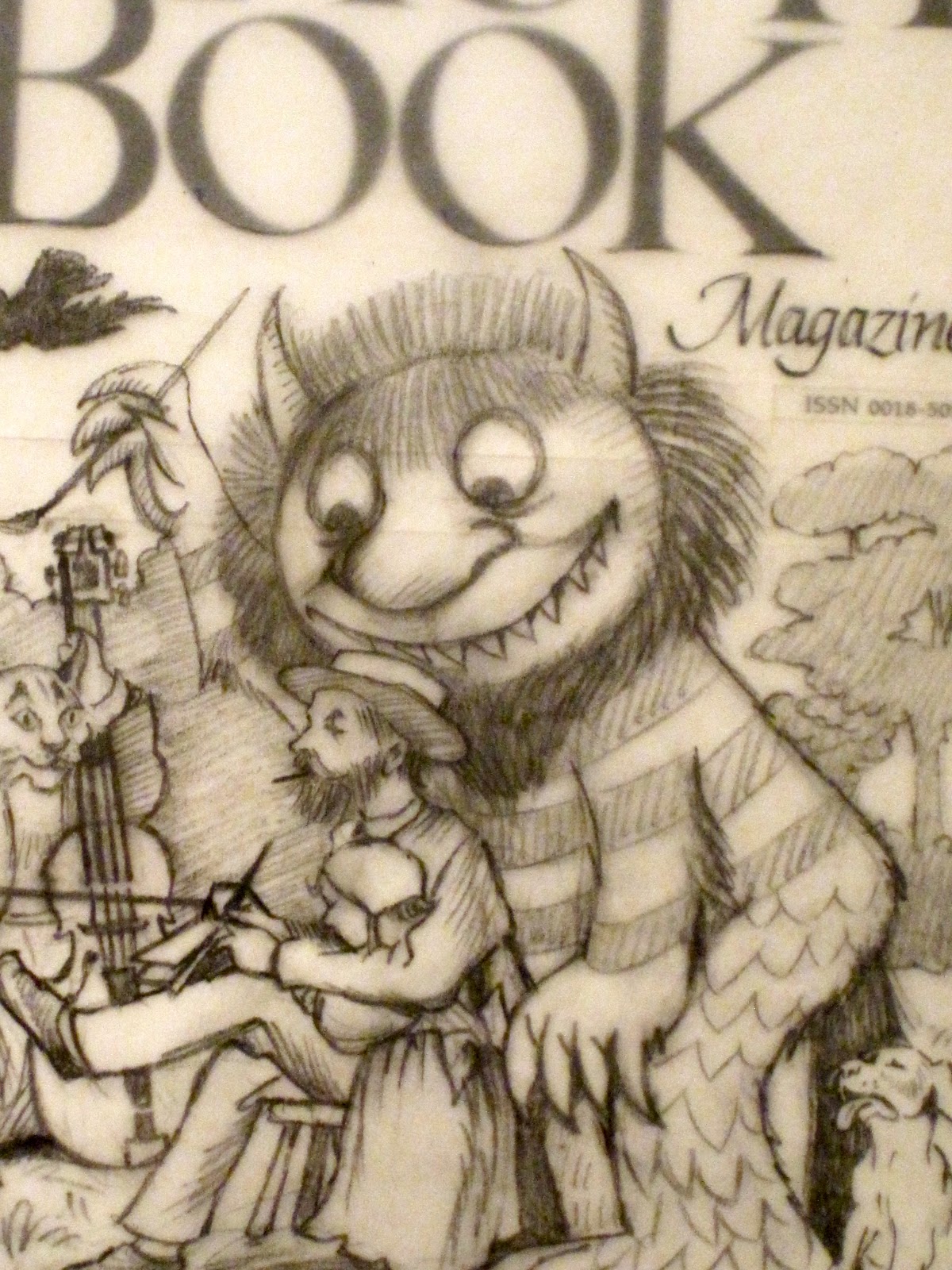
This "work in progress" was a draft for a Hornbook Magazine cover...it was on display with the finished product below.

I was especially interested to see the samples of a set and costume design that Mr. Sendak had drawn (1979) for an opera based on Where The Wild Things Are...
Sendak's set design for the opera

Sendak's costume design for Where The Wild Things Are opera

Maurice said his biggest influence towards becoming a cartoonist  was Mickey Mouse (they were, after all "born" in the same year, and Sendak loved watching Mickey Mouse films as a child)...


Maurice Sendak's self portrait with
Mickey Mouse, circa 1978

Just before leaving the exhibit, I noticed this sweet story, told by Mr. Sendak...
“Once a little boy sent me a charming card with a little drawing on it. I loved it. I answer all my children’s letters — sometimes very hastily — but this one I lingered over. I sent him a card and I drew a picture of a Wild Thing on it. I wrote, 
“Dear Jim: I loved your card.” 
Then I got a letter back from his mother and she said, 
“Jim loved your card so much he ate it.” 
That to me was one of the highest compliments I’ve ever received. He didn’t care that it was an original Maurice Sendak drawing or anything. He saw it, he loved it, he ate it.”

This is a touring exhibition.  The next stop is at the Walt Disney Family Museum in San Francisco, followed by libraries and museums in Portland; Maine; Reno; New Britain; and Connecticut.
Click here to see all the books and/or illustrated by Maurice Sendak.

Saturday, March 9, 2013

TODAY IN HISTORY: THE STORY OF A SLAVE SHIP, AMISTAD

Patricia C. McKissack recounts this amazing chapter in American history 
for beginning readers. 
Illustrations are by Sanna Stanely. Amistad: The Story of a Slave Ship   

In Spanish, Amistad means "friendship". How ironic that it was also the name of a slave ship. In 1838, the Amistad took hundreds of kidnapped Africans on a long journey across the Atlantic from slave-trading Cuba to the United States.

source

Cinque
source: National Portrait Gallery

The brave captives would not give up their freedom. Sengbe Pieh, a Mende African known as "Cinque", freed himself and the other slaves, planning a mutiny. They staged a revolt and took over the ship so they could sail back to their homeland. Instead, they were found grounded off the coast of Long Island. The ship was taken to Connecticut, where the Africans became tangled in legal battles that went all the way to the United States Supreme Court.


John Quincy Adams
source: National Portrait Gallery


On February 22, 1841, the U.S. Supreme Court began hearing the Amistad Case. U.S. Representative John Quincy Adams of Massachusetts, who had served as the sixth president of the United States from 1825 to 1829, joined the Africans' defense team. In Congress, Adams had been an eloquent opponent of slavery, and before the nation's highest court he presented a coherent argument for the release of Cinque and the 34 other survivors of the Amistad.  


On March 9, 1841, the Supreme court ruled that the captive Africans who seized control of the ship carrying them had been taken into slavery illegally.  They were declared free and some were able to return home.

For Grades 5 and up:
Amistad: A Long Road to Freedom Newbery Honor author 
Walter Dean Myers explores the issues surrounding the 
imprisonment and trial of the Amistad captives. 
Illustrations. Maps.

For further investigation:
You can see and read the actual Amistad Case documents from the National Archives by going here.

You can also read more on the State of Conneticut History Kids Page and website here.


Thursday, March 7, 2013

LITERARY COSTUMES IN FILM

Today I visited the Bowers Museum in Santa Ana, California, so that I could see their new exhibit, "Maurice Sendak: 50 Year, 50 Works, 50 Reasons".  It's the first stop for this touring exhibition that posthumously celebrates Sendak and the 50th Anniversary of his picture book, Where The Wild Things Are.  But more on that in a later post...

This post is about another exhibit at the Bowers: "CUT! Costume and the Cinema".  I was lucky enough to make it to see this exhibition before it leaves.  (March 10, 2013 is the last day - so hurry if you live in Orange County.)


All the costumes were GOR-GEOUS, but I was most excited to see the gowns designed for films based on some of my favorite classic literature.  Take a look (and don't miss the children's book at the end of this post)...

Kate Winslet wore this dressing gown in Finding Neverland,
a movie based on the life of J.M. Barrie, author of Peter Pan.
Here's a view of the back (and you can barely see the
exhibit hall we just came from with the Maurice Sendak art!)
The lovely taupe colored gown in the middle with all the ruching is from
Miss Potter, a film about Beatrix Potter, starring Renee Zellweger.
Left: hat and gown worn by Kate Winslet as Marianne Dashwood,
in the film based on Jane Austen's Sense and Sensibility (1995).
Center: hat and gown worn by Sarah Pickering as Charles Dickens' Little Dorrit (1988)
 Right: The wedding gown and veiled hat worn by Charlotte Gainsbourg
 in Charlotte Bronte's Jane Erye (1996)
Look at these quaint "underpinnings".
See more costumes that were on exhibit, HERE.

We ended our day at the Museum Gift Shop, full of great books...history and art books, picture books, pop-up books, and sticker books...

Children's section of the giftshop.

Here's a fun sticker book about costumes I found on the bookshelves.  It's from Usborne, a publishing company that specializes in non-fiction books that are fun and fact-filled.  This book, Clothes & Fashion Sticker Book, would be sure to delight any child who is interested in costumes, design, or paper dolls (for ages 5 and up).

Illustrated with photographs of clothes and accessories, this fun book includes paintings as well as photos and illustrations to bring the fashions of the past to life. It features lively text and fascinating facts that look at fashions through the ages from ancient times right up to the modern age. It offers over 100 stickers.

Well, I hope you liked my little tour.  And check back soon for my post about the Maurice Sendak exhibit at the Bowers (it will be there until April 28, 2013).

Tuesday, March 5, 2013

GOOD BOOKS FOR KIDS ON THE SCI-FI SHELF

'NOT JUST FOR STORMTROOPERS!" source
WHAT DIFFERENTIATES SCIENCE FICTION FROM FANTASY?
Orson Scott Card (author of Ender's Game) is a writer of both science fiction and fantasy. He provides the following information to differentiate between science fiction and fantasy: "If the story is set in a universe that follows the same rules as ours, it's science fiction. If it's set in a universe that doesn't follow our rules, it's fantasy."  He goes on to say that, while plot devices such as time travel can be found in both fantasy and science fiction, if the story contains metal, plastic, and/or heavy machinery, it is science fiction [or it's sub-genre, "steampunk"]; and the reader can assume, until told otherwise, that the known laws of science apply. If the story contains talismans or magic, it is fantasy; and the reader must rely on the author to describe the natural laws that exist in this fantasy world...In addition, science fiction may contain elements of time travel, space opera, alien invasions, post-holocaust worlds, alien worlds, alternative histories or realities, and gadget science fiction. [source]

Below I have complied a (starter, by no means exhaustive) list of good science fiction for kids and teens. Click on the titles for links to reviews/summaries that I have either written or have found from other sources.

Young Children, Ages 4-8
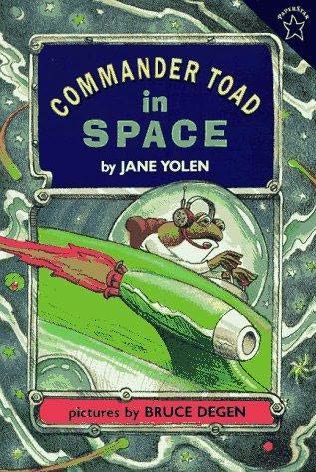
Commander Toad in Space, Jane Yolen, illustrations by Bruce Degen.  Think: Frog and Toad meet Star Wars!


Babar Visits Another Planet, Jean de Brunhoff


If You Decide to Go to the Moon, Faith Mcnulty, illustrated by Stephen Kellogg. A whimsical, but educational "travel manual" for visiting the moon.


Elementary School Age
The Iron Giant, Ted Hughes


The Little Prince, Antoine de Saint-Exupery


The Wonderful Flight to the Mushroom Planet, Eleanor Cameron. In print since the 1950s, the Mushroom Planet series is still around. Children will enjoy reading about the adventures of Chuck and David, two boys who travel to the alien planet Basidium in their homemade spaceship.


Middle School/Junior High
Ender's Game, Orson Scott Card


The Giver, Lois Lowry


The Phantom Tollbooth, Norton Juster


A Wrinkle in Time, Madeline L'Engle (a blend of sci-fi and fantasy)


Journey to the Center of the Earth, Jules Verne. This steampunk sci-fi novel follows Professor Lidenbrock, his nephew Axel, and their guide Hans as they venture deep into a volcanic crater in Iceland on a journey that leads them to the center of the earth and to incredible and horrifying discoveries.


High School
The Hunger Games, Suzanne Collins. Katniss is a 16-year-old girl living with her mother and younger sister in the poorest district of Panem, the remains of what used be the United States. Long ago the districts waged war on the Capitol and were defeated. As part of the surrender terms, each district agreed to send one boy and one girl to appear in an annual televised event called, "The Hunger Games." The terrain, rules, and level of audience participation may change but one thing is constant: kill or be killed. When Kat's sister is chosen by lottery, Kat steps up to go in her place. (I would hesitate to recommend this to middle-schoolers, although it is a YA novel for 12-17 year olds. For mature readers. My past review is here.) 


1984, George Orwell. Portrays life in a future time when a totalitarian government watches over all citizens and directs all activities.


Fahrenheit 451, Ray Bradbury.  "Although books are outlawed in Fahrenheit 451, Bradbury said in interviews that his main purpose wasn’t to argue against censorship (although that’s clearly a sub-theme). Instead, he said he was trying to paint a picture of where society might be heading, as books and other old forms of media and entertainment were being replaced by what he saw as shallow and frivolous alternatives like television shows. In this future, Bradbury argued that books would become outlawed because people themselves would become increasingly anti-intellectual and see them as suspicious. Not surprisingly, perhaps, he was no fan of electronic books: Those aren’t books. You can’t hold a computer in your hand like you can a book. A computer does not smell… A book has got to smell. You have to hold it in your hands and pray to it. You put it in your pocket and you walk with it. And it stays with you forever. But the computer doesn’t do that for you. I’m sorry." More here.


Frankenstein, Mary Shelley... Did you know that Mary Shelley began this deeply profound work when she was only 18?? When I read it, I was blown away, knowing it was penned by a young woman, and told so chillingly through the first person of Dr. Frankenstein. In this classic novel (considered to be one of the first science fiction books), readers "encounter the reality of evil, and the danger of untempered common sense and moral restraints... At the heart of this myth is the pride of the scientist who would take God's place and become a Creator in his own right...Frankenstein is a tragic story, a cautionary tale...what story could be more relevant to our society, given the increasing power wielded by scientists and businessmen over genetics and human life? Mary Shelley, with an artist's prophetic imagination, reminded us what it is like to be human - and less than human". (quote from BOOKS THAT BUILD CHARACTER, by William Kilpatrick).


The Space Trilogy, C.S. Lewis... More from William Kilpatrick: "Before C.S.Lewis wrote the CHRONICLES OF NARNIA, he became concerned with an ideological frame of mind he called "scientism". According to Lewis, scientism was the belief that technology would liberate mankind from the moral traditions of the past; the end result would be the elevation of certain scientists to the status of godhood, with the power of life and death over the whole human race....The three novels that constitute THE SPACE TRILOGY dramatize the conflict between scientism and the moral tradition of the West."
Out of the Silent Planet - A Cambridge University scholar named Ransom accidentally stumbles onto a scheme in which two men, one a scientist and the other a huckster with intellectual pretensions, prepare to travel to Mars and plunder its rich and strange culture.
Perelandra - Ransom is brought to Venus, where he finds a new Adam and Eve, who are being tempted by the evil scientists from the first novel.
That Hideous Strength - The cosmic struggle between good and evil takes place on Earth, as a scientific institute comes close to asserting its power over the world.

Monday, March 4, 2013

Opening Lines From Some Favorite Books - Did I Leave Out Your Favorite?

"There was a boy called Eustace Clarence Scrubb, and he almost deserved it." The Voyage of the Dawn Treader, C. S. Lewis

"The Mole had been working very hard all the morning, spring-cleaning his little home." The Wind in the Willows, Kenneth Grahame


"'Where's Papa going with that axe?' said Fern to her mother as they were setting the table for breakfast." Charlotte’s Web, E.B White


"It's a funny thing about mothers and fathers. Even when their own child is the most disgusting little blister you could ever imagine, they still think that he or she is wonderful." Matilda, Roald Dahl


“Here is Edward Bear, coming downstairs now, bump, bump, bump, on the back of his head, behind Christopher Robin." Winnie-the-Pooh, A.A. Milne

"When Mary Lennox was sent to Misselthwaite Manor to live with her uncle everybody said she was the most disagreeable-looking child ever seen." The Secret Garden, Frances Hodgson Burnett

“All children, except one, grow up.” Peter Pan, JM Barrie


“Mr and Mrs Dursley, of number four Privet Drive, were proud to say that they were perfectly normal, thank you very much.” Harry Potter and the Philosopher's Stone, JK Rowling


“It was the best of times, it was the worst of times, it was the age of wisdom, it was the age of foolishness, it was the epoch of belief, it was the epoch of incredulity, it was the season of Light, it was the season of Darkness, it was the spring of hope, it was the winter of despair.” A Tale of Two Cities, Charles Dickens


"It was a bright cold day in April, and the clocks were striking thirteen." 1984, George Orwell


"No one who had ever seen Catherine Morland in her infancy, would have supposed her born to be a heroine." Northanger Abbey, by Jane Austen


“When Mr Bilbo Baggins of Bag End announced that he would shortly be celebrating his eleventy-first birthday with a party of special magnificence, there was much talk and excitement in Hobbiton.” The Lord of the Rings: The Fellowship of the Ring, J.R.R. Tolkein


"Marley was dead, to begin with." A Christmas Carol, Charles Dickens


“It is a truth universally acknowledged, that a single man in possession of a good fortune, must be in want of a wife.” Pride & Prejudice, Jane Austen