Purpose of this Blog...

You may have noticed that not all books are equal in capturing children's imaginations and in cultivating those innocent, tender souls. My goal is to help you find the ones that do!
(Painting by Mary Cassatt: "Mrs Cassatt Reading to her Grandchildren" -1888)


Wednesday, May 15, 2013

Alexander Pushkin and Russian Folklore

When my husband and I were in St. Petersburg, Russia, we made a side trip to the town of Pushkin (named for the poet), which surrounds the Tsarskoe Selo ("Tsar's Village") estates.  I'll be sharing photos of the estates soon in another post; today I'd like to talk a little bit about Pushkin and Russian folklore.
Monument of Pushkin, founded on the 26th of May 1899, on the 100th anniversary of the poet's birth. 
Pushkin was educated at the Lyceum of Tsarskoe Selo.
Alexander Pushkin (1799-1837) is generally recognized as Russia's greatest poet. He was born into an aristocratic family with a long and distinguished lineage, and attended an exclusive school for the nobility in Tsarskoe Selo, outside the capital city, St. Petersburg.

Pushkin was also a novelist, but part of his literary heritage is his "fairy tales", which were loosely based on Russian folklore (and on some French fairy tales - because of this his tales were criticized, called "artificial flowers" - source).
Pushkin's Fairy Tales,  with Palekh Painting
I honestly didn't know a lot about Russian folklore or Pushkin's tales, so I did some research and found out two interesting facts...

FACT # 1 - Pushkin's tales have always been favorite subject matter for  the painting school of Palekh, a famous old center of icon-painting and lacquer miniature boxes.  (More about this fact in my next post!)

FACT #2:  There are no fairies in Russian folklore, so they should really be referred to "folktales" - they have also been called "wondertales". (Thanks to Masha Gedilaghine Holl's website, which was my source for much of the information you'll find below!)

What is, then, a folktale? It's a story. First and foremost. In Russian, it is called SKAZKA. The word is from the same root as the verb "to say" -- skazat. Therefore it, quite simply, "that which is told" -- a tale, or story. But by implication, it is fiction, not news, something someone came up with: Entertainment. 

Up until the close of the eighteenth century most everyone from tsar to peasant delighted in the folktale.  After that time, the tales were more a part of the culture of the lower class.  Also of note is that the early Russian folk tales were traditionally told only after dark - when young children were asleep - they were typically not subject matter for children (too scary).

THERE ARE FOUR BASIC TYPES OF RUSSIAN FOLK TALES:
1 - Magical tales with a female hero.
2 - Magical tales with a male hero.
3 - Animal tales (with animals as main characters, with or without the participation of human characters).
4 - Tales about everyday life.

1, 2 - The first two categories are related. Both male and female heroes will embark on some kind of a quest. It may be a trip to the forest to gather firewood, mushrooms, or berries; or it may be a journey into a far-away kingdom. Similar characters appear in both types of tales, and they usually end with a marriage, and maybe fortune as well.
--The magical tales in which the hero is female (usually a girl) center around her ability to perform certain tasks. These tasks are usually practical and test the heroin's household skills: cleaning, cooking, spinning, weaving, and of course her knowledge of the proper behavior. These tales also test her ethics: she must not lie, although telling less than the truth is allowed; she must not steal, but taking something from an evil character, after she was allowed to do so by someone from that household, is also allowed.
--Magical tales with a male hero follow a slightly different pattern. For one thing, the male hero ALWAYS leaves his home on a QUEST (the female hero may live all her adventures in her own back yard). The male hero is not expected to perform tasks, at least not by himself: he encounters magical helpers that will do his work for him, or else fix the mistakes he makes when he attempts to perform the task.

3 - The third category of tales is not magical per se, unless you count the animals' ability to speak in "people's voices" (human speech). These tales may involve the participation of humans, or not, but usually the presence of humans somewhere is acknowledged or taken for granted.
--Animal tales are not cute stories about nice furry creatures. Animal characters are strictly typecast:
"The Fox and the Wolf," watercolor and charcoal by Yevgeny Rachev [source]
  • Wolves are greedy rather stupid, and male (the Russian word for wolf is "volk," a masculine noun). 
  • Foxes are sly, calculating, and tricksters. They are also female (the Russian word for fox is "lisa," a feminine noun). 
  • Cats are opportunistic and lazy. They are male (the Russian word for cat is "kot," a masculine noun). 
  • Bears are big and lumbering (naturally), rather clumsy, and not very bright. They are male (the Russian word for bear is "medved'," a masculine noun). The Russian word that is the equivalent of "teddy bear," "misha," is also the diminutive for the name Mikhail, which is the standard "first name" of folk-tale bears. 
  • Hares are quick and cowardly, and male ("hare," in Russian, is "zaiats," a masculine noun). 
  • The goat is cunning, and female (Russian -- "koza," a feminine noun). 
  • The rooster is cocky and boastful, and male (Russian -- "petukh," a masculine noun).
4 - The fourth category of tales about everyday life includes tales about soldiers returning home who meet (and defeat) Death, or who encounter a witch, or some other kind of magical being, and who gain fortune in the end (or maybe just a bowl of soup, as in "Axe Soup," the Russian variant of "Stone Soup.")


Be sure and read this informative essay: Baba Yaga's Domain, by Helen Pilinovsky, about one of Old Russia's most famous (and complex) folklore characters.


Tuesday, May 14, 2013

Nesting...with Russian Dolls and a Book Blanket!

A dear friend brought me this cute set of nesting doll
Matryoshkas from Russia.
It's Matryoshka Madness over here! I'm doing three (3) Matryoshka-themed giveaways for May...go here for details.  You can comment on today's post and any blogs I post through May 30, 2013 to enter.

Throughout the month of May, I'll continue posting all about Russia (my trip to St. Petersburg two Decembers ago, and lots about the history, art, and children's literature of that country).

This May marks the third year I've been blogging here at Good Books for Young Souls - sharing our family's favorite books, authors, and illustrators with you, and new ones that I've discovered as well. 

That's why I'm doing three Giveaways.  Here they are, in case you missed my last post.  I'll choose three people to each win one of these three gifts...
Matryoshka luggage tag
The Littlest Matryoshka book
Matryoshka measuring spoons


I also just have to share a photo of the Mother's Day gift my oldest son gave me (he designed it) - a knit blanket, full of some of our family's favorite storybook characters -- how many do you recognize?? (Notice the Little Golden Book spine design on the left?)


Sunday, May 12, 2013

MATRYOSHKA MADNESS (& Three Giveaways) FOR MAY!

Happy Mother's Day!  The first time I ever saw Russian nesting dolls, or "matryoshkas", I fell in love with them.  Maybe because they look so motherly.  In fact, the word matryoshka is literally "little matron".  The dolls were originally made to symbolize motherhood -  specifically the mothers of large peasant families who are well fed - leading to the portly figure of the doll and her "family" inside of her!


Nesting dolls were first made in China in the early 1800's (traditional Chinese nesting boxes had been started there hundreds of years earlier).  In the 1890's, when a group of Russian artists began reviving native culture and folk traditions, the idea found its way to Russia.
Shop full of matryoshkas at Izmaylovo Market, Moscow

Artist Sergei Malyutin designed the first set of Russian nesting dolls, probably inspired by a Japanese example.  He made the largest doll a peasant girl with a babushka (kerchief) on her head.  The dolls, carved and turned on a lathe by a master wood-carver, were then painted in bright colors.  Many regions of Russia - each developing its own particular style - took up the art, inspired by Malyutin's first matryoshka.  Most of the dolls are maidens, but some sets have families, animals, or characters (like St. Nicholas).

3 GIVEAWAYS: To celebrate my 3rd Blog-iversary!
Leave a comment here on today's post and on any other future blogs I post about Russia throughout May to be entered to win any one (1) of the items below.  Three (3) people will be chosen.  Giveaway ends on May 30, 2013 at midnight PST. Winners announced May 31, 2013.

#1 Remember the cute little matryoshka luggage tag I posted about, here?
#2 The Littlest Matryoshka, (1999) by Corinne Demas Bliss, illustrations by Kathryn Brown. (ages 3-7) Click HERE to read all about the making of this book on Corinne's website. Go to The Littlest Matryoshka website to see activities and games related to the book!
#3 How about these cute Matryoshka Measuring Spoons?  Perfect for you and your little bakers!


TWO NOT-TO-BE-MISSED-BOOKS ABOUT MATRYOSHKAS: 

 The Magic Nesting Doll (2000) by Jacqueline K. Ogburn, illustrations by Laurel Long. Katya is given a magical nesting doll by her dying grandmother but is told that she can only use its magic three times. After entering a land of eternal winter, the young woman discovers a prince who has been turned into "living ice" through an enchantment. Aided in turn by a bear, wolf, and firebird that appear from inside the doll, Katya is able to restore the prince to his former self and destroy the villainous Grand Vizier. Gorgeous illustrations, reminiscent of Russian iconography! (Kindergarten - 3rd grade)
The Art of the Russian Matryoshka, (2008) by Rett Ertl, Rick Hibberd. (Mainly for parents, but if you have a child who's interested in these dolls, they'll love the photos!)  A MUST have for the obsessed, like me.  Hopefully you can find this at your local library (or buy it used), because it's pricey.
The Art of the Russian Matryoshka

MATRYOSHKA CRAFTS! (to make yourself!)...

Click here for a Bigu Handmade "How To" for Matryoshka bookmarks.

Want to  learn to make a Matryoshka fold-out CARD, found at Zakka Life?
I bet you can't resist crafting these mini-matryoshkas!
Sew to Speak has step-by-step instructions.

Make May "Matryoshka Month"!  Do you think you'll try any of these???  
Remember to leave a comment for a chance at one of my May Giveaways!  
And to all you Moms out there:
Poster available on etsy,  here.

Saturday, May 11, 2013

MOST MEMORABLE LITERARY MOTHERS

Richer than I you can never be -- 
 I had a Mother who read to me.
-Strickland Gillilan (1869-1954)


My Top 10, in no particular order:


"Marmee" from Little Women (Louisa May Alcott)
Illustration by Jessie Wilcox Smith
"Money is a needful and precious thing--and when well used, a noble thing--but I never want you to think it is the first or only prize to strive for. I'd rather see you poor men's wives, if you were happy, beloved, contented, than queens on thrones, without self-respect and peace." 
-Marmee

Caroline Ingalls, "Ma", from the Little House books (Laura Ingalls Wilder)
Garth Williams, illustrator
Ma was trembling, and she began to laugh a little. “To think,” she said, “I’ve slapped a bear!”

Mrs. Darling, from Peter Pan (J.M. Barrie)
source
(Mrs. Darling was, after all an example to Wendy, who tried her best to be a Mother to the Lost Boys - telling them stories and making them take their medicine.)
Mrs. Darling first heard of Peter Pan when she was tidying up her children’s minds. It is the nightly custom of every good mother after her children are asleep to rummage in their minds and put things straight for next morning, repacking into their proper places the many articles that have wandered during the day. If you could keep awake (but of course you can’t) you would see your own mother doing this, and you would find it every interesting to watch her. It is quite like tidying up drawers. You would see her on her knees, I expect, lingering humorously over some of your contents, wondering where on earth you picked this thing up, making discoveries sweet and not so sweet, pressing this to her cheek as if it were as nice as a kitten, and hurriedly stowing that out of sight. When you wake in the morning, the naughtiness and evil passions with which you went to bed have been folded up small and placed at the bottom of your mind and on the top, beautifully aired, are spread out your prettier thoughts, ready for you to put on. 
-J.M. Barrie

The Mother Rabbit in The Runaway Bunny (Margaret Wise Brown)
Clement Hurd, illustrator
Once there was a little bunny who wanted to run away. 
So he said to his mother, "I am running away". 
"If you run away", said his mother, "I will run after you. For you are my little bunny".

The Missing Mother Bird from Are You My Mother? (P. D. Eastman)
"I must get something for my baby bird to eat!" she said.  "I'll be back."
The egg jumped and jumped...out came the baby bird! 
"Where is my mother?" he said...
"You are not my mother!  You are a SNORT!" 
(The baby bird, to our great relief, is finally reunited with his mother by end of the story!)

The Inuit Mother in Mama, Do You Love Me? (Barbara Joosee)
Illustrated by Barbara Lavallee
"Mama, do you love me?"  
"Yes, I do, Dear One."  
"How much?"

The Brave Mother in Heckedy Peg (Audrey Wood)
Illustration by Don Wood
The mother kissed her children good-bye and said, "Be careful, and remember -- don't let a stranger in and don't touch the fire."
(This story is about seven children named Monday, Tuesday, Wednesday, Thursday, Friday, Saturday, and Sunday; a witch who intrudes on the peace of their cottage; and a spell only the children's mother can break.)

Mrs.  Molly Weasley from the Harry Potter books (J. K. Rowling)
Harry Potter and the Chamber of Secrets
Howler: (from Mrs. Weasley) "RONALD WEASLEY! HOW DARE YOU STEAL THAT CAR? I AM ABSOLUTELY DISGUSTED! YOU'RE FATHER'S NOW FACING AN INQUIRY AT WORK, AND IT'S ENTIRELY YOUR FAULT! IF YOU PUT ANOTHER "TOE" OUT OF LINE, WE'LL BRING YOU STRAIGHT HOME! And Ginny, dear, congratulations on making it into Gryffindor. Your Father and I are so proud." [From Harry Potter and the Chamber of Secrets]
And of course, we have to give honorable mention to Lily Potter - Harry's Mother - even though she has already died in the books...
“Your mother died to save you. If there is one thing Voldemort cannot understand, it is love. Love as powerful as your mother's for you leaves it's own mark. To have been loved so deeply, even though the person who loved us is gone, will give us some protection forever.”
-Dumbledore [From Harry Potter and the Sorcerer's Stone]

Mrs. Murry from A Wrinkle In Time (Madeleine L'Engle)
"No, Meg. Don't hope it was a dream. 
I don't understand it any more than you do, but one thing I've learned is that you don't have to understand things for them to be."

"Mama" from Mama's Bank Account by Kathryn Forbes
Forbes was a radio scriptwriter before she began writing short stories. Mama's Bank Account, her most well-known work, was published in 1943 and revolved around the daily struggles and aspirations of a Norwegian family living in San Francisco in the 1910s.
Mama looked at me.  
"Is no account”, she said. “In all my life, I never been inside a bank.” 
And when I didn’t – couldn’t answer, Mama said earnestly: “Is not good for little ones to be afraid – to not feel secure.”

"HAPPY MOTHER'S DAY!" and thanks to all my Facebook followers who posted their favorite literary Moms.

Here are a few more that I had to give "honorable mention" to:  Charlotte the Spider, from Charlotte's Web (E.B.White); Mrs. Rabbit - Peter Rabbit's mother (Beatrix Potter); Little Bear's Mother (Else Holmelund Minarik); Mama from All-of-a-Kind-of-Family (Sydney Taylor); Frances the Badger's Mother (Russell Hoban); Mrs. Moody from the Little Britches series (Ralph Moody); Max's mother from Where the Wild Things Are (Maurice Sendak); Critter's mother (Mercer Mayer); Betsy, Tacy, and Tib's moms (Maud Hart Lovelace); Mrs. Hamley from Wives and Daughters (Elizabeth Gaskell); Dowager Duchess of Denver - Lord Peter Wimsey's mother (Dorothy Sayers); Aunt Betsy Trotwood, who adopts David Copperfield (Charles Dickens); and of course Marilla Cuthbert, who adopts Anne of Green Gables (L.M. Montgomery).

One more adoptive "Mother" - Horton the Elephant from Horton Hatches the Egg (Maysie is probably one of the worst literary mothers!) and Horton Hears a Who (Dr. Seuss).

What about Mother Goose?  Go here.

Thursday, May 9, 2013

Iconography in a beautiful Russian children's book...

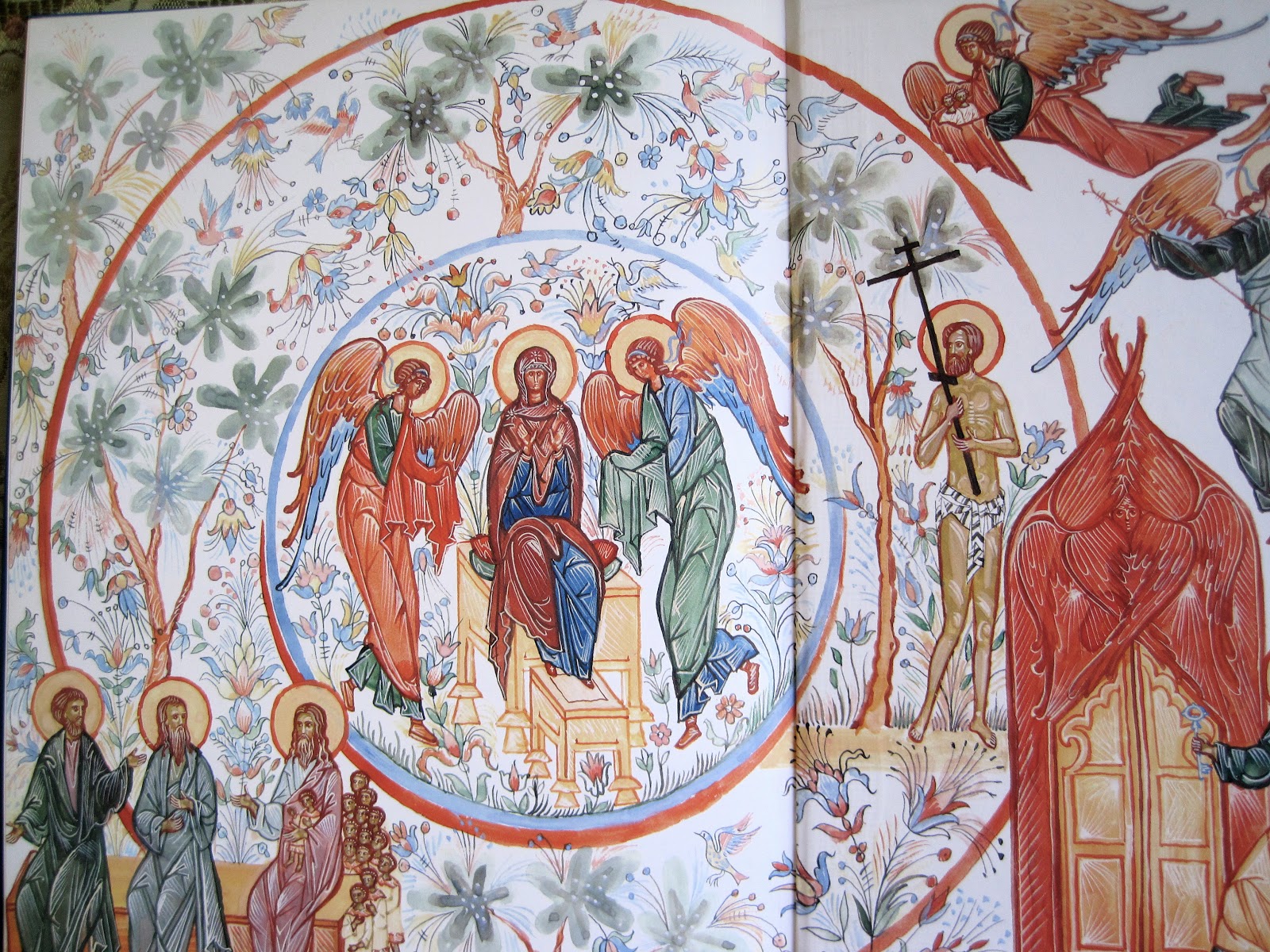
"Here before you, my young friends, is a curious book. It was written for children but grown-ups may also find it interesting. It wasn't meant as entertainment but it will captivate you nonetheless, and even though our narrative is serious, it contains many wonderful pictures. This isn't a book of fairy tales, legends or fables, but it will show you the way to a country that has no equal in any country on earth, for it was created by the All-Wise God in His own image and likeness. It's a wonderful place, not far from each of you, and it's called . . . your own soul."

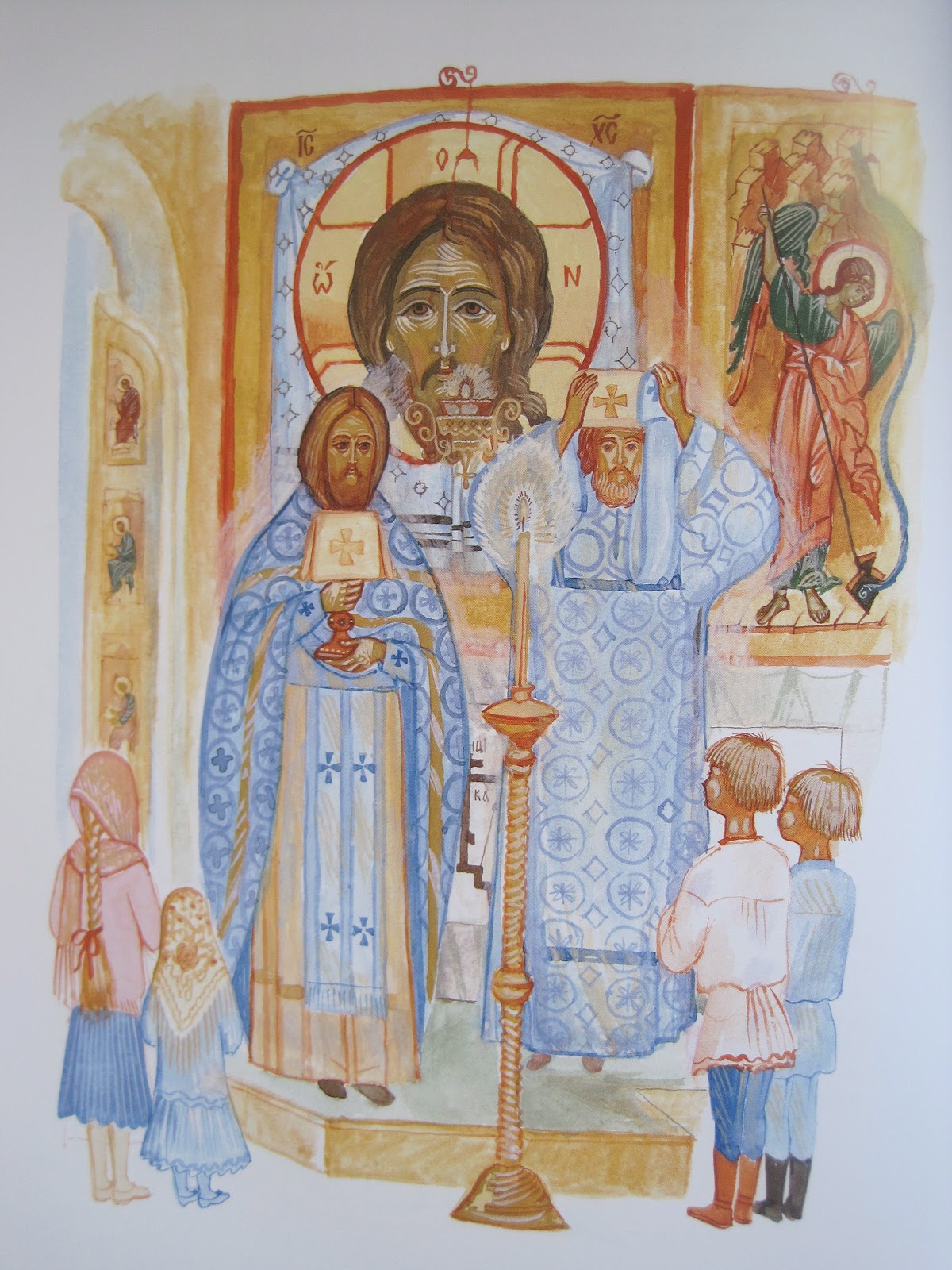
The Path to Confession by Fr. Artemy Vladimirov, pastor of All Saints Church in Moscow, is full of gorgeous watercolor illustrations, done by by G.A. Skotina in a traditional  iconographic style...


The term "icon" is derived from the Greek word "eikon" meaning "likeness" or image. In the Eastern European Christian tradition, the subjects of icons can be portraits of Christ, his Mother, or saints, but they may also be narratives about sacred events, or even depictions of liturgical hymns.  Icons are also referred to as "Windows to Heaven".


Tens of thousands of copies of The Path to Confession have been sold in the original Russian version, and now English-speakers can benefit from Fr. Artemy's gentle, yet sober introduction to confession. This book is a feast to the eyes as well as the soul.


Chapter III addresses "The Battle Against Sin": Disbelief; Pride and disobedience; Laziness and despondency; Envy, greed, lying and stealing; Intemperance in eating and drinking; Unchastity and cursing; Those who have bad manners; and Anger, irritability and fighting...


Fr. Artemy's serious, yet loving counsel about the preparation for the Sacraments of Confession and Holy Communion may in some parts of the text seem strict to our American ears and culture, so I would recommend that parents read it before deciding which parts to share with their children (age and maturity of the child, as well as parenting styles will also be determining factors in how parents will want to present the material).


How much do you know about Russian icons?  Click here for a brief history and some excellent links and resources.


Adults and teens may also enjoy this book, The Underground Struggle to Save Russian Iconography: HIDDEN AND TRIUMPHANT, by Irina Yazykova.  Go here for description and ordering info.


Monday, May 6, 2013

Russian Pascha Treats for Bright Week...

Ilya Kavernez - Joyous Resurrection - source

Today I'm sharing my recipe for Russian "Sweet Pascha Cheese", a traditional Russian treat put into Easter baskets and served at Pascha and during Bright Week to accompany "Kulich", a delectable sweet bread (click here for the bread recipe).  There are lots of authentic Russian Pascha Cheese recipes out there - this is a fairly simple one - "tried and true" - that was passed along to me by a friend who has made it for years.


PASCHA CHEESE INGREDIENTS:
3 lbs Farmers Cheese (or Ricotta)
1 1/2 lb. unsalted butter, softened
1 1/2 pints whipping cream
2 T. + 2 t. vanilla extract
4 c. granulated sugar
5 egg yolks*

Procedure: (Do this a week in advance)  1- Gather all your ingredients before you start.
2- Line 6" clay pots with 2 layers of cheesecloth, letting the edges hang over so you'll have extra to cover the top when you're done.  (You'll need at least four 6" clay pots - or you can mix 6" and 3".  I ran into trouble because this recipe made so much and I didn't have enough pots - luckily, my daughter had some mini ones that we filled!
3- Beat the butter, vanilla, and sugar until light.  Add egg yolks one at a time, beating until creamy. Add farmer's cheese until blended. (The eggs in this recipe are uncooked - go here to decide if you're comfortable with this.  If not, there is a version of the recipe without eggs here.)
4- Whip the cream in a chilled bowl, until soft peaks form.
5- Fold in the whipped cream to incorporate it with the cheese mixture.
6- Pour into prepared pots and cover with the over-lapping cheese cloth.
7- Put all the pots in the refrigerator, placing a saucer (or weight) on top and paper towels or a pan underneath, so any extra liquid can drain out.

8- After 5-7 days, the cheese is ready to un-mold.  Note: You can put it on a plate with edible flowers or strawberries around the edge.  We made a bunch of pots - a large one to share at our church celebration and some smaller ones to give away and enjoy at home! Here was the finished product - it tasted like cheesecake!  Symbolism: Cheese is something Orthodox Christians fast from during the 40 days of Lent.  White symbolizes the purity of Christ and the Joy of the Resurrection!