Purpose of this Blog...

You may have noticed that not all books are equal in capturing children's imaginations and in cultivating those innocent, tender souls. My goal is to help you find the ones that do!
(Painting by Mary Cassatt: "Mrs Cassatt Reading to her Grandchildren" -1888)


Showing posts with label Hawaii. Show all posts

Friday, September 18, 2015

There and Back Again

“When going back makes sense, you are going ahead.” ― Wendell Berry

Hard to believe it's already mid-September! Traveling is always an adventure, but it's nice to be back home.

With my daughter and grandsons in tow, I had a lovely trip to my mom's in Indiana (see my last post) en route to our destination in New York - where I helped my daughter, her husband, and their boys get settled into their new home as my son-in-law attends seminary there for the next three years.

My airplane read, while flying the friendly skies back
to my husband and my quiet house.

For my daughter and her little family, "going ahead" has meant moving and going away from their families and friends in order to follow what God has for them.

But for me, "going ahead" - moving forward - has meant going back - to my dear husband and a very quiet home.

My two little grandsons were especially hard to leave, as we now have to love each other from afar. But we're all "going ahead" and being brave!

My grandson heading up to story hour at their new neighborhood library.

Today I'm giving you a peek into my journeys, which included adventures not only in Indiana and New York, but also Hawaii!  (Nice how that worked out: the beauty of Kauai really helped sooth my soul after our sad good-byes in New York!)

Back porches and lightning bugs.
We must be in Indiana...

My mom in her new white rocker -
aren't back porches and rocking chairs the best?

Moving on, and moving in...unpacking in New York.


Coffee break!

 Super cute coffee place, yummy pastries.


Antique tables and chairs and a "book" shelf, to complete the vintage French shabby chic atmosphere.


And Latte Heart Art, 'cause he melts mine.


Home again to unpack and re-pack for a quick trip to Hawaii, where my husband and I saw...

Sea Turtles

A "Tunnel of Trees" and gorgeous waves

Waterfalls, cliffs, sunsets...

And a rainbow on the beach!

All good things must come to an end, but like I said, it's good to be home!  My friends wonder how I'm doing - making the adjustment of my grandchildren being gone. I'm happy and at peace, and "going ahead", because I know they and their Mommy and Daddy are where God wants them to be.

And it's probably helped that "saying goodbye" was the "norm" for me as a child...

If you've followed my blog for very long, you know that my Dad was a priest and writer.  He dedicated his life to helping people find the Kingdom of God on this earth, and he had to travel all around the United States to do that. He missed us, and I'm sure he often wished he didn't have to travel so much. I know we missed him!  But we all knew he was doing God's work.

After I was grown and married (I am the oldest of six), Dad once told me his goal as a parent was to someday be able to say (3 John 1:4):
I have no greater joy than to hear that my children are walking in the truth. 

My Dad's goal wasn't that we should or shouldn't have certain careers, or that we had to live close to him and my Mom.  He never tried to pressure us like that; he knew that life - and God - could take us all in different directions.  He let us work out our own salvation.

And because our Dad walked in truth, we knew we shared a common bond in Christ that would never be broken - no matter how far away any of us lived.  That was the example my parents set for us, and I try to have the same faith in my kids as they make their life decisions.

My grandson visiting his (namesake) Great Grandpa's
graveside in Indiana.

A Nun's Advice on "Letting Go"
I happened across a very pertinent quote from the book Becoming Icons of Christ (my airplane "read" pictured at the top of my blog post) - it's a good reminder for Sundays when I am in church participating in the Divine Liturgy:

As we are present at the liturgy, we bring our lives, ourselves, our loved ones, the whole world to offer in sacrifice - to make holy - before God.  As we do this, we learn that the truest relationship we can have with others is to allow them to be themselves and to place them in God's hands. Liturgy teaches us that this is true prayer. It is the way of radically letting go rather than always attempting to control.  
-Mother Raphaela

A good place to end this post!  If any of you are struggling with being far from family, or "releasing"  your grown children to live their own lives, I hope this helped a little.

I highly recommend Mother Raphaela's collection of talks and essays, Becoming Icons of Christ.  She is the abbess at Holy Myrrhbearers Monastery, which is on 220 acres of pastures, woods, wetlands, and a four-acre mill pond in Ortega, NY.  You can read about it here.


Tuesday, May 22, 2012

A is for Aloha


The landscape of Hawaii is as exotic as its history and people. The picture book, A is for Aloha, written and illustrated by native Hawaiians, U'ilani Goldsberry and Tammy Yee, presents a loving introduction to one of the most-visited places on Earth. From the meaning of the word "aloha" to the plight of the state bird, author U'ilani Goldsberry answers questions that most visitors have about the lush multi-island paradise. Illustrator Tammy Yee offers her beautiful artwork of this colorful culture.

L is for Lei 
The lei is a symbol of Aloha, and can be given when greeting or parting from someone. Early Polynesian settlers introduced the lei custom to the Hawaiian Islands, when they arrived from Tahiti.  Lei were constructed of flowers, leaves, shells, seeds, nuts, feathers, and even bones and teeth of various animals. In Hawaiian tradition, these garlands were worn by ancient Hawaiians to beautify themselves and distinguish themselves from others.

Today, a hand-woven lei is an extra special gift, since it carries not only a blessing and beauty, but also represents the gift of time and care by the maker. When you give a lei, you are giving a little part of you with it.
Making a ti leaf lei.
On our recent trip to Kauai to visit friends, I enjoyed learning how to make a couple of different authentic Hawaiian lei.  After hiking around with my hostess, collecting ti leaves and bougainvillea, we set to work.  First we made a braided  ti leaf lei, traditionally worn by men and boys, at weddings and special occasions.
I'm actually securing the end of the lei between the toes of my left foot, 
while I continue twisting and adding new ti leaves to form a long cord.
Lei are worn around the neck, or head, or the brim of a hat.  Some are very intricately designed with patterns of alternating flowers and/or leaves, strung or woven delicately to create a lei that will last for days with refrigeration. After wearing them, they can be dried, to later adorn your home.
I used the lei to adorn our hotel lamps!
This is a more complicated one that my friend made.

My friend and I had also cut branches of bougainvillea for a flower lei that could decorate the brim of a hat.  I cut off each individual flower, threaded it on a special long steel lei needle, and then onto a strand of dental floss (the end of which I had securely knotted). I was especially excited to learn to make this garland, because we have an abundance of bougainvillea here in California, and I knew I could also do this at home. ("how to" link here)


Isn't it cute?
MAY DAY IS LEI DAY
While on our visit, we learned that all over Hawaii, May 1st is a special day. If you are lucky enough to be there on that day, you will get to enjoy a holiday unique to Hawaii called "Lei Day".

Lei Day was instituted on May 1, 1928, when everyone in Honolulu was encouraged to wear a lei. Each year the festivities grew into what are now celebrations on each island with hula, music, lei making demonstrations, exhibits and lei making contests.

May Day is celebrated in almost every elementary and high school throughout the state. A Royal Court is chosen and together with the King and Queen, each Princess and Kahili Bearer represents one of the islands. They each wear the color and flowers of their respective island and by way of traditional Hawaiian song, and dancing the Hu’la, they celebrate the Hawaiian culture and beauty of the islands.


Island Colors:
Red - Hawaii
Pink - Maui
Yellow - Oahu
Purple - Kauai
Green - Molokai
Orange - Lanai
Gray - Kahoolawe
White - Niihau


Locals and tourists are invited to come and enjoy this joyful celebration.  Here are the words to “May Day is Lei Day in Hawaii”, composed by Leonard and Ruth Hawk:

May Day is Lei Day in Hawaii 
Garlands of flowers everywhere 
All of the colors in the rainbow 
Maidens with blossoms in their hair 
Flowers that mean we should be happy 
Throwing aside a load of care 
Oh, May Day is Lei Day in Hawaii 
May Day is happy days out there

Click here to read my post about the picture book Luka's Quilt.  (Luka and her Tutu attend a Lei Day celebration.)

Wednesday, May 9, 2012

HAWAIIAN MISSIONARIES, FLOWERS, AND QUILTS

Our dear friends who hosted us during our stay on Kaui have quite a family history with Hawaii:  they are descendants (have you seen the movie with George Clooney?) of some of the first missionaries that ventured forth from the East Coast of the United States to the"Sandwich Islands" back in the 1840's!

Dr. James W. Smith (a great-great? grandfather of our friends) was the first Western-trained physician on the island, who arrived as a missionary with his wife, Melicent.  They raised a family while struggling to save a remnant of the Native Hawaiian population from the ravages of Western epidemics, which the Native Hawaiians had no immunity to.

I've been engrossed with their story from the book, 100 Years of Healing: The Legacy of a Kauai Missionary Doctor, researched and written by Evelyn E. Cook.

Missionaries first began arriving in the "Sandwich Islands" in the 1820's, bringing Christianity and some other influences to the Hawaiian culture, including melodic music and...quilts!

Before the missionaries arrived, Hawaiian women had always made bed coverings from kapa, a cloth made from the inner bark of native trees. Strips of this bark were beaten and felted together to make it into a cloth that was smooth and soft to the skin. The top layer of kapa was dyed and stamped with an overall design.  Women of higher status had the leisure time to decorate more extensively.

As cotton fabric became more available with the westernization of Hawaii, it was possible for the missionaries to help the native women create durable and beautiful bed coverings with applique on solid fabric: quilts.  These appliqued quilts had a single design radiating symmetrically from the center covering the whole quilt.  The pattern was made much like we might make a cut paper snowflake, but with fabric.  These traditional Hawaiian quilts were made with only two solid colors, one for the background and one for the appliqued design pattern.


I found a beautiful shop where these two-colored "Hawaiian Quilts" are sold.  And I found a picture book by Georgia Guback about a young Hawaiian girl named Luka, whose "Tutu" (grandmother) wants to make her a special traditional Hawaiian quilt.
Luka's Quilt by Georgia Guback

From the book jacket:  Luka and her grandmother Tutu are best friends. They spend lots of time together and enjoy each other's company. But everything changes when the quilt comes along. The traditional Hawaiian quilt Tutu makes as a gift for Luka isn't at all what her granddaughter expects. Luka is disappointed, Tutu is hurt, and they don't feel like they can be friends anymore. When Lei Day arrives, Tutu suggests putting aside their differences so they can enjoy the festivities. The celebration makes them feel better--and also sparks the compromise that will make Luka and Tutu best friends again. 


I was a little disappointed in the ending, given that the grandmother puts forth such a great effort to make amends, but Luka never apologizes to her about not being grateful for the quilt gift and all the hard work her Tutu had to do in making it.

But the author reveals a lot about the cultural detail of traditional Hawaiian quilts through the beautiful paper cut illustrations.  Luka anticipated a colorful "garden" quilt, and is disappointed that her grandmother has pieced it with only two colors.  I think the book could have greatly benefited from a little more explanation and a historical note about the history of traditional Hawaiian bed covers, "Kapa Moe".
Inspiration for many of the designs on these quilts comes from the natural beauty of flowers and leaf patterns of the Hawaiian Islands.  Here are some of the beautiful flowers that we saw on Kauai and Maui...


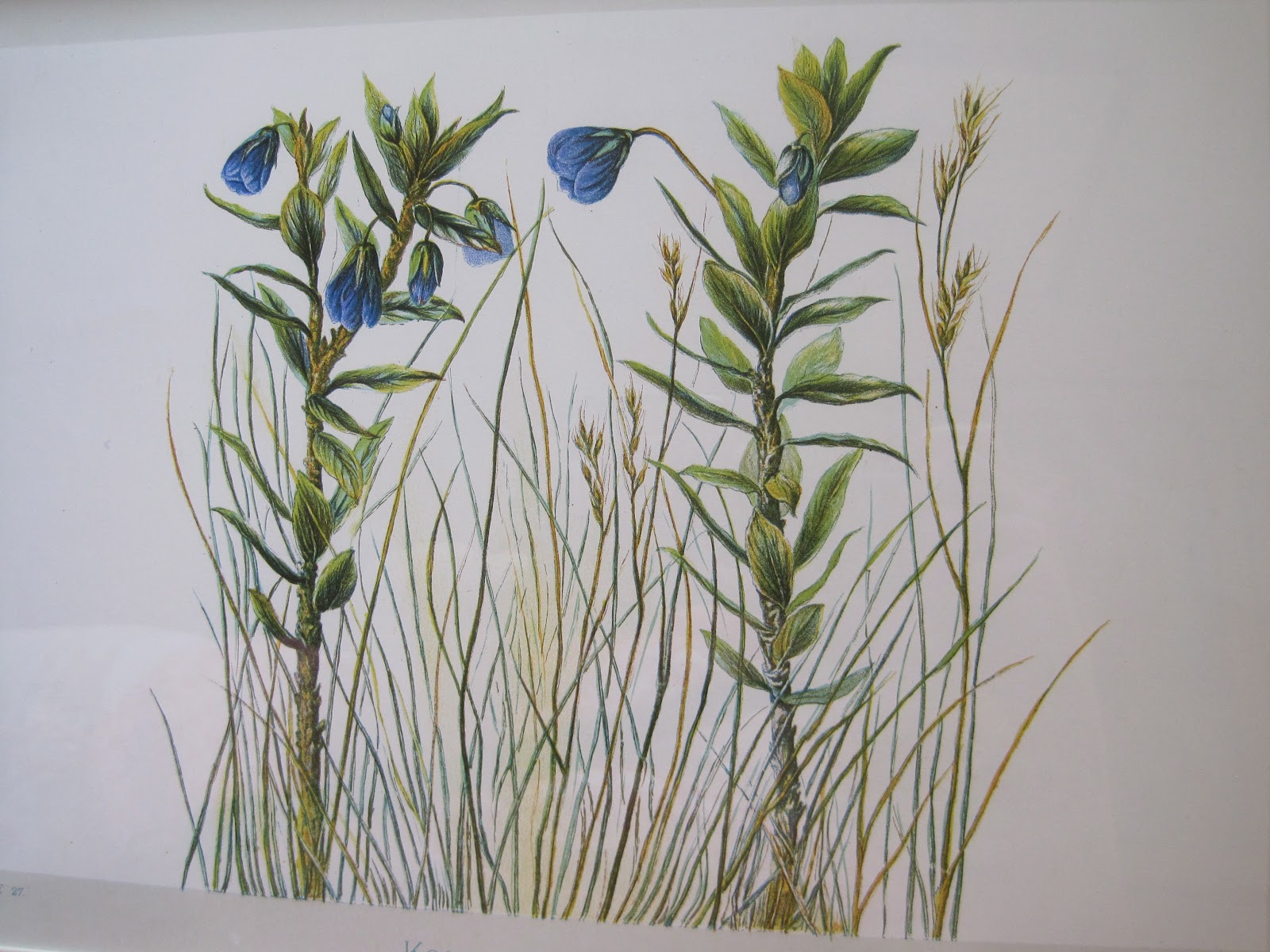
I also came across a beautiful vintage flower journal in a little museum we went to.  I would absolutely love to have an old book like this, so that I could frame the color plate pages!

Indigenous Flowers of the Hawaiian Islands
by Isabella McHutcheson Sinclair.


Here's a link to the whole collection here, on Flickr, if you are interested. Isabella Sinclair moved to Hawaii after marriage to her husband in 1863 and engaged herself in collecting botanical specimens, painting watercolor sketches of the plants and preparing a collection that eventually became a book. She documented the authenticity of her 44 colored plates, sending specimens of each plant to the Royal Botanic Gardens at Kew, England.  The director encouraged her to publish her work and assisted her in this when she and her husband came to London in 1885.  Reviewers commented that although Mrs. Sinclair did not profess to be a botanist, she was a keen observer and gifted artist as evidenced not only by her drawings but by the written descriptions that accompany them. -Digitized by Michael B. Thomas. 2008. University of Hawaii, Joseph F. Rock Herbarium.