Purpose of this Blog...

You may have noticed that not all books are equal in capturing children's imaginations and in cultivating those innocent, tender souls. My goal is to help you find the ones that do!
(Painting by Mary Cassatt: "Mrs Cassatt Reading to her Grandchildren" -1888)


Showing posts with label L. Frank Baum. Show all posts

Wednesday, July 30, 2014

Road Tripping Through Laura Ingalls Wilder Country...(or: "The Yellow Brick Road Trippers")

With the help of Roadtrippers.com, our daughter has planned some adventures and sightseeing for us as we make the looong drive from California in order deliver her and our grandson - and their "stuff" - safely to her husband near Chicago, Illinois.


Kansas, the "Sunflower State" - source

After traveling to Utah's Zion National Park and some sites in Grand Junction, Colorado, we're moving on to....Kansas!

Yes, we'll be road tripping through Dorothy Gale and Laura Ingalls Wilder country on our way across several Midwestern states to Illinois...

The Road to Oz...
I'm hoping we can visit the OZ Museum in Wamego, KS!
According to the Kansas Historical Society website,
Kansans have mixed feelings for Baum and his story. Dorothy, a little girl from Kansas, lives in a bleak, drab environment...The Kansas Baum describes was based on his experiences living in South Dakota in the 1880s.  Many Kansans found this description of Kansas unjust and untrue...but after having traveled through the colorful and exciting Land of Oz, Dorothy exclaims as she taps together the heels of her ruby slippers, "There's no place like home. There's no place like home." Many Kansans point to Dorothy's desire as the more important message of the work.

The "Real" Little House on the Prairie...
This map shows the Ingalls' family travels in Iowa, Kansas, Minnesota, Missouri, Nebraska, South Dakota, and Wisconsin.

Unfortunately our route won't take us as far south as Independence, Kansas, to see a replica of the real Little House on the Prairie...
  
...so we'll just have to settle for a tour in the video below from the awesome website about Laura Ingalls, Frontier Girl.


In 1869, the Ingalls' family moved to this location, 12 miles southwest of Independence, Kansas. They stayed here about a year before returning to their earlier home in Pepin, Wisconsin. Laura Ingalls Wilder was only 3 when the family lived in Kansas, but when she started writing the "Little House" books, she based Little House on the Prairie on memories of her older family members: Pa, Ma, and Mary. The Michael Landon television series Little House on the Prairie was not set at this location, but at Walnut Grove, Minnesota, where the family moved in 1874. The small Little House on the Prairie cabin at this location is a recreation [of the original home] based on the description found in the book. The foundation of a small house believed to have been the home of the Ingalls' family, was found at this location in 1977.  [source: kansastravel.org]
(Click here for my past post about Laura Ingalls Wilder.)

Saturday, May 31, 2014

Vintage Collectible Art - in Books!

The "hunt" is the best part of the BOOKISH business I share with my daughter at The Brick Basement in Fullerton, CA.  (Hopefully I'll be able to sell some of our finds online - more on that in the near future).
I'm especially excited about some books I found recently from the set  BEST IN CHILDREN'S BOOKS, because they are from my own childhood - my mom read aloud to us from the books in the set we had growing up.  Our volumes didn't have the book covers, so it's doubly fun to see the books with their original covers intact!

The 42 volume set, published between 1957 and 1961 by Nelson Doubleday.  Each volume highlighted a mix of classics, original new stories, poetry, and non-fiction from many notable authors.  They also showcased art from some of the better know illustrators and artists of that time.

Here are a few favorite illustrations from the books I have:
Hans Christian Andersen's The Steadfast Tin Soldier
illustrated by Idellete Bordigoni (from volume #37)
Margery Williams' The Velveteen Rabbit
illustrated by Maruice Sendak (from volume #35)

Volume #33 (1960) was full of vintage treasures:
Favorite Mother Goose Rhymes
illustrated by Adrienne Adams
Sophocles the Hyena by Jim Moran
illustrated by Andy Warhol (yes, you read that correctly)
A Dime's Worth for Free by Marion Holland
illustrated by Richard Scarry

Volume #31 (1960) is especially poignant, because of some very collectible art by the late Maurice Sendak that I'll show you in my next post;  but I'll end today's with these illustrations by the Petershams...
The Picnic Basket by Margery Clark
illustrated by Maud and Miska Petersham


Not to be missed:  Volumes 1 and 18, with artwork by the D'Aulaires; Volume 20, with Jean de Brunhoff's Babar; Volume 40 has Dorothy and Oz by L. Frank Baum, with illustrations by Richard Scarry; and other volumes throughout the series that include art by Leonard Weisgard, Don Freeman, Paul Galdone, Barbara Cooney, and Peter Spier, to name a few.
Go here for a complete list of the 42 volumes and their author/illustrators.

Tuesday, October 8, 2013

About as Close to The Emerald City as You Can Get: Hotel del Coronado!

We just returned from an idyllic family vacation at the Hotel del Coronado near San Diego, California. The weather was sublime.

The stunning Hotel del Coronado - The Emerald City?

And guess who else loved this place -- L. Frank Baum, who first visited the turn-of-the century seaside resort with his family in 1904.  He wrote at least three of his Oz books while staying at "The Del"...

Although L. Frank Baum hailed from the Midwest, he preferred to winter in the warm and welcoming sunshine of the picturesque community of Coronado, California, just across the bay from San Diego. 

Doesn't the Emerald City look familiar?

Some people think the author based his design of the bejeweled Emerald City on the Hotel del Coronado; but Baum had already written the first book which included the fictitious Emerald City (The Wonderful Wizard of Oz, published in1900), before ever visiting the hotel in 1904.

L. Frank Baum had storytime with children on the lawn at the
Hotel del Coronado. (photo 1904, source]

Still, you can see why Baum found the hotel so entrancing. With its whimsical design, vibrant red roofs, magical spires, and one-of-a-kind setting, the "Hotel Del" is as close to Emerald City as you'll ever get!  

And Baum is credited with designing the stunning chandeliers in the "Crown Room" of the hotel - don't you think they're fit for the Cowardly Lion? [From Material Dreams: Southern California Through the 1920's by Kevin Starr, source]

Chandeliers in the Crown Room, of the Hotel del Coronado,
designed by Baum [source]

L. Frank Baum - who suffered from a weak heart - usually resided at the hotel for months at a time; in later years he would sometimes rent a house nearby.  During his years in Coronado, Baum wrote the third, fourth, and fifth books of the Oz series: Dorothy and the Wizard of Oz (1908); The Road to Oz (1909); and The Emerald City (1910).

The house L. Frank Baum's would sometimes rent on Star Park Circle,
 just around the corner from the Hotel Del Coronado. [source]

Something else to see in Coronado: The children's area of the Coronado Public Library is home to nine beautiful glass panels (a permanent exhibit, by Brenda Smith) displaying Oz culture and featuring many of Baum's characters. 


Wizard of Oz Glass panels, Coronado Public Library [source]

Detail: Dorothy and the Munchkins [source] 

Baum moved to Hollywood in 1910, where he spent the last nine years of his life at his home, "Ozcot" (he was one of the community's earliest residents).  

He passed away in 1919, but his memory and his legacy in California cultural history live on. 

I hope you can "follow the yellow brick road" someday to Coronado Island, and the Hotel Del! You won't be disappointed.


Tuesday, October 11, 2011

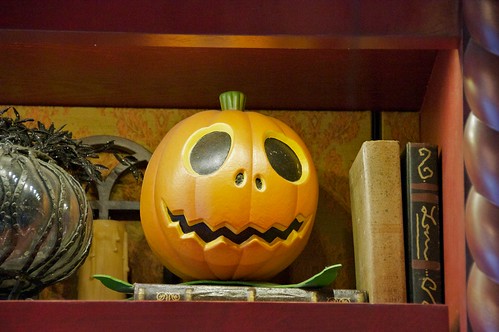
book-or-treat: literary pumpkins!

Jack Skellington pumpkin head
Jack Skellington as a pumpkinhead - source
Before Jack Skellington - the main character in Tim Burton's animated film, The Nightmare Before Christmas - there was L. Frank Baum's storybook character, Jack Pumpkinhead...

Jack Pumpkinhead first appeared in Baum's The Marvelous Land of Oz (published in 1904).  Jack, tall and lanky, with a body made from tree limbs and jointed with wooden pegs, has a jack-o'lantern for a head (hence the name).  But unlike typical jack-o'lanterns, this pumpkin still has all its insides.  In The Road to Oz, Jack has settled in a large pumpkin-shaped house near the castle of the Tin Woodman in Winkie Country. Jack spends much of his time growing pumpkins to replace his old heads, which eventually spoil and need to be replaced. (The old heads are buried in a graveyard on his property.)

In 1913, to publicize the relaunching of the OZ series after a three-year hiatus, Baum wrote a set of six short stories under the series title The Little Wizard Stories. They were each published as separate books and intended for somewhat younger children, in a style similar to today's Little Golden Books.  So children read about Jack again, in the short story, Jack Pumpkinhead and the Sawhorse of Oz.


The 23rd OZ book, Jack Pumpkinhead of Oz was written by Ruth Plumly Thompson, the writer who continued the OZ books after the death of L. Frank Baum.

So, are the similarities between the Two Jacks purely coincidental?
"...in his first scene in The Nightmare Before Christmas, Jack Skellington does have a pumpkin on his head, and looks very much like Jack Pumpkinhead. Also, the director of Nightmare was Henry Sellick who, eight years earlier, had been a storyboard artist on Return to Oz, and therefore had several opportunities to draw Jack Pumpkinhead. From another perspective, similarities can also be seen between Scraps, the Patchwork Girl of the OZ books, and Sally in The Nightmare Before Christmas, so there may be another connection there, but it's also not terribly likely."(source: The Wonderful Wizard of Oz website).
You might like my other OZ post HERE.

Want to explore some other pumpkinheads - Jack-O'Lanterns - inspired by books?  Here's what I found...
Jane Austen inspired Victorian pumpkins

How about a Sleepy Hallow(een) Pumpkin?

Fun party decor, inspired by Edgar Allen Poe's The Raven

Cinderella Pumpkin
Halloween meets Cinderella: 
from allaboutpumpkins.com: "Cinderella" pumpkins are a unique French heirloom whose correct name is "Rouge vif D'Etampes". The source of their nickname it that they resemble the pumpkin that Cinderella's fairy godmother transformed into a carriage. This pumpkin is recorded as having been the variety cultivated by the Pilgrims and served at the second Thanksgiving dinner. There is something magical about them. Cinderellas make a delightful decorative accent for the fall season, but additionally their flavor is good for any pie or winter squash recipe.
"Fairytale" pumpkins ("Musque De Provence") have high, deeply ridged cheeks that are often found in the older varieties. This one is also from France. The greenish-brown coloration of the skin makes it very decorative. It could be the biggest jack-o'-lantern on the block... also good in pies!
Fairytale Heirloom Pumpkin

Cinderella Coach Pumpkin

This cute forest cottage pumpkin reminds me of something you'd read about in one of the THE BRAMBLY HEDGE books, by Jill Barklem.


source

Tuesday, May 11, 2010

WORLDS IN WORDS ON PAPER

Years ago, I remember asking a dear family friend, Fr. Jack Sparks, whether fairy tales and fantasy books were as important for children as historical novels, biographies, non-fiction books, and the "classics". I had begun home-schooling our three children and was hearing some mixed opinions on the most beneficial literature for kids. Fr. Jack had his PhD and had taught at Penn State University back in the 1960's. So, to be honest, I was expecting a very academic answer. I was pleasantly surprised by his reply about his "Oz Summer"...

When he was eight years old - in 1936 - young Jack spent months in bed following a ruptured appendix and long hospital stay. Besides all the well-known children's literature his mother could find, she read aloud L. Frank Baum's "OZ" books to him. Those stories took them to a magic land very different from his own home in Indiana and stirred his imagination like nothing else ever had. He ended our conversation by saying, "You know," - with the ever-present twinkle in his eye - "I look forward to giving each of my grandchildren their OZ Summer, the year they turn eight!"

Well, I could hardly wait to go to the library that week - and let me say, we were not disappointed! The books are filled with some of the most imaginative writing I've ever come across. It's no wonder that THE WONDERFUL WIZARD OF OZ (published in 1900) became a best seller! Baum received over 10,000 letters from children begging for a sequel! (There are fourteen total in the series written by Baum and nine are still in print).

Jim Trelease writes about L. Frank Baum: "He was America's first science fiction writer. Indeed, as often happens in sci-fi, some of his imagining eventually became reality. Fourteen years after Baum wrote about a mechanical man, the word "robot" was coined - but Baum imagined him first. Fifty years before Walt Disney created a real magical kingdom, Baum imagined one. And almost a half-century before Dr. Suess gave us fluff-muffled Truffles, Poozers, Skinks, and one-wheeler Wubbles, Baum created Wheelers, Scoodlers, Munchkins, Skeezes, and Quadlings."

List of OZ Books, in the order written, that are still in print: THE WONDERFUL WIZARD OF OZ; THE MARVELOUS LAND OF OZ; OZMA OF OZ; DOROTHY AND THE WIZARD OF OZ; THE EMERALD CITY OF OZ; THE PATCHWORK GIRL OF OZ; THE LITTLE WIZARD SERIES; and TIK-TOK OF OZ. (See thewizardofoz.info for a list of all the books and answers to any questions you could ever have about the series),

"I learned to live in books, to find worlds in words on paper."
+Fr. Jack N. Sparks, Memory Eternal
December 3, 1928-February 8, 2010