Purpose of this Blog...

You may have noticed that not all books are equal in capturing children's imaginations and in cultivating those innocent, tender souls. My goal is to help you find the ones that do!
(Painting by Mary Cassatt: "Mrs Cassatt Reading to her Grandchildren" -1888)


Showing posts with label Maurice Sendak. Show all posts

Thursday, October 30, 2014

A WILD RUMPUS AT THE LIBRARY - HAPPY HALLOWEEN, COURTESY OF M. SENDAK!

Can you blame me?  I mean, could you have resisted buying a costume of Max's "wolf suit" (from Where the Wild Things Are) - half price - even if it meant saving it for your grandson for almost two years?

To the great delight of her local librarians, my daughter took her little two-year-old "King of the Wild Things" to their library story hour Halloween Party all dressed up and ready to make "mischief of one kind and another".  Here's a little photo blog of the day...enjoy!

The night Max wore his wolf suit and made mischief of one kind and another...

...they called him the most wild thing of all and made him king of all wild things.

"And now", cried Max, "let the wild rumpus start!"

And Max, king of all wild things, was lonely and wanted to be where someone loved him best of all.

But the wild things cried, "Oh please don't go - we'll eat you up - we love you so!"  And Max said, "No!"

Like all wild things, my grandson finally had to say good-bye and head for home to a good supper. Hope you have a Happy Halloween - be safe!

Friday, June 13, 2014

Vintage Collectible Art in Books - Part 2

Are you ready for Richard Scarry's drawings of OZ, and some wonderfully whimsical art from Maurice Sendak?  Both of these illustrators shared June birthdays (Scarry's was on the 5th, and Maurice Sendak's was the 6th), and I just had to share a few more lovely illustrations (mentioned here in my past post) from The Best In Children's Books - a vintage 42-volume set published between 1957 and 1961.
Richard Scarry's cover illustration of Baum's With Dorothy in Oz (Volume 40) brought memories of childhood read aloud time with my mom flooding back!

The pages of these treasured volumes hold wonderful story collections and original artwork that (in some cases) can only be found between the covers of these books!

Such is the case for the amazing original illustrations I've posted today, starting with Richard Scarry's vision of OZ...


From Maurice Sendak, I'd like to share these gems found in Volume 31. Sendak's illustrations accompanied "Windy Wash Day and Other Poems" by Dorothy Aldis...


"...perhaps the most intriguing part of the series is the illustrators. Their names are not given on the table of contents page, but are found only on the title page of the individual story. Because of this lack of credit, most of the illustrations done in this series are not mentioned in bibliographies of the artists' work. Thanks to the efforts of art director Diana Klemin, many now-famous illustrators did some of their earliest work in this series, including Maurice Sendak, Ezra Jack Keats, Peter Spier, Barbara Cooney, Feodor Rojankovsky, Richard Scarry, and even Andy Warhol...." [source: de Grummond Children's Literature Collection - read more here]

Thursday, September 12, 2013

Writing about a LITTLE BEAR

Else Minarik, a former newspaper reporter and first-grade teacher on Long Island, N.Y., wrote Little Bear as a reaction against the stale “Dick and Jane” books of the 1940s.

“I had originally written the books illustrated with my own drawings for my daughter, Brooke, who wanted to learn to read at an early age,” she said.

Later, she mimeographed copies for her students (also beginning readers), with her own illustrations.

Born in Denmark on Sept. 13, 1920, Minarik immigrated with her family to the United States when she was 4 years old. “Little Bear was me in Denmark. I was cuddled and loved,” she recalled.

Hans Christian Andersen (read to her by her mother) was an early influence — and so too, according to Minarik, were childhood trips to the zoo...

When Else Minarik took her Little Bear manuscript to Random House, an editor told her that perhaps if she changed the characters to children, the publisher would consider it. 

“I thought to myself, all children of all colors would be reading the stories. All children love animals. The bear is fine. I love them because Mother took me to the Bronx Zoo every day, and I fell in love with the cubs. My bears were a family.” 

The editors at what was then Harper & Row agreed with Minarik, and used Little Bear as the debut title in their long-running “I Can Read!” series for beginning readers.


Little Bear appeared in 1957 with illustrations by Maurice Sendak (who dressed the bears in Victorian finery.) This Little Bear is a charming cub with good intentions that are sometimes marred by his lack of experience and clumsiness. 

He resembles most preschool children: his world is innocent, close and secure, with Mother Bear at its center. Father Bear appears, but only from time to time, and is clearly of less importance.


In the simply written, yet thoughtful stories - which include real and imaginary situations - Minarik conveyed key characteristics of all young children's lives: the need for both safety and independence, imagination and play, and the importance of family and of making friends.

The Little Bear books belong to some of my earliest memories of childhood reading.  We lived in a Victorian farmhouse at the time, with a parlor and an attic - and my mom had a sewing machine like Little Bear's mother!  I remember wondering, like Little Bear, what it would be like to go try to go the moon.  And my dad travelled quite a bit when I was young, so I could identify with that part of Little Bear's story too.  

I think Maurice Sendak's rich Victorian illustrations were the perfect pairing with Minarik's simple prose. It's quite ironic that we lost them both last year:  Mr. Sendak on May 8, 2012, at the age of 83, and Else Holmelund Minarik at the age of 91, on July 12, 2012.

{All quotes taken from an article by Star-News Correspondent MJ Engle - source}


Wednesday, August 21, 2013

New-Found Appreciation for Randolph Caldecott

I am delighting in a recent book purchase: Caldecott & Co., by Maurice Sendak (a Caldecott Medal winner himself in 1970).  The book, consisting of essays written about several authors and illustrators that Sendak admired, as well as autobiographical essays and interviews by Sendak, is an opinionated, yet thoughtful, observation of some of The Best of what is out there for children.

To be completely honest, I've sometimes wondered if the "Caldecott Medal" was a bit over-hyped - I mean, really, can you judge art?  But in reading Mr. Sendak's chapter about Randolph Caldecott, I've gained a new appreciation for Caldecott himself and a better understanding of the importance of the standard set by this "Father of the Modern Picture Book" and how that standard should be upheld and lauded in the world of children's picture books.


From The Diverting History of John GilpinShowing how he went farther than he
intended, and came home safe again. (1878)
(The illustration on the Caldecott Medal is taken from this book)
Sendak gives a wonderful explanation about what Randolph Caldecott brought to children's books in his opening paragraph about him:

Caldecott's work heralds the beginning of the modern picture book.  He devised an ingenious juxtaposition of picture and word, a counterpoint that never happened before.  Words are left out -- but the picture says it.  Pictures are left out -- but the word says it.  In short, it is the invention of the picture book.

Mr. Sendak goes on to describe in detail the talent and humor of Caldecott's books, something I had really not given full attention to in my own observations of his work!  He sites Caldecott's "rhythmic syncopation of words and images", saying "the characters leap across the page..." and revealing "Caldecott is an illustrator, he is a songwriter, he is a choreographer, he is a stage manager, he is a decorator, he is a theatre person: he's superb, simply."

One of my favorite Caldecott works is one that I've featured before, here: The Milkmaid.  Be sure and notice all that is going on in his amazing illustrations. Below are some more favorite Nursery rhymes...

Cover Art - go here to see all the book's illustrations
Hey Diddle Diddle and Baby Bunting (which Maurice Sendak describes in delightful detail!)
Go here for all the illustrations on Project Gutenberg.


"And the dish ran away with the spoon..." from Hey Diddle Diddle
Cover illustration for Randolph Caldecott's Sing a Song of Sixpence (1880) ,  public domain.
Thank you, Mr. Caldecott the sense of movement, humor, and vitality you brought to children's books!

source
In the United States, receiving the Randolph Caldecott Medal is the highest honor an artist can achieve for children’s book illustration. Established in 1937, this medal is given to the artist who has created the most distinguished picture book of the previous year. It accompanies the prestigious Newbery Medal which is awarded for the most distinguished American children’s book published the previous year. 

The Randolph Caldecott Medal is awarded by the American Library Association and was named in honor of the nineteenth-century English illustrator Randolph J. Caldecott. Caldecott’s illustrations for children were unique to their time in both their humor and in their ability to create a sense of movement, vitality, and action that complemented the stories they accompanied. 

The Randolph Caldecott Medal itself captures that vitality. Rene’ Paul Chambellan designed the medal in 1937, inspired by one of Caldecott’s illustrations for “The Diverting Story of John Gilpin,” showing John Gilpin astride a runaway horse, scattering squawking geese, chased by yelping dogs, and waved at by startled onlookers. Significantly, the recipient of the Randolph Caldecott Medal is memorialized on the reverse of the medal with engraved name and date of award.

Monday, June 10, 2013

Maurice Sendak: From Window Dresser to Wild Thing Creator

source
Today would have been beloved author and illustrator Maurice Sendak's 85th birthday.  Sendak died just over a year ago, May 8, 2012.  He is best know for writing and illustrating the Caldecott Medal book Where the Wild Things Are, but he lent his detailed illustrations to many other children's books, including one of my favorite childhood series: Else Homelund Minairk's Little Bear books.
As a child, I recall being completely caught up in those simple stories of imaginative Little Bear -- his travel to the moon and his encounter with a mermaid at the seaside -- all via Sendak's wonderful illustrations. The cover art, framed beautifully by twisting branches and flowering vines, is not typical of children’s books; but Maurice Sendak would be proud of that!

His creative artwork is a perfect example of how influential exceptional picture books can be in cultivating art appreciation for little ones.  In high school, I was constantly drawn to the detailed floral beauty of William Morris textiles, as well as the pen and ink cross-hatch style of Edward Gorey’s illustrations. I sometimes wonder if my early exposure and fascination with Maurice Sendak's art had anything to do with forming my future tastes.
Richly detailed Sendak illustrations can be found in
Dear Mili, by Wilhelm Grimm (more photos here - source)
Often sick and kept indoors as a child, Maurice Sendak loved spending his time reading and drawing. I read somewhere that the first book Sendak read as a boy was Mark Twain’s The Prince and the Pauper, and that he always kept his original copy of it as a reminder of the influence of great storytelling.

Other than having taken a few night classes in art after high school graduation, Sendak was basically a self-taught artist. This talent, combined with his admiration for Walt Disney’s Fantasia - which he saw at the age of twelve - inspired Sendak to pursue a career where he could utilize his artistic abilities. 

From Window Dresser to Wild Thing Creator 
Here are some interesting facts and trivia about this very gifted man...
  • Before he wrote and illustrated books, Maurice Sendak was commissioned as a window dresser for F.A.O. Schwarz. 
  • His first-ever illustrated book was a 1947 science textbook, Atomics for the Millions, co-written by his high school biology teacher. If you're lucky enough to come across the first edition of this collector’s item in a used bookstore, grab it!  (Click here to see images from the book). 
  • Maurice Sendak's Caldecott Medal winning book, Where the Wild Things Are, published in 1963, is one of the top ten bestselling children's books of all time, about a mischievous boy named Max, his imaginary wild friend-things, and their rumpus in the forest.  It was originally conceived as "Where the Wild Horses Are", but Sendak told People Magazine, "I couldn't draw horses." (go here to read my past post about the 50th Anniversary of Wild Things.)
    • Maurice Sendak's "The Hobbit", in pen and ink, 1967 (Credit: Maurice Sendak/Beinecke Rare Book and Manuscript Library of Yale University)
  • Another bit of information many may not be aware of, is that Sendak (at J.R.R. Tolkien’s request) submitted two illustrations for The Hobbit's 30th Anniversary Edition in the late 1960's.  There was a bit of a mix-up and mislabeling of the artwork samples, so Tolkien did not approve the drawings. The two men never did talk in person, because the day the publisher had scheduled their meeting, Sendak suffered a heart attack.  You can read more here about "the 1960's masterpiece that could have been", in this LA Times guest essay by Tony Di'Terlizzi.
  • In the late 1970's Sendak began a second career designing sets for ballets and operas (both stage and television productions).  His chief musical passion was always Mozart. 
  • Sendak described his books as stories "about human emotion and life. They’re pigeonholed as children's books, but the best ones aren't -- they're just books". (From a People Magazine interview in 2003.)

What is your favorite book by Maurice Sendak?

Thursday, March 21, 2013

WHAT'S ON MY SPRING BOOKSHELF?

Spring is here, and Easter is near! Yesterday was the first official day of Spring. To celebrate, I got out some special books just for you. Any of these picture books make great Spring reading, and would be perfect for a child's Easter basket (watch for my next post: ideas for making book-themed Easter baskets). 

Right click on the titles for descriptions of each book.  I've listed them from left to right on the shelf...

1- What Do You Hear, Angel? Elizabeth Crispina Johnson/Masha Lobastov.
2- The Three Little Pigs, Paul Galdone  
3- Home for a Bunny, Margaret Wise Brown/Garth Williams
4- The Paintbrush Bunny, Adrienne Adams
5- The Hidden Garden, Jane G. Meyer/Masha Lobostav
6- Mr. Rabbit and the Lovely Present, Charlotte Zolotow/Maruice Sendak
7- Because You are My Baby, Jennifer Ward/Sylvia Long 
8- Easter Eggs For Anya, Virginia Kroll/Sally Wern Comport

Do you have a favorite Spring-themed book?  I'd love to know what it is!


Monday, March 11, 2013

Maurice Sendak Memorial Exhibition: 50 Years, 50 Works, 50 Reasons

Celebrating the 50th anniversary of Where the Wild Things Are, this touring exhibition made its first stop at The Bowers Museum (through April 28, 2013) in Santa Ana, California.  I had the pleasure of seeing it last week!

To start, there were eight signed watercolor and ink illustrations of scenes from William Shakespeare's "Macbeth" that Sendak made as a 16-year-old in Brooklyn, to avoid flunking English.  

The story goes that Sendak's teacher couldn't get him to speak up in class or write essays, but she'd noticed he was always drawing and told him he could earn a grade with his artwork. The teacher kept the drawings and went on to exchange letters with her former student for decades until her death. Sendak reportedly got an A+ on the assignment, and the artwork was kept by the teacher and later saved by her grandson.

Maurice Sendak (June 10, 1928 - May 8, 2012) was probably best known for his imaginative picture book, Where The Wild Things Are, which won the 1964 Caldecott Medal, but did you know Maurice wrote and/or illustrated over 100 books in his lifetime! (The list is here - which are your favorites?)

Here are a few photos I took in the exhibit hall...

Bronze sculpture of Max and the Sea Monster
from Where The Wild Things Are

Max and a Wild Thing

Commisioned poster

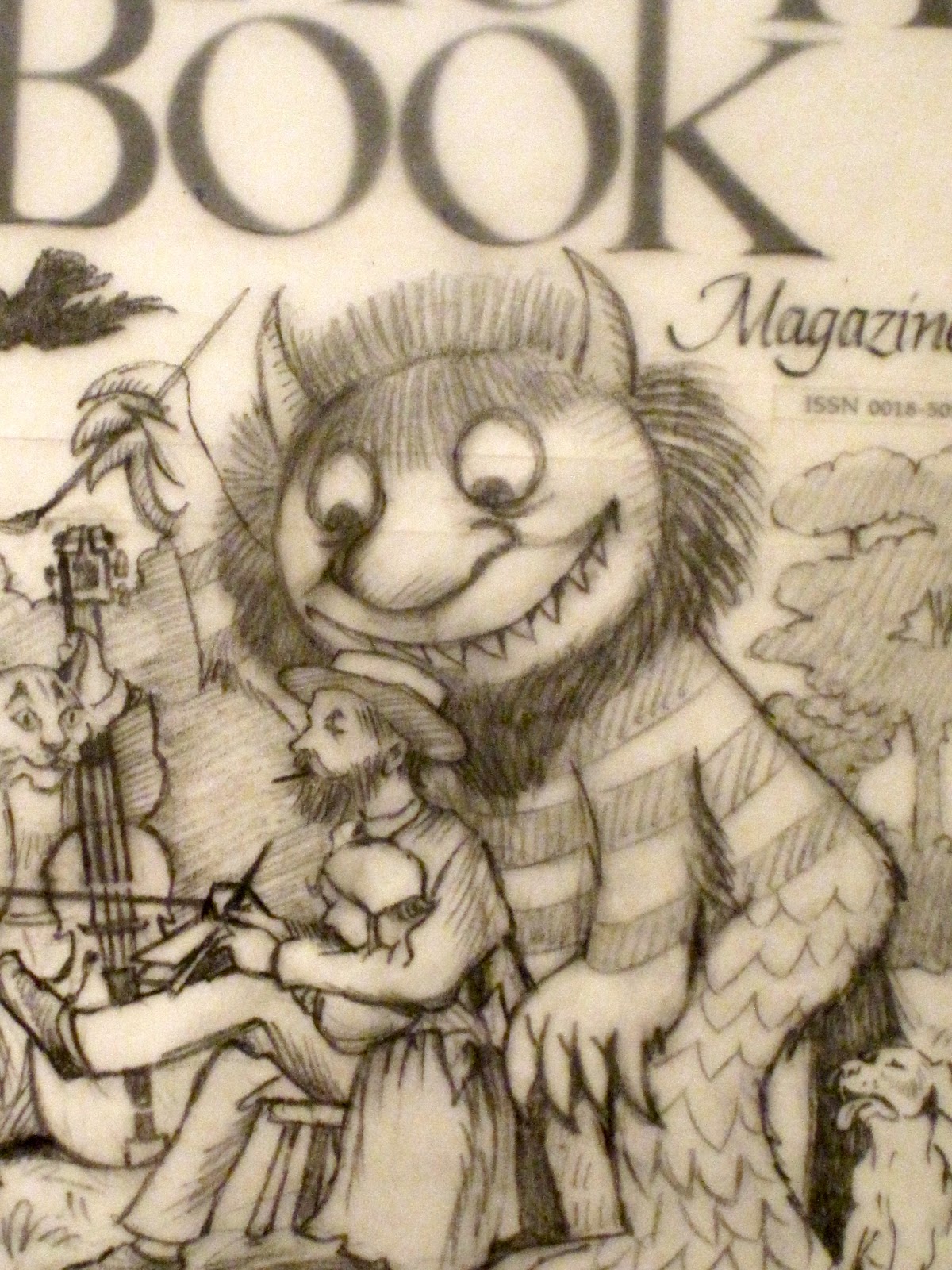
This "work in progress" was a draft for a Hornbook Magazine cover...it was on display with the finished product below.


I was especially interested to see the samples of a set and costume design that Mr. Sendak had drawn (1979) for an opera based on Where The Wild Things Are...
Sendak's set design for the opera

Sendak's costume design for Where The Wild Things Are opera

Maurice said his biggest influence towards becoming a cartoonist  was Mickey Mouse (they were, after all "born" in the same year, and Sendak loved watching Mickey Mouse films as a child)...


Maurice Sendak's self portrait with
Mickey Mouse, circa 1978

Just before leaving the exhibit, I noticed this sweet story, told by Mr. Sendak...
“Once a little boy sent me a charming card with a little drawing on it. I loved it. I answer all my children’s letters — sometimes very hastily — but this one I lingered over. I sent him a card and I drew a picture of a Wild Thing on it. I wrote, 
“Dear Jim: I loved your card.” 
Then I got a letter back from his mother and she said, 
“Jim loved your card so much he ate it.” 
That to me was one of the highest compliments I’ve ever received. He didn’t care that it was an original Maurice Sendak drawing or anything. He saw it, he loved it, he ate it.”
This is a touring exhibition.  The next stop is at the Walt Disney Family Museum in San Francisco, followed by libraries and museums in Portland; Maine; Reno; New Britain; and Connecticut.
Click here to see all the books and/or illustrated by Maurice Sendak.

Saturday, May 15, 2010

FUN AND CURIOUS - THE PRESCHOOL YEARS

Some of my favorite picture books belong to this age group. Whereas baby stage books are focused mainly on fun sounding language, reassuring themes, and bold artwork, in the 3-5 category we still get all that - plus imaginative stories that have more characters, interacting with each other and making discoveries about life. Joke books and silly stories are also part of this group's favorites, as they begin to develop and undertand their own sense of humor.

Take for instance, A Hole Is To Dig, by Ruth Krauss. (Think: A Blog is to Write). This is a hilarious book of "first definitions for children" and my kids adored the text and pictures. The book really would not be complete without the endearing artwork of Maurice Sendak. (Sendak wrote and illustrated Where the Wild Things Are).

"What is a hole?
A hole is when you step in it
you go down.

A hole is
for a mouse
to live in...

Mashed potatoes are to
give everybody enough.

A face is so you can
make faces.

A face is something to have
on the front of your head."


Exceptional Picture Books for Preschoolers - and their siblings! (I'm loving even typing up this list because just seeing the titles brings back such happy memories of many hours of reading aloud to my own children!!!)

The Little Engine That Could, by Watty Piper
Make Way For Ducklings, by Robert McCloskey
Madeline (series), by Ludwig Bemelmans
The Napping House, by Audrey and Don Wood
Harold and the Purple Crayon, by Crockett Johnson
Corduroy, by Don Freeman
The Snowy Day, by Ezra Jack Keats
The Story of Ferdinand, by Munro Leaf
The Freight Train, by Donald Crews
Good Dog, Carl (series), by Sandra Day
The Very Hungry Caterpillar, by Eric Carle
Where The Wild Things Are, by Maurice Sendak
The Story of Babar (series), by Jean de Brunhoff
If You Give a Mouse a Cookie (series), by Laura Numeroff
Angelina Ballerina (series), by Katherine Holabird
Millions of Cats, by Wanda Gag
The Story About Ping, by Marjorie Flack
Blueberries for Sal, by Robert McCloskey
A Child's Garden of Verses, by Robert Lewis Stevenson
Mouse Paint, by Ellen Stoll Walsh
Miss Rumphius, by Babara Cooney
Hattie and the Wild Waves, by Barbara Cooney
Bread and Jam for Frances (series), by Russel Hoban
Chrysanthemum (series), by Kevin Henkes
If I Ran the Circus, by Dr. Suess
All the Places to Love, by Patricia MacLachlan
Hillside Lullaby, by Hope Vestergaard
Tikki Tikki Tembo, by Arlene Mosel
Little Bear (series), by Else Homelund Minarik
The Growing Story, by Ruth Krauss