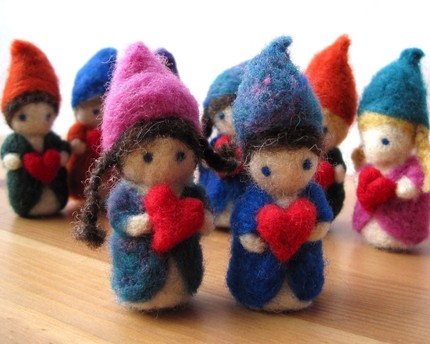
St. Nicholas Tradition: The Swedish gift-giver is a Jultomten. The Jultomten, unlike Santa Claus, is believed to be a little dwarf or gnome who lives under the floorboards of the house. He might also live in the barn and guard their farm. He rides a goat, called Julbocker. The goat is a reference to the Scandinavian god, Thor, whose chariot was pulled by two goats. The Jultomten will hand out gifts from a sack to the children on Christmas Eve. Even though this pagan tradition was outlawed by both church and state in the middle ages, it persisted in private.
Highlighted Tradition: St. Lucia Procession


St. Lucia Day is celebrated on December 13, which also - according to folk tradition - follows the longest night of the year. Lucia means "light" and after long winter months with few hours of sunlight, there is certainly good reason to honor her. To read more about this 4th-century girl from Italy who died for her faith, click here. Swedish families, offices, schools, and churches choose one girl to wear a crown of candles as she represents St. Lucia in processions throughout Sweden.
Scandinavian Tomte (this post has a review of the book The Tomten)
Christmas in Scandinavia (this post has a link to a recipe for St. Lucia Buns)
Happy St. Lucia Day! (this post includes my reviews of books about St. Lucia)
Swedish families enjoy Christmas trees, which they decorate with candles, apples, Swedish flags, small gnomes in red hats, and ornaments made of straw. They bake pepparkakor, or ginger cookies, and serve a smorgasbord, or buffet, for their dinner on Julafton (Christmas Eve). It might include ham, pickled pigs' feet, and lutfisk (dried codfish). Risgrynsgrot, a special rice porridge, is served with cinnamon and sugar and a single, hidden almond. Custom has it that whoever finds the almond in their bowl will marry in the coming year.

Early one Christmas morning in Sweden, Flicka, Ricka, and Dicka open their eyes. Soon they will have their Christmas gifts! Maj Lindman's books were originally published in the ’40s and ’50s. They were the wholesome adventures of three little Swedish girls, Flicka, Ricka, and Dicka, and three little boys, Snipp, Snapp, and Snurr. Longtime fans of the series will delight in revisiting the story, and new readers will find fun and excitement as the girls must save their friend Bertie after an ice-skating disaster. This updated hardcover edition
 comes with paper dolls!
In Sweden and Finland, the Christmas season ends a week after Epiphany, on St. Knut's Day, January 13. This is the day the tree is taken down and the ornaments are stored for the next year. St. Knut was King Knut IV, and ruled from 1080-1086. He was know for his generosity to the poor. This song is sung when the tree is finally taken out of the house:
Christmas has come to an end,
And the tree must go.
But the next year once again
We shall see our dear old friend,
For he has promised us so.


 written and illustrated by Jan Brett. After viewing Goosey-Goosey's brood of chicks, Henny the hen longs for her very own offspring. But each morning a greedy, elf-like "Tomten" steals her newly laid egg, insisting he needs "a little yummy for my hungry, hungry tummy." Henny awakens her friend, Hedgie the hedgehog, with a loud wail, "No eggs, no chicks, no peeping babies," and he offers to help Henny put a stop to the Tomten's thievery. (Click


 (1946);
  (1948). (Please don't waste your time on any of the adapted films - some things are just better left to the imagination!)

 Think of Laura Ingalls Wilder's LITTLE HOUSE books, only set in Sweden. Charming stories of a simpler time. These delightful tales include
  and
and 

 . These two gorgeously illustrated picture books were favorites of my youngest son. The setting is a quiet farmstead, deep in the forest: "Here is a lonely old farm, where everyone is sleeping. All but one..." a little dwarf-like creature (think of a gnome*) from Swedish folklore, called a "Tomten" who guards the farm. No one has ever seen him, but sometimes his little footprints are visible in the snow. He checks on all the barnyard animals and talks to them in Tomten language (a silent little language they can understand). He tiptoes to the house and peeks in on the sleeping children before going back to his cozy corner of the hayloft, where he dreams of the coming summer.