Purpose of this Blog...

You may have noticed that not all books are equal in capturing children's imaginations and in cultivating those innocent, tender souls. My goal is to help you find the ones that do!
(Painting by Mary Cassatt: "Mrs Cassatt Reading to her Grandchildren" -1888)


Tuesday, August 6, 2013

Summer Harvest

And so with Peter, John, and James, 
Our God, whom heaven's hosts proclaim,
Climbs up Mount Tabor, there to pray, 
Where, look! He shines more bright than day.
by Mother Melania, illustrated by Bonnie Gillis

In many Christian denominations, August 6th is the commemoration day of the revealing of Christ's radiant divinity to his disciples, Peter, James and John: the "Feast of the Transfiguration".

Every year our family attends a liturgy for the Transfiguration at our Orthodox parish, where many beautiful scriptures and hymns are read and sung in celebration of this special summer feast day.  And we bring...fruit! 
It is tradition to bless fruits on this day - especially grapes. Why grapes? This is an ancient Christian custom.  At the beginning of  August, farmers used to gather the early fruits of their summer harvest (grapes, figs etc.) and present them in the Church to be blessed and to given freely to the congregation. [source]
These fruits are called the “beginnings”. They show physical transformation and represent a religious transformation (i.e. wine in Holy Communion).  
Two girls in our parish, excitedly watching the blessing,
and waiting for the grapes to be passed out to be eaten
at the end of the service!

The book The Transfiguration of Our Lord, featured at the top of this post, can be listened to  here, where it is beautifully read by Dr. Chrissi Hart on Ancient Faith Radio's program "Under the Grapevine".


All the books from the "Twelve Great Feasts for Children" series, by Mother Melania (formerly Sister Elayne), can be purchased here, from Ancient Faith Publishing.
(About the "Twelve Great Feasts for Children" series: Glowing watercolor illustrations highlight the beauty of each of the Church's feast days. The simple, psalm-like poems are written especially for children, but the whole family will enjoy them. In the Orthodox Church Year, the Feast of Feasts, in a class by itself, is the Resurrection. After the Resurrection in importance come the twelve Great Feasts. These feasts are the Church’s celebration of, and participation in, key events leading to our salvation. Little books for little hands. 24 pages each.)
Icon of the Transfiguration [source and more information]


Friday, August 2, 2013

Vintage Shopping Near the Mission Inn


During our recent stay at the Mission Inn (see yesterday's post), my husband and I had fun exploring downtown Riverside.  Come along for a little tour...


After the used bookstore, we headed over to Simple Simon's Bakery for coffee and a croissant.


And then on to Mrs. Tiggy-Winkles, just down the street!


As we left Riverside later that afternoon, we drove past the beautiful City Hall, Metropolitan Art Museum, and lots of restaurants and antique stores. We'll definitely be back for another visit!  I've heard that the Festival of Lights in December at the Mission Inn is not to be missed!


Thursday, August 1, 2013

Sun-kissed in Riverside, California

My husband and I just returned from a wonderful little getaway for our 30th Wedding Anniversary. We stayed in Riverside, California, at the famed Mission Inn.


How did this historic landmark, complete with antique bells, flying buttresses, a medieval clock, Tiffany stained glass windows, Mediterranean domes, and a five-story rotunda come to be in a Southern California?


Riverside was the birthplace of the California citrus industry. In the late 1800’s, wealthy easterners and Europeans flocked to Riverside in search of both a warmer winter climate and to invest in the area’s profitable new sun-kissed commerce...

In the 1870's a second "Gold Rush" began in California with the arrival of golden sweet and seedless navel oranges.  Two trees were brought to Riverside from Brazil. Talk about perfect timing: in 1877 the Transcontinental Railroad was completed, allowing shipments of the luscious and sturdy fruit to be delivered to eager East Coasters!


The "citrus heyday" lasted from the 1880's - 1955.
During this time, citrus growers commissioned imaginative paper labels
from lithography companies in San Francisco and Los Angeles
to capture the attention of Eastern wholesale dealers.
(I saw these vintage labels in a used bookstore - more tomorrow!)

By the early 1900's people were coming to Riverside not only for its navel oranges, but for the Mission Inn! The Mission Inn evolved along with its surrounding community.


The hotel started as a two story adobe home, built in 1874 by the Miller family, who took in paying guests and soon added additional wings, calling it the Glenwood Hotel. But it was their 23-year-old son Frank, who purchased the home/hotel from his parents in 1880 and eventually made it into a popular resort, re-named the Mission Inn.

By the 1890’s, Riverside was the richest city per capita in the United States. The consistent influx of tourists to Riverside made Frank Miller recognize the desperate need for a grand resort hotel.  In 1902 he modernized it, and added a garden. He also hired an architect and added more wings. Then he began traveling the world...

Miller's travels took him to Europe and Asia, where he loved visiting shrines with his family and began collecting art and objects of interest (his favorites were bells and crosses) for his Inn.  He even had to create new areas of the hotel to accommodate his finds!

It is truly amazing how much he did to transform the hotel before his death in 1935. (Read more here...)
The medieval clock and fourth (top) floor rooms, "Author's Row" - where we stayed!

The next time you peel a sun-kissed (Sunkist) orange, I hope you'll think about Riverside, California and the Mission Inn.                                           Tomorrow I'll tell you about some children's books I found in Riverside (and more)... 


Friday, July 26, 2013

The Coziness of Jan Brett

I don't know of many other author/illustrators who produce more engaging and cozy, animal stories than Jan Brett...
So when I came home last night from a flower arranging class with my little teapot full of roses, snapdragons, and stock, I knew just which book to display it with:  Jan Brett's Town Mouse Country Mouse!
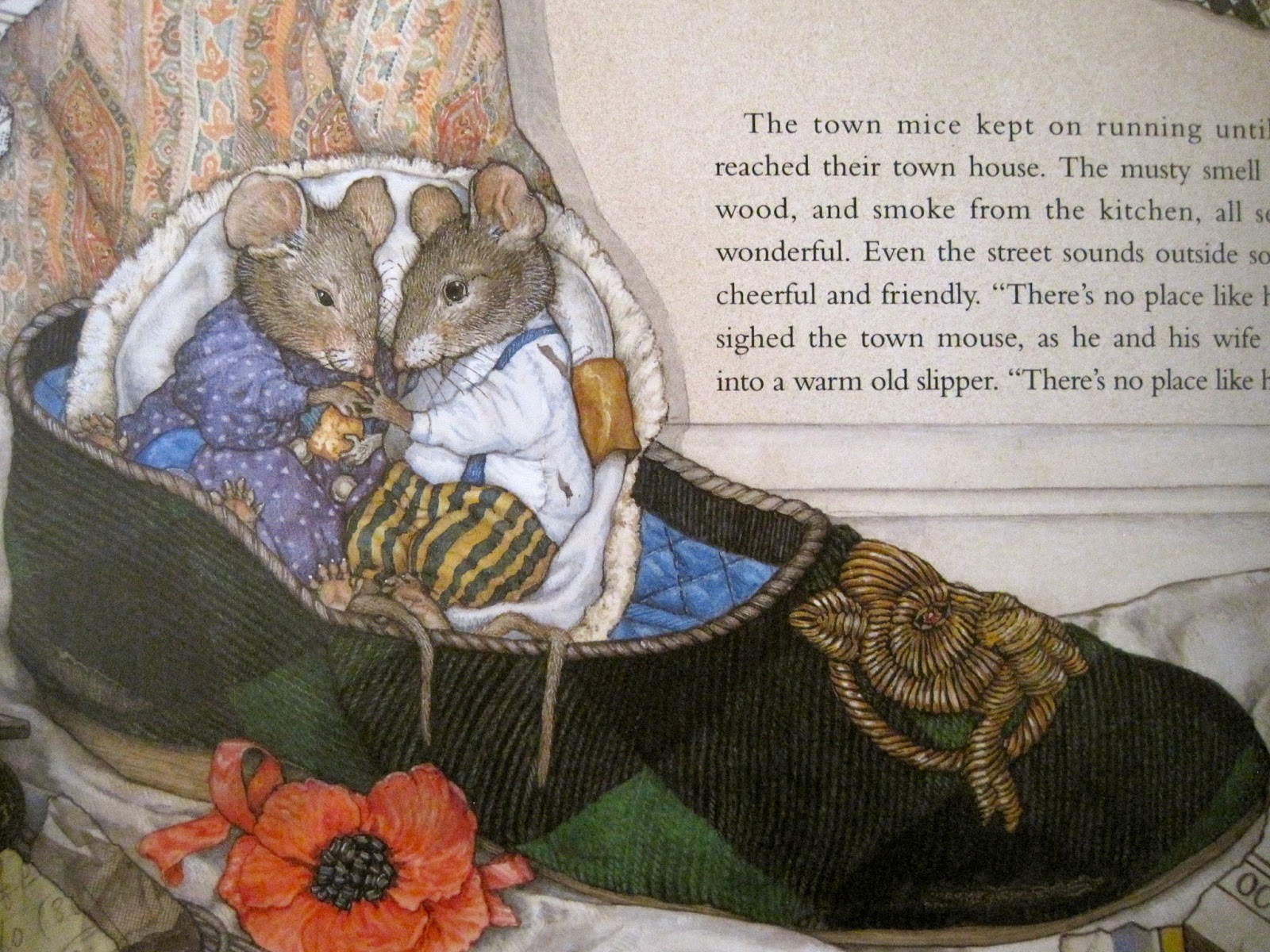
Her version of this classic tale goes back and forth between a country mouse couple visiting an elegant Victorian townhouse and a town mouse couple trying out the lush green countryside.  Each couple faces challenges and predators (mainly an owl and a cat) that often show up in the page border illustrations!
In the end, each couple ends up in their own home.  But you'll have to read the book to see what happens to their predators!
"There's no place like home." sighed the town mouse, as he and
his wife settled into a warm slipper.
(Like Jan Brett's style?  Also see my posts on Valerie Greeley and Beatrix Potter, two of my other favorite animal story author/illustrators).

Wednesday, July 24, 2013

Take it From an Expert: Reading Aloud Costs Nothing But Time

Did you know that a seventh (and final) edition of Jim Trelease's The Read Aloud Handbook has just been published?  If you read my very first blog post, you know that this book helped me immensely as I ventured into the arena of libraries and reading aloud with my own children.  It was our treasure map to books, where some our first discoveries included My Father's Dragon,  Ira Sleeps Over, Kermit the Hermit, and The Stories Julian Tells.
source

"Mother Goose Stories" (Frederick Sands Brunner 1886-1954)

Three decades have passed since The Read Aloud Handbook was first published in 1982.  So who is Jim Trelease?  He's a dad (now a grandfather) and retired journalist, artist, and lecturer who is passionate about reading aloud to kids...
This is the edition I had, printed in 1985
True story: One afternoon, a few years after discovering Mr. Trelease's book (thanks to my mother-in-law, who was a first grade teacher at the time), I came across a magazine article that really frustrated me.  It was written by a mom who had basically given up reading to her son because he didn't like it!  I think she sarcastically mentioned some classics and how only girls like them.

I wrote a letter to the editor about how Jim Trelease's book had helped me.  My letter was published, and one afternoon I heard a voice starting to leave a message on our answering machine (we screened all our calls during our homeschooling years):  "Hello, Wendy.  This is Jim Trelease calling..."  

I picked up the phone immediately.  Jim's adult daughter had seen my letter in the magazine and had told him about it.  He was calling to thank me.  Of course I thanked him! (My kids still tease me about how long I left that message on our machine!) 

Here's an excerpt from the introduction to the seventh edition of this invaluable book:

In the thirty years since the first edition of this book, much has changed in the world, as well as in American education. And so, too, the book has evolved. 

Back in 1982, there was no Internet or email, no cell phones, DVD players, iTunes, iPods, iPads, Amazon, e-books, Wi-Fi, or Facebook. The closest thing to an "instant message" was a facial expression that exasperated mothers gave their children. "Texting" was something you did on a typewriter. The first CD player was just going on sale, Starbucks was just a coffee-bean shop in Seattle, and if you said "laptop" to people they'd have thought you were talking about some kind of TV-dinner tray...


Want more?  The Read Aloud Handbook, 7th Edition, is now available, with revised and updated chapters, and the ever-valuable "Treasury of Read-Alouds" (over 300 recommended books!) at the back of the book with nine categories of books and their descriptions, listed alphabetically by title.  There is also an author/illustrator index.

Chapter titles include:
Why Read Aloud?
Digital Learning: Good News and Bad News
Dad - What's the Score?
A Hyper Kid's Road to Reading

Can't wait?  Before you get this new edition from your bookstore or local library, you can peruse Jim's excellent website at no charge - here.  
Didn't we tell you? Reading aloud costs nothing but time!


Saturday, July 20, 2013

Decorating with Books

“Books are not made for furniture, but there is nothing else that so beautifully furnishes a house.” ― Henry Ward Beecher


Sharing some favorite pins today from my "Library and Reading Spaces" Pinterest Board...

here
here
here
here
here

Thursday, July 18, 2013

A Bohemian Artist, and the Oldest American Picture Book Still In Print

Wanda Hazel Gág {source}
Wanda Hazel Gág - pronounced "Gog" (1893–1946) was an American artist, author, translator and illustrator.  She is most noted for writing and illustrating the children's book, Millions of Cats, which won a 1928 Newbery Honor award - a rarity for a picture book. It is the oldest American picture book still in print!

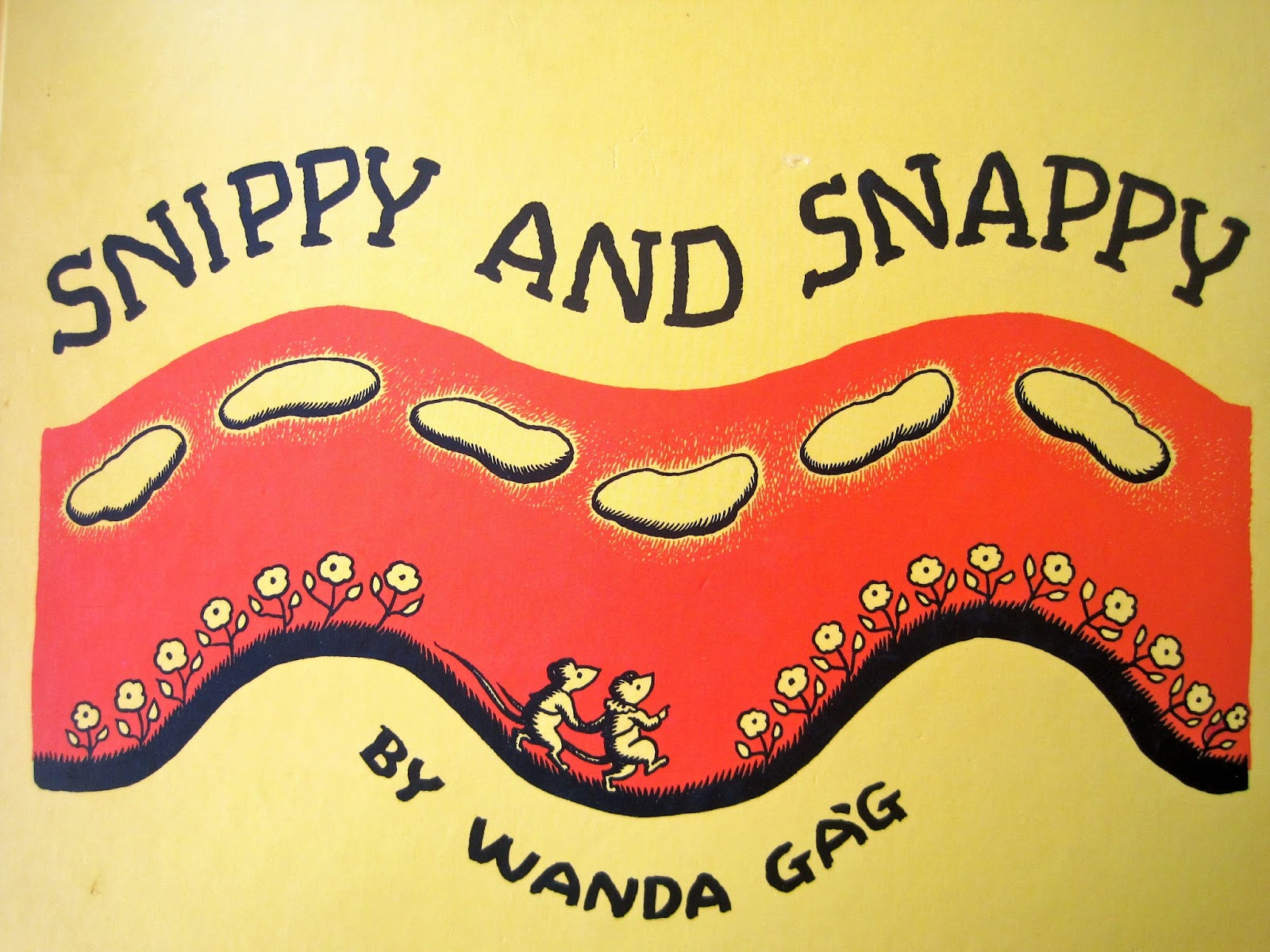
I decided to do some research about this author/illustrator after I bought her charming Snippy and Snappy book (1931) for 50 cents at a library bookstore in Indiana when I was visiting my mom.

Just like in Millions of Cats, all the illustrations (except for the cover art) are black and white, with the hand drawn text often rolling across the page, woven in and out of the artwork...

"Snippy and Snappy were two little field-mice.
Snippy was Snappy's sister.
Snappy was Snippy's brother.
They lived with their father and mother in 
a cozy nook in a hay field"

One day Snippy and Snappy wander away from home while playing with their mother's yarn ball. 

While they are sleeping in the woods, a hand reaches down and snatches their ball of yarn.  So ...

Their journey takes them to a large house full of mysterious things, including cupboards full of wonderful-smelling cheese.

Just as Snappy begins to nibble at a piece of cheese in a mousetrap, their father jumps down to rescue them and lead them safely back home.

At the time Wanda Gág began writing children's stories, there was a movement among educators against fairy tales. They said realistic literature was more worthwhile than fairy tales for children.   Wanda Gág disagreed, saying,"I know I should feel bitterly cheated if, as a child, I had been deprived of all fairy lore..."
She translated and published Tales from Grimm in 1936. 


Two years later she translated and illustrated Snow White and the Seven Dwarfs as a reaction against the "trivialized, sterilized, and sentimentalized" Disney film version.

You can read and see all of Wanda Gág's illustrations for Snow White and the Seven Dwarfs here on Project Gutenberg.  (Do her illustrations remind anyone else of Virginia Lee Burton's artwork?)

To read about Wanda Gág's life, go here, to the website of the Wanda Gág House - her childhood home in New Ulm, Minnesota that is now a museum and interpretive center.