Purpose of this Blog...

You may have noticed that not all books are equal in capturing children's imaginations and in cultivating those innocent, tender souls. My goal is to help you find the ones that do!
(Painting by Mary Cassatt: "Mrs Cassatt Reading to her Grandchildren" -1888)


Showing posts with label St. Patrick. Show all posts

Thursday, March 17, 2016

Two Picture Books for the Irish!

Happy St. Patrick's Day! Today I'm reposting my two favorite books for this Irish Saint from the 4th Century...
You can read my post about this fun alphabet book, S is for Shamrock, here.

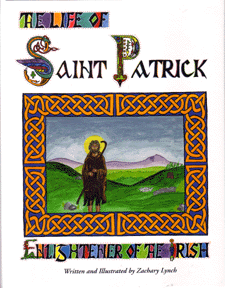
I also highly recommend a more serious book, The Life of Saint Patrick: Enlightener of the Irish. (My past post reviewing this lovely book can be found here.)
Not to worry if you don't have it!  Kids will enjoy listening to the book, read by Chrissi Hart on her podcast "Under the Grapevine",  here.  

Tuesday, March 17, 2015

A Little Limerick-y Nonsense for St. Patrick's Day

My daughter snapped this cute photo of my grandson with a fun Roald Dahl quote last week in San Diego - the quote is perfect for my St. Patrick's Day post today...

So how about this "Little Nonsense":  90 degree weather in Southern California. In March!  

Today is thankfully a bit cooler, but we really haven't had much of a winter this year. We're relishing the sun, but praying for rain as we enter a fourth year of drought.

Roald Dahl wasn't the only one who appreciated nonsense. Edward Lear was a master at it, especially with limericks - witty poems of five lines that have a specific and distinctive rhythm. 
When I think of limericks, I think of Ireland - maybe because the word sounds so Irish.  I discovered there are both a city and county of Limerick in Ireland, and that is where the limerick poem gets its name from.  But whether the poems actually originated there has long been up for debate.  

How about a limerick for St. Patrick's Day:
In Ireland you won’t find a snake 
In a field, a forest or lake. 
If you’re happy with that 
 Give thanks to St. Pat, 
He did it for everyone’s sake.


Luke Dingman icon 

Here's a silly limerick from Edward Lear:
There once were two cats of Kilkenny. 
Each thought that was one cat too many, 
So they started to fight 
And to scratch and to bite– 
Now, instead of two cats, there aren’t any.

And don't forget Mother Goose:
Hickory dickory dock, 
the mouse ran up the clock; 
the clock struck one 
the mouse ran down; 
hickory dickory dock!

Try writing your own limerick, following these rules...

1- The five lines have a specific pattern: the first, second and fifth lines (the longer lines) rhyme; and the third and fourth (shorter) lines rhyme. (AABBA) 

2 - This five line poetry also follows a syllable count. 
Line 1: 7-10 syllables 
Line 2: 7-10 syllables 
Line 3: 5-7 syllables 
Line 4: 5-7 syllables 
Line 5: 7-10 syllables

Happy St. Patrick's Day! Do you have a favorite limerick?

Friday, March 16, 2012

THE TRUE STORY OF ST. PATRICK

Zachary Lynch's Life of Saint Patrick, Enlightener of the Irish, published by Conciliar Press, tells the exciting story of this beloved Saint. Born in Scotland, he was captured at the age of 16 and brought to Ireland as a slave to herd and tend sheep.  During this time, he came to have a deep faith in God, and eventually escaped.


After returning home, he became a priest and then a bishop and later went back to Ireland as a missionary, bringing Christianity to its people.  He died March 17, 461. 

Lynch's gorgeous Celtic illuminations bring St. Patrick's story to life, and draw us into the isolated land of a pagan Irish King and his druids.

St. Patrick Puppet Craft
Your kids might enjoy making this cute paper bag St. Patrick puppet.  The instructions can be found here...
source


The Lorica ("Breastplate") of St. Patrick 
The story of this prayer is that Patrick and his followers used it to protect themselves from many dangers and from the people who wanted to kill them as they travelled across Ireland. (It is also called the "Deer's Cry" because their enemies saw not men, but deer, as they passed by in pursuit of Patrick and his followers). It may not have been written by St. Patrick, but is considered to reflect his theological focus on the Trinity. It is one of my favorite prayers, especially helpful during times of trouble or distress. 
Iconography by Dn. Matthew D. Garrett - source
You can find a link here, but I'll include a short verse:
Christ with me, Christ before me, Christ behind me,
Christ in me, Christ beneath me, Christ above me,
Christ on my right, Christ on my left
Christ where I lie, Christ where I sit, Christ where I arise
Christ in the heart of every man who thinks of me,
Christ in the mouth of every man who speaks of me,
Christ in every eye that sees me,
Christ in every ear that hears me.

Monday, September 6, 2010

SAINTS OF THE BRITISH ISLES

CONCILIAR PRESS offers three wonderful picture books for children, about three different saints of the British Isles.  You can order them through Conciliar's website.

The first, THE LIFE OF SAINT PATRICK, is written and illustrated by Zachary Lynch.  Most of us grew up with the custom of wearing green on St. Patrick's Day and we may have even heard that St. Patrick used the clover (shamrock) to teach the people of Ireland about the Holy Trinity.  But do you know the story of how sixteen-year-old Patrick arrived on the island of Hibernia (the ancient name for Ireland), left, and eventually returned as a missionary?

Lynch's gorgeous Celtic illuminations bring the story to life, and draw us into the isolated land of a pagan Irish King and his druids.  St. Patrick faced many dangers, but said, 

"I was not afraid of these things, because of the promise of heaven,
because I have thrown myself into God's hands,
who reigns over all things."


The second book is THE LIFE OF SAINT BRIGID, Abbess of Kildare, lovingly told by Jane G. Meyer.  Again we see Zachary Lynch's captivating and colorful illustrations, full of Celtic influence.

"Brigid saw Christ in everyone she met, and had
a particular love for those less fortunate than herself."

Her father, a chieftain, becomes weary of Brigid's generosity and takes her away to be sold to a neighboring king.  While the deal is being settled with the king, Brigid gives away her father's sword to a poor leper.  The king, realizing that Brigid would give away his wealth as well, advises Brigid's father to release her from slavery and grant her freedom. 

Brigid's prideful father yields to the plan, but tries to force her to  marry - which leads Brigid to scar her own face, in order to be left alone by her family.  They finally understand her desire to devote herself purely to Christ, and she is allowed to become a nun,
"...marrying Christ and His Church instead of man.
And as a sign of God's hand upon her, the scar on her cheek was healed
as the priest placed the white veil upon her head."  

The rest of the story is about Brigid, Abbess of Kildare, who tends sheep and the poor, founds convents, works miracles, and visits kings.  St. Brigid is known today as a patron of travelers, healers, and midwives; and a protector of flocks and herds, and newborn babies.  


THE RAVENS OF FARNE, by Donna Farley, with illustrations by Heather Hayward, is a story from the life of St. Cuthbert, who lived in England in the 7th Century A.D.  When he moves to the Island of Farne, he is greeted by the many birds that inhabit the island. 
"The birds built nests to hold their eggs,
And the monk built a place to hold his prayers."
After St. Cuthbert plants grain and is harvesting it, the birds suddenly descend and try to steal it.  The monk is surprised as he tells them:
"If God Himself has said you may, I will give you leave to eat.
But if not -
- if not, stop taking what is not yours and be off!"
You'll have to read the story to find out what happens and how the birds end up helping the Saint.  To this day, it  is a law on the Farne Islands that people may not hurt the birds who dwell there!