Purpose of this Blog...

You may have noticed that not all books are equal in capturing children's imaginations and in cultivating those innocent, tender souls. My goal is to help you find the ones that do!
(Painting by Mary Cassatt: "Mrs Cassatt Reading to her Grandchildren" -1888)


Showing posts with label books for young adults. Show all posts

Tuesday, December 16, 2014

In the True Spirit of Christmas, Some Spiritual Book Recommendations For Last-Minute Shopping...

Because of my recent travels, I'm way past due getting out these book recommendations, but hey, if you're a last minute shopper in search of some spiritually edifying gifts, this post is for you!

Does this image of parcels, snow, and Mr. Tumnus' furtive glance as he talks with Lucy Pevensie in the movie adaptation of C.S. Lewis' The Lion, the Witch and the Wardrobe, make you think of the angst that often accompanies Christmas shopping?
Thank goodness we're not in a land where it is "always winter but never Christmas". However, in this final countdown towards Christmas, we need to take time to slow down and remember to pray, or we might experience "always December but never Advent".  Christmas Eve will suddenly be here, but we'll be too stressed to even remember what we're celebrating!

And consider, what better time than Christmas to give spiritual books, as presents that can help our loved ones remember His Presence!

Today I'm sharing some nice gift offerings, especially for my Orthodox followers, from Ancient Faith Publishing...I'm always excited to see which review copies from AFP will show up on my front doorstep - they're like new friends who I look forward to meeting. (If you're not familiar with this Orthodox Christian publishing company, go here.)

CHILDREN' BOOKS:

A CHILD'S GUIDE TO THE DIVINE LITURGY

For my Orthodox readers: this little gem is the perfect size to fit in a child's Christmas stocking! Compiled and edited by AFP, this book is beautifully illustrated with mixed media by Megan Gilbert.
A Child's Guide to the Divine Liturgy is just what it's title states: as opposed to an exact "follow-along-with-every-word-in-the-service-booklet", it's a nice little volume that is a perfect "pocket companion" to help guide kids through what the Orthodox Divine Liturgy is all about.  Colorful illustrations showing children in a variety of traditional Orthodox settings (many jurisdictions' traditions, vestments, etc. are represented) are featured on every page - making this book engaging for children from about ages two to ten. Each section of the guide is color coded, so even beginning readers can easily navigate the contents.  The book includes liturgical prayers, explanations and icons of the 12 major Orthodox feast days, a glossary, and more.  A grand guide in a small package! Ordering info and a look inside this book feature here.


FROM GOD TO YOU, The Icon's Journey to Your Heart by John Kosmas Skinas.  

This book is a follow-up to the popular PICTURES OF GOD, which I posted about here.  In his new picture book, Skinas delves into the history and sacred role of icons.  The first page sets the tone of the book beautifully with this quote: "The icon is a place of meeting where you and God can gaze at each other from the two sides of eternity."  The author relates the story of how God sent the first icon ("The Icon Not Made by Hands", also called "The Holy Napkin") and we are introduced to many other icons and traditions that have been handed down throughout our church's history. With scripture references and a "Notice This" feature for every holy image, this book is a wonderful help for children ages 4-10.  Can be ordered here.

BOOKS FOR YOUNG ADULTS/ADULTS:

THE MYSTERY OF ART, Becoming an Artist in the Image of God by Jonathan Jackson.

If you know a young adult Christian artist who is pursuing music, dance, acting, or painting...please consider this book!
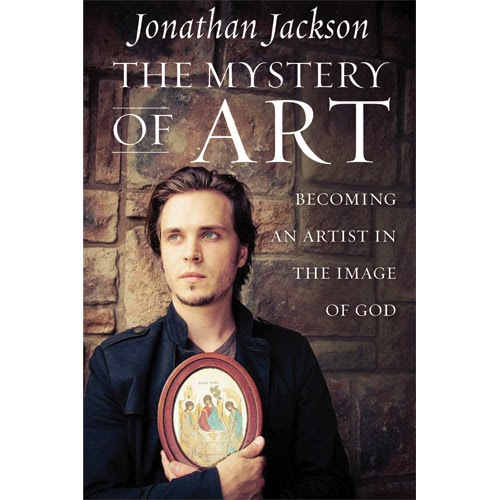
Do you know about Jonathan Jackson?  Besides his career in Hollywood and music, he's an Orthodox Christian (short bio here).

My 25-year-old musician son is devouring this book! He commented, "I really needed to read this right now.  It's speaking to a lot of things that I'm currently dealing with spiritually."

I really wanted to give you my own book review of The Mystery of Art, by Jonathan Jackson, but I couldn't pry my review copy from my son's hands long enough to read it myself!  Instead, I'm sharing the book description from Ancient Faith Publishing's website:

Emmy Award-winning actor and musician Jonathan Jackson explores the profound implications of human creativity in the image of God, along with the process of becoming an artist (of any sort) dedicated to practicing his or her art from the context of a deep relationship with God. The true Christian artist is not necessarily one who treats religious themes, but one who creates through the power of the Holy Spirit to the glory of God.
Can be ordered here.

NEARLY ORTHODOX, On Being a Modern Woman in an Ancient Tradition by Angela Doll Carson.

Here's one for the girls (18 and up)!  Not to be missed.
Open this book, and you'll find yourself traveling with Angela along what is for her a new, yet Ancient Road on her journey towards chrismation into the Orthodox Church.

Her style - intentional, yet free flowing, is full of poetic metaphors - she puts you right there with her.  Smack.  In the midst of whatever struggle she is facing, and whatever emotion she is feeling.

In the Introduction she tells us: "The mapmaking of this book, my spiritual geography as it were, depends on those intersections of the past, the present, and the future.  They are intricately woven. They are sometimes congested and confusing."

Not chronologically, Angela's pilgrimage begins "in the middle, the muddy middle" to East from West. The stories she tells intertwine, like her winding journey from Catholicism to Protestantism to Orthodoxy.

We travel with her as she fights "Giants in the Road", and we follow as she leads us "Into the Roar."  She honestly observes and confronts her modern experiences and outlook on life as she sees them in juxtaposition with ancient Eastern Orthodox spirituality.

Along her journey she has passed landmarks that must be confronted: her parents' divorce, her inner punk rocker, and feminism, to name a few.  She begins to encounter and consider the Orthodox Traditions of liturgy, icons, prayer, confession (and some not universally practiced "small t" Orthodox traditions as well), as she travels toward the day of her chrismation, and realizes the road and journey don't stop there.

The appeal of Angela Doll Carlson's book (besides her engaging, poetic writing) is that Angela's intimate and honest questions, struggles, fears, and reflections about herself and her faith make you more aware of your own!

She reminds us that the Ancient Road, "a long lifetime road", though full of struggle, will help lead us to our destination, a true and healthy dependence on God, not ourselves. After all, aren't all of us just "nearly Orthodox", trying to live out our faith?  Ordering info here.

FAMILY DEVOTIONS

THE ANCIENT FAITH PRAYER BOOKEdited by Archimandrite Vassilios Papavassiliou 

This beautiful green prayer book would make a festive Christmas gift; but order a few extra volumes for wedding, baptism, namesday, and birthday gifts! It's small enough to tuck away in a purse.  And I have to mention, besides a collection of some of the most beautiful ancient prayers of the Orthodox Church, this devotional includes some helpful and compassionate prayers for marriage, family life, pregnancy, childbirth, and miscarriage.  You can order it here.

Last but not least, Ancient Faith Publishing has a beautiful selection of Christmas cards, ornaments, icons, jewelry, and more in their CHRISTMAS STORE!  Go here to see their wonderful offerings. Remember, there are 12 Days of Christmas in which to give gifts...December 26 - Epiphany, January 1.


Wednesday, March 21, 2012

Have you tasted THE HUNGER GAMES?

I'm just starting the final book of THE HUNGER GAMES trilogy. My general impression of much of what is labeled "YA Lit" is not always positive so I hadn't pursued these books, until my niece recommended them to me a few weeks ago.

She is a smart, gifted young girl and her parents have raised her and her two older brothers with many of the same family values shared by my husband and me.

So, of course, I took notice and listened.  Her enthusiasm won me over, and I immediately started reading the first book, titled The Hunger Games.  And let me tell you, it's a major page-turner!

Author Suzanne Collins certainly doesn't shy away from big issues in her books: the brutality of war, personal ethics, power of the elite class, sacrifice, and the dangerous nature of an entertainment and voyeuristic-driven society (ouch - how about the mania of reality TV in our own culture).

She also doesn't shy away from asking a question that comes with those big issues:  in the midst of all this darkness, how do we hold on to what makes us truly human?

As a script writer, Collins knows how to deliver a plot and character driven story, full of quick dialogue.  Her writing sytle does not put this book in the category of great literature, but it's definitely an exciting, if dark, read. Here's the basic premise of this sci-fi trilogy, which the author says was inspired by the Greek myth, "Theseus and the Minotaur" (more about that later)...

Katniss is a 16-year-old girl living with her mother and younger sister in the poorest district of Panem, the remains of what used be the United States. Long ago the districts waged war on the Capitol and were defeated. As part of the surrender terms, each district agreed to send one boy and one girl to appear in an annual televised event called, "The Hunger Games." The terrain, rules, and level of audience participation may change but one thing is constant: kill or be killed. When Kat's sister is chosen by lottery, Kat steps up to go in her place.

If you haven't yet read the H.G. trilogy, I hope you can get some of your questions answered here in my post; but you as a parent will ultimately have to determine at what age your kids are ready to read the books and deal with the issues brought up in these cautionary tales. The second book of the trilogy is Catching Fire, and the last book is Mockingjay.  (The YA age recommendation is 13-17.)

PARENTS SHOULD PREVIEW:
Like another controversial book, William Golding's poignantly written Lord of the Flies, The Hunger Games is an ugly, if important book to read.  Parents should definitely preview Collins' books, especially if you plan to let your kids see the upcoming movie versions of THG Trilogy. I can assure you, many good discussions are sure to surface about the intense content of these stories.

As you can imagine, there is plenty of graphic violence that your teen will be confronted with in these books. There is also a rather hefty dose of romantic teen struggle, even though Katniss is more often motivated by love for her family than by lust for a boy. Thanks to the manipulative powers of the Game Makers, bow-and-arrow-wielding Katniss is thrown into the arena with Peeta (the boy she is selected to compete with from her district) and torn between her feelings for him and Gale (a boy left back home in District 12, who Katniss had hunted for food with ever since the death of her father).

The author works in plenty of PG-13 situations, but she is careful about anything being sexually explicit.  For example, besides kissing, there is some "sleeping together", but the characters are truly sleeping. Katniss is even referred to as "pure" in comparison to the voyeurism of the inhabitants of the Capitol.

FIGHTING FIRE WITH FIRE?
I'm not sure how all this will play out on the big screen, but producer Nina Jacobson is determined to protect the message that Suzanne Collins was trying to convey in her books.

The Hunger Games 
series is ultimately a message about the dangers of oppressive government and senseless war and violence.  By putting children into a televised battle that is prime-time entertainment, Collins shocks us as readers into an awareness of one way society becomes desensitized to violence and real-life tragedy.  The preciousness of life gets forgotten, through the celebrity of reality TV programming.  Suzanne Collins also sends young readers a strong warning about not just living out an existence on the sidelines while allowing an elite class or oppressive government to take away our humanity by turning us against each other and depriving us of compassion and love of neighbor.

Does it sound ironic that this book is being made into an "entertainment", as a movie?  It will be interesting to see how it goes. (Collins wrote the screen play herself and is listed as an executive producer, so I have a feeling her message will be delivered intact.)

Below, I've included an excerpt from an excellent Library School Journal interview by Rick Margolis with author Suzanne Collins. You might be surprised by some of the things she has to say about teaching our children about war...

IMAGE CREDIT: TODD PLITT/SCHOLASTIC

...your last eight novels have closely examined the effects of war and violence on children. Why are you so obsessed with that topic?


That would definitely go back to my childhood. My father was career Air Force. He was in the Air Force for 30-some years. He was also a Vietnam veteran. He was there the year I was six. Beyond that, though, he was a doctor of political science, a military specialist, and a historian; he was a very intelligent man. And he felt that it was part of his responsibility to teach us, his children, about history and war. When I think back, at the center of all this is the question of what makes a necessary war—at what point is it justifiable or unavoidable?

So let me get this straight. You’re a young kid and your dad is discussing the philosophical significance of war with you and your three siblings?


Ab-so-lutely! One of my earliest memories is being at West Point and watching the cadets drill on the field. If you went to a battleground with my father, you would hear what led up to the battle. You would hear about the war. You would have the battle reenacted for you, I mean, verbally, and then the fallout from the battle.


And having been in a war himself and having come from a family in which he had a brother in World War II and a father in World War I, these were not distant or academic questions for him. They were, but they were also very personal questions for him. He would discuss these things at a level that he thought we could understand and were acceptable for our age. But, really, he thought a lot was acceptable for our age, and I approach my books in the same way.


How so?


I mean, a lot of things happen in “Gregor.” Those books are probably for—what?—ages 9 to 12 or 9 to 14? There’s biological terrorism in the third book. There’s genocide in the fourth book. There’s a very graphic war in the fifth book. But I felt that if my audience came with me from the beginning of that series, they would be able to understand that in context. And I feel the same way about the “Hunger Games” series.


You know, I have two children of my own, so I can think about, “Alright, how would I say this to them?” Things were discussed with me at a very early age. For some people, both of these series, “Gregor” and the “Hunger Games,” are fantasies; some people call them sci-fi. But for me, they’re absolutely, first and foremost, war stories.


One of the most disturbing aspects of the “Hunger Games” is that children are forced to murder other children on live TV. I can’t think of another series for young people that has so much kid-on-kid violence.


Well, the thing is, whatever I write, whether it’s for TV or whether it’s books, even if I’m writing for preschoolers, I want the protagonist to be the age of the viewing audience. So I’m not going to write a war story for kids and then just have them on the sidelines. If I write a war story for kids, they’re going to be the warriors in it.


And if it’s a gladiator story—which is how “Hunger Games” began, I’d say it’s essentially a gladiator story—then the children are going to be the gladiators. They’re not going to be sidelined. They’re going to be the active participants in it. There will be adult characters, but you’re going to go through it with someone who is the age of the intended audience.


Your books send a strong message that grown-ups have messed up the world big-time, and kids are the only hope for the future.


Absolutely. I can’t remember how much we talked about Theseus and the Minotaur the last time we spoke, but Theseus and the Minotaur is the classical setup for where The Hunger Games begins, you know, with the tale of Minos in Crete….


Right. As punishment, Minos ordered the Athenians to throw seven young men and seven maidens into a labyrinth to be devoured by the Minotaur—until Theseus finally kills the monster. I remember you telling me that as an eight-year-old, you were horrified that Crete was so cruel—and that in her own way, Katniss is a futuristic Theseus.


But once the “Hunger Games” story takes off, I actually would say that the historical figure of Spartacus really becomes more of a model for the arc of the three books, for Katniss. We don’t know a lot of details about his life, but there was this guy named Spartacus who was a gladiator who broke out of the arena and led a rebellion against an oppressive government that led to what is called the Third Servile War. He caused the Romans quite a bit of trouble. And, ultimately, he died.


What do you hope young readers take away from your books?


One of the reasons it’s important for me to write about war is I really think that the concept of war, the specifics of war, the nature of war, the ethical ambiguities of war are introduced too late to children. I think they can hear them, understand them, know about them, at a much younger age without being scared to death by the stories. It’s not comfortable for us to talk about, so we generally don’t talk about these issues with our kids. But I feel that if the whole concept of war were introduced to kids at an earlier age, we would have better dialogues going on about it, and we would have a fuller understanding.


Can those dialogues help put an end to war?


Eventually, you hope. Obviously, we’re not in a position at the moment for the eradication of war to seem like anything but a far-off dream. But at one time, the eradication of slave markets in the United States seemed very far off. I mean, people have to begin somewhere. We can change. We can evolve as a species. It’s not simple, and it’s a very long and drawn-out process, but you can hope.

[You can read the full interview HERE]

Monday, October 17, 2011

FAMILY READ ALOUD: LITTLE BRITCHES

“Ralph Moody's books should be read aloud in every family circle in America” — Sterling North.


This treasure is not to be missed!  During a recent stay at my sister's house, my 10- and 12-year old nephew and niece told me I had to read and review one of their family's favorite read alouds, LITTLE BRITCHES, by Ralph Moody, for my blog.  Inspired by their excitement (and the fact that another of my blog readers had also recommended this book), I started it immediately.


LITTLE BRITCHES: Father and I Were Ranchers, is the recounting -- by a boy -- of simpler times living on a ranch in Colorado in the early 1900's; but like the LITTLE HOUSE ON THE PRAIRIE books, simpler doesn't mean easier.  The tremendous difficulties this family faced and overcame are unfathomable by today's modern standards, but weren't all that out of the ordinary for families living out West a hundred years ago!

Denver & RioGrande Railroad
The book's author and main character, Ralph Moody, was the second of six children born in New Hampshire to Charles and Mary Moody.  The story begins in 1906, when Ralph is eight. His family buys a small ranch (sight unseen) in Colorado, hoping the dry climate will ease the condition of the father's tuberculosis. The farmhouse is in such bad shambles that Charles and Ralph are forced to spend many days scavenging for materials.  While they make repairs, the rest of the family lives in a Denver hotel. On the day the family finally takes the train to their new home, their two horses are frightened away by coyotes and become entangled on a railway trestle. So begin the adventures and life lessons that Ralph recalls more than forty years later.

The main theme of the book is the deep love and trust between a father and son, with some humor, lots of hard work, school mischief, a tornado, horses, cowboys, and roundups thrown in. (Boys, especially, will love this book.)
Colorado roundup
A true hero, Ralph is not perfect, and is always learning from his mistakes.  You can feel the joy in Moody's retelling of his childhood days, as well as the ache in his heart when recalls his patient father..."I wish I knew how Father was able to say things so as to make you remember every word of it.  If I could remember everything the way I remember the things Father told me, maybe I could be as smart a man as he was."

I was riveted throughout the whole book and shed tears at the end. (Don't worry, the gripping story continues in the next book of the series: MAN OF THE FAMILY). I loved LITTLE BRITCHES because without being overly sentimental, it relates the gallantry, love, and perseverance of families who settled some of the most challenging frontiers of our country.

"My goal in writing is to leave a record of the rural way of life in this country during the early part of the 20th century, and to point up the values of the era which I feel that we, as a people, are letting slip away from us." -Ralph Owen Moody


Source for this post: Littleton History.

Go to Beautiful Feet Books for information about all the books in the series, for 3rd grade and up.  (Note about the language:  the cowboys and some of the ranchers use a bit of rough language that is realistic to the time, but which can easily be edited, if you're not comfortable with that during family read aloud time.)

Thursday, April 28, 2011

NEWEST OFFERING FROM RENEE RIVA

Renee Riva again stays true to old fashioned, timeless values in her newest book, HAPPY CAMPER.  It's a perfectly wholesome romantic comedy for ages junior high and up. I thoroughly enjoyed the antics of Renee's heroine, Allie Jaskie, aka "Sage Forrester".  A recent graduate of fashion and design school, Allie is desperately searching for work, and finally manages to land an interview for a job as field reporter at Happy Camper Magazine.  There is only one minor problem:  she hates camping.  Especially in the snows of Mt. Rainer, Washington.

But that's precisely what her new boss, editor Charlie Braun, wants her to report on.  He, of course, finds himself attracted to this cute, but slightly quirky girl, in spite of (or maybe partly due to) the fact that she shows up for an interview in some unique outdoor attire she found last-minute at the Goodwill (her main accessory is an old canteen slung across her shoulder!)

Allie's fairly convincing job application and interview pretty much dupe Charlie - who is desperate to find a good journalist who will help him climb another rung of the ladder at Happy Camper so he can finally move into a better, bigger office - into hiring her.

You'll smile your way through this fun book and the situations that "Sage" finds herself in as she tries to deliver on promises she can't always keep.  Hint:  Much to her own surprise, she find celebrity status in bright pink tents, Girl Scout songs, and trendy hiking attire.  A heart-warming love story! (And don't 'ya think Charlie has a great last name?)

You might also like my post about Renee Riva's other books found HERE.  All her books are available on AMAZON.
"Author Highlight: Renee Riva" (posted August 18, 2010)

Wednesday, August 18, 2010

AUTHOR HIGHLIGHT: RENEE RIVA

If  you look back to one of my past blog posts, "Tips for Selecting Good Books", you'll see that all Renee Riva's stories fit the criteria (according to William Kilpatrick) of what constitutes a "good" book.   Whether you choose to read aloud her cute children's picture books (illustrated by talented Steve Bjorkman):  Guido's Gondola and Izzy the Lizzy; her fun chapter book:  Farley's Five and Dime; or her hilarious Saving Sailor Trilogy, you will find an author who sticks to writing imaginative family classics that not only entertain, but teach and inspire...without sounding preachy or overly sentimental.

Today I'd like to focus on her trilogy of novels for teens and young adults (or "for ages 12-100", as Renee says on her website).  The first book in the trilogy, Saving Sailor , is followed by Taking Tuscany  and Heading Home. [1/23/13 update: Saving Sailor is now available in as an audio book, click here to listen to a sample.]

I just finished reading the first novel and literally laughed out loud at the antics of A.J., a ten-year old girl, who likes to talk with a fake Southern accent, and her dog, Sailor.  The story is told from A.J.'s innocent and spunky perspective.  She's part of a big Italian-Catholic family who spend their summers on an island in Idaho during the 1960's.  I was taken back to my own preteen years, when, like A. J., I still tried to sneak the marshmallow bits out of the "boring part" of the box of breakfast cereal, my dolls were trolls, and I wasn't ready to admit that boys were starting to be a little bit interesting (though I, too, was secretly smitten with with Joe Cartwright from BONANZA!).


One thing that is really refreshing about this series, is that A. J.'s story isn't about family dysfunction and shallow friendships, that you often find in many contemporary "coming of age" books for teen girls, but about wholesome (and sometimes feisty) family love and hope:  think All-of-a-Kind Family, Mama's Bank Account , or Betsy-Tacy , mixed with the humor of  Barbara Robinson's The Best Christmas Pageant Ever .

On the other hand, this is by no means an old-fashioned, Little House on the Prairie  series.  The characters are colorful and eccentric - from A.J.'s down-to-earth, mischievous parents (her mom, Sophia, pretends to be Sofia Loren out in public, just to cause a stir), to her wonderful and understanding teacher, Sister Abigail (who oversees some hilarious catechism sessions) - you'll be drawn into the plot immediately.

A.J.'s constant honesty in confronting her beliefs and her shortcomings is completely endearing.  The series follows her from Indian Island, in Idaho, to Tuscany, Italy (where she moves with her family for 8 years) and then back to the island, where she is finally reunited with her childhood friend, Danny.  You'll want to read all the books to find where A. J.'s heart, and God, lead her.

Renee Riva says the Saving Sailor Trilogy is "based on a true story, sort of".  I knew I'd like it as soon as I read her Introduction:
  When I was growing up, I thought I came from the weirdest family on earth.  Now, as I look back on my childhood, I know I did...for one thing there were seven of us...I had only one set of parents, and they actually loved each other.  A lot.  Scary, isn't it?  And here's the real clincher -- I had a great childhood.  The kind where your mom stayed home and baked cookies for you...what can I say?  Pretty much, just, Thank God. 
  Did I mention we weren't perfect?  Well, we weren't.  But perfect isn't what makes a great childhood.  What makes a childhood great is being able to look back and remember the good over the bad, the laughter over the tears, and the love that covered a multitude of sins.
  It's looking back to that one summer that stands out above the rest.  You know...the one where you knew what really mattered in life:  God, your dog, your hamster, and your family.  Most definitely in that order.

To read more about Renee Riva and her books, and to see fun pictures of her real-life childhood and family, go to her website:  http://www.reneeriva.com/