Purpose of this Blog...

You may have noticed that not all books are equal in capturing children's imaginations and in cultivating those innocent, tender souls. My goal is to help you find the ones that do!
(Painting by Mary Cassatt: "Mrs Cassatt Reading to her Grandchildren" -1888)


Showing posts with label space. Show all posts

Tuesday, March 5, 2013

GOOD BOOKS FOR KIDS ON THE SCI-FI SHELF

'NOT JUST FOR STORMTROOPERS!" source
WHAT DIFFERENTIATES SCIENCE FICTION FROM FANTASY?
Orson Scott Card (author of Ender's Game) is a writer of both science fiction and fantasy. He provides the following information to differentiate between science fiction and fantasy: "If the story is set in a universe that follows the same rules as ours, it's science fiction. If it's set in a universe that doesn't follow our rules, it's fantasy."  He goes on to say that, while plot devices such as time travel can be found in both fantasy and science fiction, if the story contains metal, plastic, and/or heavy machinery, it is science fiction [or it's sub-genre, "steampunk"]; and the reader can assume, until told otherwise, that the known laws of science apply. If the story contains talismans or magic, it is fantasy; and the reader must rely on the author to describe the natural laws that exist in this fantasy world...In addition, science fiction may contain elements of time travel, space opera, alien invasions, post-holocaust worlds, alien worlds, alternative histories or realities, and gadget science fiction. [source]

Below I have complied a (starter, by no means exhaustive) list of good science fiction for kids and teens. Click on the titles for links to reviews/summaries that I have either written or have found from other sources.

Young Children, Ages 4-8
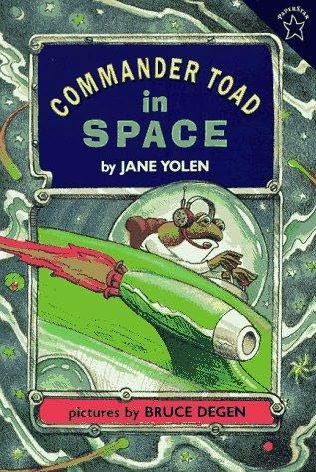
Commander Toad in Space, Jane Yolen, illustrations by Bruce Degen.  Think: Frog and Toad meet Star Wars!


Babar Visits Another Planet, Jean de Brunhoff


If You Decide to Go to the Moon, Faith Mcnulty, illustrated by Stephen Kellogg. A whimsical, but educational "travel manual" for visiting the moon.


Elementary School Age
The Iron Giant, Ted Hughes


The Little Prince, Antoine de Saint-Exupery


The Wonderful Flight to the Mushroom Planet, Eleanor Cameron. In print since the 1950s, the Mushroom Planet series is still around. Children will enjoy reading about the adventures of Chuck and David, two boys who travel to the alien planet Basidium in their homemade spaceship.


Middle School/Junior High
Ender's Game, Orson Scott Card


The Giver, Lois Lowry


The Phantom Tollbooth, Norton Juster


A Wrinkle in Time, Madeline L'Engle (a blend of sci-fi and fantasy)


Journey to the Center of the Earth, Jules Verne. This steampunk sci-fi novel follows Professor Lidenbrock, his nephew Axel, and their guide Hans as they venture deep into a volcanic crater in Iceland on a journey that leads them to the center of the earth and to incredible and horrifying discoveries.


High School
The Hunger Games, Suzanne Collins. Katniss is a 16-year-old girl living with her mother and younger sister in the poorest district of Panem, the remains of what used be the United States. Long ago the districts waged war on the Capitol and were defeated. As part of the surrender terms, each district agreed to send one boy and one girl to appear in an annual televised event called, "The Hunger Games." The terrain, rules, and level of audience participation may change but one thing is constant: kill or be killed. When Kat's sister is chosen by lottery, Kat steps up to go in her place. (I would hesitate to recommend this to middle-schoolers, although it is a YA novel for 12-17 year olds. For mature readers. My past review is here.) 


1984, George Orwell. Portrays life in a future time when a totalitarian government watches over all citizens and directs all activities.


Fahrenheit 451, Ray Bradbury.  "Although books are outlawed in Fahrenheit 451, Bradbury said in interviews that his main purpose wasn’t to argue against censorship (although that’s clearly a sub-theme). Instead, he said he was trying to paint a picture of where society might be heading, as books and other old forms of media and entertainment were being replaced by what he saw as shallow and frivolous alternatives like television shows. In this future, Bradbury argued that books would become outlawed because people themselves would become increasingly anti-intellectual and see them as suspicious. Not surprisingly, perhaps, he was no fan of electronic books: Those aren’t books. You can’t hold a computer in your hand like you can a book. A computer does not smell… A book has got to smell. You have to hold it in your hands and pray to it. You put it in your pocket and you walk with it. And it stays with you forever. But the computer doesn’t do that for you. I’m sorry." More here.


Frankenstein, Mary Shelley... Did you know that Mary Shelley began this deeply profound work when she was only 18?? When I read it, I was blown away, knowing it was penned by a young woman, and told so chillingly through the first person of Dr. Frankenstein. In this classic novel (considered to be one of the first science fiction books), readers "encounter the reality of evil, and the danger of untempered common sense and moral restraints... At the heart of this myth is the pride of the scientist who would take God's place and become a Creator in his own right...Frankenstein is a tragic story, a cautionary tale...what story could be more relevant to our society, given the increasing power wielded by scientists and businessmen over genetics and human life? Mary Shelley, with an artist's prophetic imagination, reminded us what it is like to be human - and less than human". (quote from BOOKS THAT BUILD CHARACTER, by William Kilpatrick).


The Space Trilogy, C.S. Lewis... More from William Kilpatrick: "Before C.S.Lewis wrote the CHRONICLES OF NARNIA, he became concerned with an ideological frame of mind he called "scientism". According to Lewis, scientism was the belief that technology would liberate mankind from the moral traditions of the past; the end result would be the elevation of certain scientists to the status of godhood, with the power of life and death over the whole human race....The three novels that constitute THE SPACE TRILOGY dramatize the conflict between scientism and the moral tradition of the West."
Out of the Silent Planet - A Cambridge University scholar named Ransom accidentally stumbles onto a scheme in which two men, one a scientist and the other a huckster with intellectual pretensions, prepare to travel to Mars and plunder its rich and strange culture.
PerelandraRansom is brought to Venus, where he finds a new Adam and Eve, who are being tempted by the evil scientists from the first novel.
That Hideous Strength - The cosmic struggle between good and evil takes place on Earth, as a scientific institute comes close to asserting its power over the world.

Thursday, March 15, 2012

WANT TO KNOW MORE ABOUT THE NIGHT SKY?

source

Wow - In case you haven't heard (or seen the bright heavenly bodies), March 2012 ranks among the best months ever for planet watching!  Five planets are visible, according to Earthsky.org:
"Mercury, the innermost planet, makes its best evening appearance for the year in the Northern Hemisphere. All over the world, Mars shines at its greatest brilliance for the year – and moreover, the red planet stays out all night long. Plus, the brightest and second-brightest planets – Venus and Jupiter, respectively – come together for a stunning conjunction in mid-March. Saturn, the farthest and faintest visible planet, is nonetheless as bright as the brightest stars, and its glorious rings are surprisingly easy to view through a backyard telescope".

source
Do you have a child who is showing interest in the night sky?  Below are some excellent picture books about the planets. (To read my past posts about space, the moon, and constellations, click HERE).

Since ancient times, people have been looking up and wondering about all of the things that glow in the night sky, and about our place in the big, wide universe. The study of the night sky and all of the objects and forces up there is called astronomy, and A Child's Introduction to the Night Sky by Michael Driscoll is a great introduction to what astronomers have learned (and are still discovering), what astronauts and scientists explore—and what you yourself can find by gazing up into the night sky... (ages 8 and up)


You live on Earth, so you already know a lot about it. But do you know about its place in out solar system? For instance, it's not the largest planet. If Jupiter were a hallow ball, 1,000 Earths would fit inside it. And did you know our planet Earth takes 365 days to go around the sun, while the planet Pluto takes 248 years?
This simple text by Franklyn M. Branley introduces the nine planets in our solar system and is complemented by Kevin O'Malley's full-color illustrations, which incorporate some of the newest space photographs available. How hot is it on Venus? Which planet takes longest to orbit the sun? Find out the answers in this updated version of this popular text.  Included are many hands-on activities... (ages 5 and up)


My kids loved The Magic School Bus series! To celebrate its 20th anniversary, Scholastic has re-releasing the ten original Magic School Bus titles in paperback. With updated scientific information, the bestselling science series ever is back!
The Magic School Bus Lost in the Solar System, by Joanna Cole and Bruce Degen: The field trip to the planetarium is foiled when the museum turns out to be closed, but Ms. Frizzle saves the day. The Magic School Bus turns into a spaceship and takes the class on a trip zooming through the atmosphere, to the Moon, and beyond! With up-to-date facts about the solar system, revised for this edition. (ages 5 and up)

Thursday, September 29, 2011

RETRO ROCKETS AND MORE

THIS IS THE LAST DAY YOU CAN ENTER MY SEPTEMBER GIVEAWAY - be sure and leave a comment or click here for details about my drawing for BOB BOOKS SIGHT WORDS. Contest ends at midnight tonight - winner announced tomorrow, Sept. 30, 2011. CONTEST OVER.  Giveaway winner: Theron Mathis!  Congratulations, Theron, send me an email with your address so I can mail you the sets. 

Today I'd like to showcase a unique book, THIS IS THE WAY TO THE MOON, by M. Sasek.  It's one of those books that grabs your attention with its bold, retro artwork. This title was first published in 1963 as This is Cape Canaveral, then later as This is Cape Kennedy. It was reissued in June 2009 as This is the Way to the Moon. Why so many titles?
Cape Canaveral was renamed Cape Kennedy after the assassination of President Kennedy in 1963. However, since the new name wasn't popular with local residents, the former name was restored to the area of Cape Canaveral in 1974. But the NASA installation base there goes by the name Kennedy Space Center, so you can see why this gets confusing!  The new title is a neutral way of describing the space center and the surrounding area.

Miroslav Sasek (born in Prague in 1916, died in 1980) was a Czechoslovakian author/illustrator of nonfiction for children.  From 1959-1974, he published his THIS IS... series.  These wonderful books are full of nostalgia and introduce children to great countries, cities, and landmarks in an entertaining and understandable way. (More about the other titles from his series in a future post).

But back to today's book, THIS IS THE WAY TO THE MOON... it is an awesome historical record of the perceptions and attitudes during the '60s about space (included in this edition are footnotes of facts and figures that have changed since they were first printed).

Kids of all ages (but especially 4-8 year olds) will enjoy the bold, colorful illustrations of giant missiles, huge antennae, astronauts (human and non-human) and even a chocolate space shuttle, all recreated with amazing detail. THIS IS THE WAY TO THE MOON will also jog the memories and delight the souls of those adults who may remember it from their own childhoods.

BEYOND BUZZ LIGHTYEAR:
If your kids love space and the cosmos, you can find more fun book recommendations (fiction and non-fiction) from my past post HERE.

Have you ever wanted to make a child's quilt with a space theme? Check out the adorable fabric at the FAT QUARTER SHOP.

Don't sew? Don't worry - go to The Pat a Cake Baby to order RETRO ROCKET RASCALS themed baby gear HERE.

What about throwing a rocket/astronaut themed birthday partyCLICK HERE for ideas and a DIY tutorial for making jet pack favors for the attendees. Of course you'll need a rocket ship birthday cake - find a step-by-step recipe HERE from Parenting.com.


Invitations? How about these nifty printable retro rockets from Etsy...

Wednesday, September 8, 2010

BOOKS ABOUT CONSTELLATIONS, THE MOON, AND SPACE (with some silliness thrown in)

There was a point in time when all my oldest son wanted to check out from the library were books about space and astronomy.  (It was after his Dinosaur and Oceans/Sharks Phases.)  Since we homeschooled, I was completely happy to help him find books that fed his interest!

source

In this post I've included books we enjoyed back then - along with a few new ones I've discovered since.  Some are silly, some are sweet, and several are very informative and educational.  So...."To infinity and beyond!!"

PICTURE BOOKS


HARRY AND HORSIE by Katie Van Camp, illustrated by Lincoln Agnew.  (ages 3 and up)  A little boy named Harry follows his best-friend-stuffed-animal, "Horsie", out into the night sky in order to rescue him and bring him back home, in this charming retro-space adventure.


HOW TO CATCH A STAR and THE WAY BACK HOME by Oliver Jeffers (ages 3 and up)  Cute childhood fantasy stories and unique illustrations by this new author/illustrator from Belfast, Northern Ireland.


I'LL SEE YOU WHEN THE MOON IS FULL by Jim Fowler, illustrated by Susi Fowler (ages 4-8).  Delightful tale of a father going away on a business trip and how he explains to his son how long until he'll be home: "...when the moon is full."  He proceeds to explain the phases of the moon.
 

WAIT TIL THE MOON IS FULL by Margaret Wise Brown, illustrated by Garth Williams. (ages 4-8).  In this story, a little raccoon must wait - as his mother tells him - "Til the Moon Is Full" to go out into the night.   So he waits, as the moon gets bigger and bigger...


SPACE CASE by Edward Marshall, illustrated by James Marshall.  (Kindergarten and up).  A silly Halloween story, in which a "thing" from outer space thinks he is joining some other aliens, who are actually children out Trick-or-Treating.  Funny humor and illustrations.

NON-FICTION:


THE MOON BOOK by Gail Gibbons. (ages 4-8)  Gail Gibbons does a great job with science books for kids.  Her simple, bright illustrations and explanations with just the right amount of detail, offer a great introduction to young children in this book about the moon.


GLOW-IN-THE DARK CONSTELLATIONS by C.E. Thompson (ages 4-8)


THE GLOW-IN-THE-DARK NIGHT SKY BOOK by Clint Hatchett (ages 9-12)


FIND THE CONSTELLATIONS by H.A. Rey.  (ages 9-12) The statistical data in this classic has been updated, but the vintage illustrations remain the same!


MOONWALK: FIRST TRIP TO THE MOON (Step-into-Reading Book) by Judy Donnelly. (ages 5-8)  Historic trip to the Moon of the crew of APOLLO II and their lunar module, "EAGLE". School Library Journal: The story of Apollo II's historic flight, from lift-off, through 'The Eagle has landed,' to splashdown and quarantine. Donnelly does a good job of setting the stage with chapters on the history of the idea of flight to the moon, astronaut selection and training, and look at the flight's effect on people in general.