Purpose of this Blog...

You may have noticed that not all books are equal in capturing children's imaginations and in cultivating those innocent, tender souls. My goal is to help you find the ones that do!
(Painting by Mary Cassatt: "Mrs Cassatt Reading to her Grandchildren" -1888)


Showing posts with label fairy tales. Show all posts

Friday, April 2, 2021

Sisters, Sisters...

There were never such devoted sisters!

My granddaughters are the cutest.


We love singing them the "Sisters Song" from White Christmas - especially in light of the fact that Maria (the youngest of my daughter's four children) was born in December - on Christmas Eve!

My husband recently found a long lost box high up on a shelf in our garage.  It was full of some of our kids' favorite childhood picture books!  I separated them out according to each (now adult) child so they can pass them along to their own kiddos.


When I came to the pile of my daughter's books I smiled as I thought of her little girls enjoying their mommy's old books...because they already love books!


Today I'd like to highlight a story about two sisters, Snow White and Rose Red, heroines of one of Grimm's fairytales. I remember it being a favorite of my childhood fairytales.  Growing up, we had a recorded version with a follow-along Little Golden book.

There was once a poor widow who lived in a lonely cottage. In front of the cottage was a garden wherein stood two rose-trees, one of which bore white and the other red roses. She had two children who were like the two rose-trees, and one was called Snow-white, and the other Rose-red... 


I loved Gustav Tenggren's illustrations of the blonde and brunette sisters, as different in their personalities as their red and white rose bushes - and I could never decide which girl I'd rather be. The story also features a bear, and an ungrateful dwarf (who always reminded me of Rumplestiltskin).

This beautiful version, Snow & Rose written and illustrated by Emily Winfield Martin, was gifted to me by my daughter! It's a nice chapter book version for kids 8-12, with beautiful illustrations throughout.

From Publisher's Weekly:

Sisters Snow and Rose once lived a charmed life in a grand house with a beautiful garden. After their father disappears into the woods, the girls and their mother are forced to move into a small cottage in the same forest. There, they befriend a boy named Ivo, discover a mysterious library filled not with books but objects, are tricked by a strange little man, and bond with a protective bear. 

Unfolding over episodic chapters that build to a well-deserved happy ending, this moody fairy tale emphasizes family, friendship, and the powerful bond of sisterhood. Martin’s characterization of the two contrary sisters is especially moving: Rose is the type of person who “holds on to a thing she loved as tightly as she could,” while Snow wants “to see or hear or taste something she loved over and over again, to remind herself that it was real.” 

The sisters’ contradictions make their relationship all the stronger, and Martin’s prim full-color paintings and spot illustrations tenderly highlight key characters and moments. Ages 8–12.

Incidentally, when Maria was born, I gifted her with one of Emily Winfield Martin's picture books, The Wonderful Things You Will Be.


And this past Christmas, we gave her a cute little stuffed doll of the protagonist baby (her doppelganger), who, along with sister Lexi, keeps Maria company day and night.

Oh, how I miss our little Snow (Lexi) and Rose (Maria)!  Such devoted sisters.

Thursday, January 21, 2021

Thumbelina? No, Saint Ia on a Leaf!


Melinda Johnson has a new picture book about St. Ia.  Her hagiography (which we'll get to in a minute) is fairytale-like and her mode of transportation reminded me of Hans Christian Andersen's Thumbelina

Children love fairytales, which, much like stories of the saints, have a lot to teach us. When I was a little girl, Thumbelina was one of my favorite fairytales.  We had the Little Golden Book version, with illustrations by the Swedish artist, Gustaf Tenggren


Thumbelina was as small as your thumb. As fairytales (and some saints' stories) go, the beautiful girl had several mishaps involving unsuitable and unwanted suitors.  But luckily, several creatures took pity on her and came to her rescue.

Thumbelina may have been defenseless, but she was not helpless. She made do with what nature could give her to survive (a leaf for a boat, blades of grass for a bed, honey for food...). One day she found a swallow, numb with cold and near death. She wove him a blanket from hay and took care of him all winter long.

To repay her kindness, in the spring the swallow let her fly away with him on his back to avoid her unwanted marriage to a mole.  The swallow took her far away to a lovely lake and put her down on a flower petal right next to a little man just her size.  He was the King of the flower spirits. 

You can guess the ending: they got married and lived happily ever after.  Is it irresponsible to read children fairy tales, or can they point us to our King? Go here for thoughts from Fr. Stephen Freeman: https://blogs.ancientfaith.com/glory2godforallthings/2015/10/28/about-fairy-tales/

So now to Saint Ia of Cornwall, an Irish Virgin-martyr, remembered on February 3. 

source

I first came across Saint Ia's story in a lovely new book, Seven Holy Women, just put out by Ancient Faith Publishing.  This not-to-be-missed collaborative book was Melinda Johnson's brain child.  I could hardly wait to gift Seven Holy Women to several close friends, my daughter, and our new daughters-in-law for Christmas.

The lives of the saints are important for us to read, especially now during our Covid-enforced isolation - many of the saints certainly lived in isolation. We can definitely learn from their example of time spent with God. 

The science and news of Covid has become for many a distraction during the boredom that can come from isolation. We want connection with life outside our small space. We want answers. So we turn to the news/internet, and as we are inundated with daily (even hourly) updates, science and politics become THE MOST IMPORTANT THING. Suddenly everyone has an opinion to share on their facebook and instagram feeds because we also want people to pay attention TO US. And the more urgent, the more of a possibility that we'll get people to pay attention to us, but unfortunately away from THE ONE THING NEEDFUL. We all need to try our best to use this extra time found in isolation for meditative and fervent prayer and inspiration from our Saints. The last thing we need is more distraction from this.

Some in the world may tell us our saints' stories aren't important, that only truly historically accurate and scientifically explainable stories are to be taken seriously. For more thoughts on this, please refer to Orthodoxartsjournal.corg for excellent articles, especially several from Nicholas Kotar regarding the truth of the Lives of the Saints, here.

Nicholas Kotar says: Seen from the prism of today's mundane reality, which has been rendered practically black and white by the precision of the scientific method, these events [he is referring to a historical mythical event he previously recounted] are simply impossible. But every wise man from time immemorial has warned about judging the past through the lens of the present. Who's to say dragons didn't threaten the monks of the Egyptian desert...that's a question one would be foolish to try to answer until one has tried to understand what these dragons really are, and not in the sense of trying to find a specimen to dissect.

The poet, then, instead of assessing the truthfulness of a certain aspect of a Life or of the Life itself, has a much more important calling - as an apologist of the mythical and improbable in the lives in general.

Back to today's picture book...

As mentioned at the top of my post, Melinda Johnson is also the author of this new little board book, Saint Ia Rides a Leaf. I think it will help parents to know a few details of the life of St. Ia before reading the picture book to their children. 

Saint Ia was an Irish virgin-martyr saint born around 480.  She was baptized into the Christian faith around the tender age of thirteen and wanted to go to Cornwall with missionaries Sts. Fingar and Piala to help teach the Gospel of Christ. 

However, when she arrived at the shore the morning of their planned trip, the ship had already set sail (they probably thought the undertaking too dangerous for her and left early).  Distraught, Ia prayed to God for help.  And He brought it - in the form of a miraculous leaf.


The leaf grew when St. Ia's staff touched it, and she stepped in and was transported across the Irish Sea to England. This is where the simply-told picture book story ends in its telling. 

Saint Ia ultimately ended up landing in St. Ives in Cornwall. She actively evangelized across the countryside. There was a chapel erected by her in Troon, fourteen miles inland to the east. You can read about it here, on historicengland.org.  Ia was eventually martyred under the persecutions of the wicked Breton Prince Tewdwr in the middle of the sixth century.

Author Melinda Johnson is an excellent story-teller, and you will love her fun, energetic portrayal of sweet Ia.  Young children will enjoy Kristina Tartara's cute, colorful illustrations as well as Ia's three companions - a fish, a crab and a sea bird.  

Did Ia really sail to England on a leaf?  She certainly did get there, as history shows. As much as we can learn from a fairytale Thumbelina, we can learn much more from a historical young girl named Ia who loved God with all her heart.  Saint Ia, pray for us! 

Saint Ia Rides a Leaf is available here, from St. Vladimir's Seminary Press.  It can also be found from the Ancient Faith Publishing Store, along with Melinda Johnson's other books Letters to St. Lydia, and the Sam and Saucer chapter books. 

Go here, to Raisingorthodoxchristians.com, for some fun activities as well as a cute coloring page to go with this book!

Thursday, August 4, 2016

A New Book (For Me), in Which I am Introduced to a Moomintroll

What do you get from an author who 1) was born into the Swedish speaking minority of Finland; 2) spent her summers in a family cottage on an island; 3) had a father who was a sculptor, and a mother who was a graphic designer; and 4) as a young woman became so sad during WWII that she wanted to write something innocent and hopeful?  Tove Jansson's  Moomins!


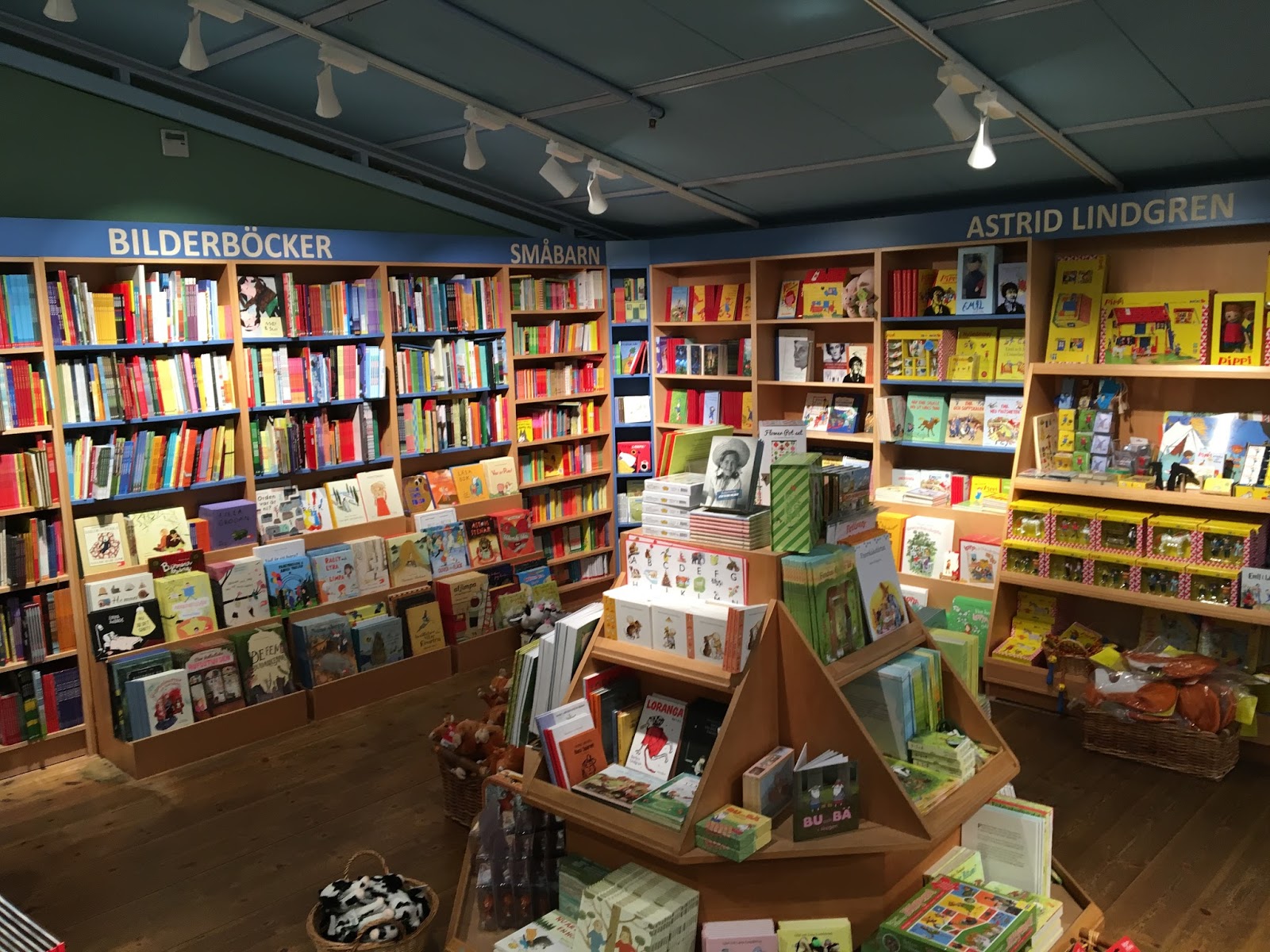
If you've been following my blog the past few weeks, you are aware that I recently returned from a tour of Scandinavia. Our tour guide's sweet wife (herself a lover of children's literature and especially Astrid Lindren - more about that later), made sure I got to make a quick stop at the largest children's bookstore in Sweden. 

The bookstore was in a museum called Junibacken, which is devoted to children's literature.


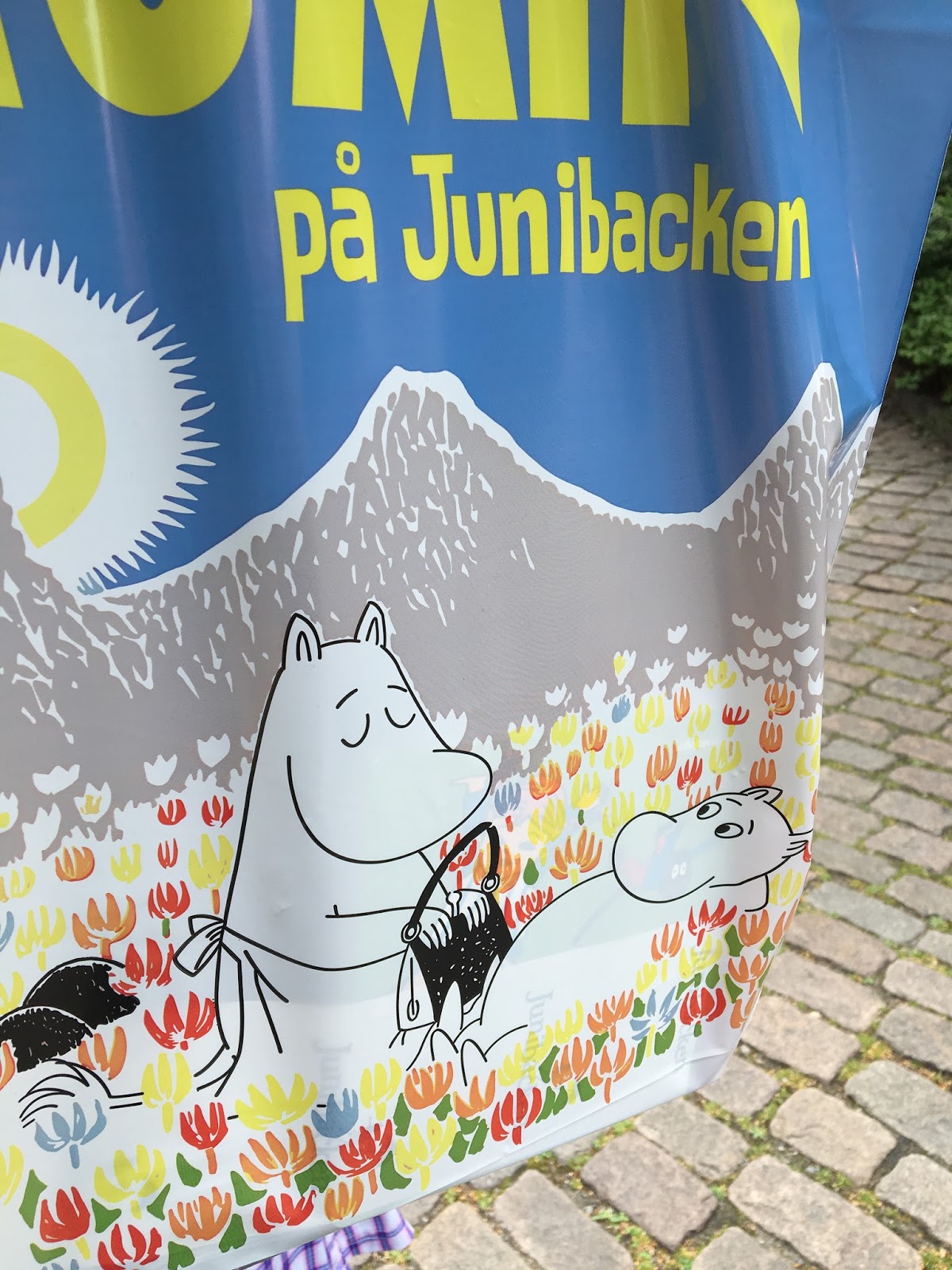
Junibacken Museum happened to have a Mumin (Swedish for "Moomin") Exhibit while we were there!  The exhibit consisted of a little themed playland with lots of fun settings from Tove Jansson's books...


Moominmamma's Kitchen


Well, truth be told, I had never read the Moomin books, but I had seen them listed on several "Best Children's Books" lists.  So I excitedly purchased my first one!


Moomintrolls.
Are they trolls, or what?
I'm not really sure...
As you can see, they are way cuter than the ugly Troll I came across at the Voss train station in Norway!


But Moomintrolls certainly seem to have stepped out of the world of Scandinavian folk-lore!

Finn Family Moomintroll is the third in the series, and the first one  ever translated into English.  I figured the English speaking world's introduction to the Moomin family was a good place for me to start!

Tove Jonsson's adorable illustrations really add to the stories.  They bring the reader along, and help us see the land and characters she has created.


(By the way, I adore the vintage book covers like the one above - see more here.  In my opinion, the new Puffin editions like mine, pictured at the top of this post, completely leave out the whimsical fairytale nature of the books.)

In Finn Family Moomintroll, the first bit of real magic happens after the Moomins have woken up from their long winter sleep and are enjoying a spring day mountain-top experience.  That's when they find a black top hat.


A Hobgoblin's Hat!  (Which they bring home.)

In the corner between the table and the kitchen door stood the Hobgoblin's Hat with the eggshell in the bottom.  And then something really strange happened.  The eggshell began to change its shape.
(This is what happens, you see.  If something lies long enough in the Hobgoblin's Hat it begins to change into something quite different - what that will be you never know beforehand.  It was lucky that the hat hadn't fitted Moomominpappa because the-Protector-of-all-Small-Beasts knows what would have become of him if he had worn it a bit longer.  As it was he only got a slight headache - and that was over after dinner.)
Meanwhile the eggshell had become soft and woolly, although it still stayed white, and after a time it filled the hat completely.  Then five small clouds broke away...

Moomintroll (Moomminpappa and Moominmamma's child) and the Snork Maiden (his friend) figure out how to fly the little clouds.  So they hop on, and away they go!  

They come across Hemulen (another Moomin), who collects stamps.


When they greet him, Hemulen says:
"That's extraordinary.  But I'm so used to your doing extraordinary things that nothing surprises me.  Besides I'm feeling melancholy just now...my stamp collection is complete"....

"I think I'm beginning to understand," said Moomintroll slowly.  "You aren't a collector anymore, you're only and owner, and that isn't nearly so much fun."

There are all sorts of whimsical (and some slightly scary) characters in Moominvalley, and they go through all sorts of non-sensical adventures.  


Think Edith Nesbit's "Psammead", from The Five Children and It, mixed with L. Frank Baum's The Marvelous Land of Oz, a little bit of of A.A. Milne's Winnie the Pooh and the Hundred Acre Wood thrown in, and you've got an idea of how fun these books are.

Have you read about the Moomins?  If you haven't, I think you and your child will really like these silly little creatures!

And please come back for more posts - I still have a Scandinavian Book Giveaway coming up! 

Friday, June 24, 2016

Fairy Tale Reading by Lamplight

“If you want your children to be intelligent, read them fairy tales. If you want them to be more intelligent, read them more fairy tales.” ― Albert Einstein


"Bedtime Story", artwork by Chris Dunn

Wednesday, October 15, 2014

Andrew Lang, Rescuer of Fairy Tales

“If you want your children to be intelligent, read them fairy tales. If you want them to be more intelligent, read them more fairy tales.” 
 ― Albert Einstein
source
Andrew Lang's well-known "Fairy Books" are a series of fairy tales - a collection of twelve books in all - published between 1889 and 1910. Each volume is distinguished by its own color, all collected and edited (not written, as some mistakenly assume) by Lang.

Anita Silvey (The Essential Guide to Children's Books) said, "The irony of Lang's life and work is that although he wrote for a profession - literary criticism; fiction; poems; books and articles on anthropology, mythology, history, and travel...he is best recognized for the works he did not write." 

Fairy Book History:
Victorians favored realistic and instructive stories for children. In the late 19th century, interest in the native fairy tales of Britain had declined and there were very few books recounting them for young readers. 

In fact, fairy tales and magical stories in general were being attacked by some educationalists as being harmful to children.  Lang - who had taken pleasure in nursery rhymes and folktales since childhood - challenged this notion by collecting and editing fairy stories for the first of his "colored fairy books", The Blue Fairy Book (published in 1889).

According to the Folio Society:
Whilst other folklorists collected stories directly from source, Lang set about gathering those stories which had already been recorded. This gave him time to collect a much greater breadth of fairy tales from all over the world, most from well-known writers such as The Brothers Grimm, Madame d’Aulnoy and others from less well known sources. Whilst Lang also worked as the editor for his work and is often credited as its sole creator, the support of his wife, who transcribed and organized the translation of the text, was essential to the work’s success.


It's a Reading Rainbow of Books!
You can see the contents of each book here. The names and publication dates of Lang’s 12 "Fairy Books" are as follows:
  • The Blue Fairy Book – 1889 
  • The Red Fairy Book – 1890 
  • The Green Fairy Book – 1892 
  • The Yellow Fairy Book – 1894 
  • The Pink Fairy Book – 1897 
  • The Grey Fairy Book – 1900 
  • The Violet Fairy Book – 1901 
  • The Crimson Fairy Book – 1903 
  • The Brown Fairy Book – 1904 
  • The Orange Fairy Book – 1906 
  • The Olive Fairy Book – 1907 
  • The Lilac Fairy Book – 1910
J.R.R. Tolkein said, "None rival either the popularity, or the inclusiveness, or the general merits of the twelve books of twelve colours which we owe to Andrew Lang and his wife."

A Thirteenth "Fairy Book"?  Lang's very own work...
Did you happen to notice the title of the book pictured at the top of my post?  My Own Fairy Book was written by Andrew Lang, "made up altogether from his own head" (as the introduction says), and published in 1895.  Lang said he always felt "rather an impostor" because "so many children seem to think" he wrote the twelve fairy books. You can read "My Own Fairy Book" onlinehere, on Project Gutenberg.

If you especially love fairies, go here to read my past post, "I Do Believe in Fairies, I Do! I Do!".


Friday, May 17, 2013

Russian Folktale Art Fit for a Tsar!

The work of Palekh artists must be counted among the true wonders of Russian art. When you look at their creations on black lacquer backgrounds each of them seems to glisten and sparkle with gold, silver and all the colors of the rainbow... 
-Abram Raskin, art scholar and Merited Art Worker of Russia.


I'd love your feedback and comments about these two gorgeous folk tale books (not technically "fairy tale", if you remember from my last post) I brought home from my trip to St. Petersburg. (Remember, a comment will enter you into my May Giveaways!)

Both books are illustrated with artwork from painted Russian lacquer boxes. By the way - I see that you can get used copies of the Russian Fairy Tales book very inexpensively, here from Amazon - for sure a lot cheaper than what you'd pay for one of the lacquer boxes!  This post is full of my own photos from Pushkin's Fairy Tales...


Russian lacquer art developed from the 17th-19th Century Russian icon painting tradition - which sadly came to an end with the collapse of Imperial Russia during the Russian Revolution of 1917 (although thankfully this tradition is being revived by young artists of the 21st Century) . The icon painters, who previously had been employed by supplying not only churches but people's homes with icons, needed a way to make a living.

Since many of the icons had been painted on cypress-wood panels or a papier-mâché base, the artists  began specializing in the craft of making papier-mâché decorative boxes and panels that were lacquered and then hand painted, often with scenes from folk tales.

There are four centers (schools) which practice the art of this Russian craft - both of my fairy tale books show the work of artists from the Palekh School, using the technique of painting in egg-based tempera overlaid with intricate gold leaf highlighting to decorate their miniature lacquer boxes.

 (Artwork by Alexei Orleansky a painter of the Palekh school, from Russian Fairy tales)

In my next few posts I'll be sharing different Russian folktales with you.  Today, I'll be sharing the artwork and stories from Pushkin's Fairy Tales.  Pushkin's tales are quite long, and written in verse (he was more influenced by French fairy tales then Russian folk tales, which were always written in prose).  I bought the book for my son-in-law, because he's especially interested in Russia and its literature.


From "Ruslan and Ludmilla", an epic tale in verse by Pushkin,
published in 1820.
From "The Golden Cockerel"
"The Tale of the Golden Cockerel" was the last folktale in verse by Pushkin, published in 1835.  It's based on a couple of chapters from the short story "Legend of the Arabian Astrologer" from the Tales of Alhambra by Washington Irving!

The only tale of Pushkin's that might interest younger children is "The Tale of the Dead Princess and the Seven Champions" (champions could also be translated as "knights").  Does the number seven make you think of any other fairy tale - SNOWWHITE AND THE SEVEN...?

Here is the Princess, in all her glory (and holding the "Pippin" apple), with the seven brother knights -  "champions...ruddy, bushy-whiskered men" (they're not dwarfs in this version, and they live in a mansion in the forest, as opposed to a cottage).

The Princess and her seven champions

She runs away from her step-mother, the Queen, and finds the knights' forest mansion.  The seven brothers love her, but she tells them she cannot marry any of them because "another still is dearest. I must his forever be; Elisey, the prince, is he."


This prince eventually comes looking for her - asking the Sun and Moon to help him find his soon-to-be-wife.  Little does her fiance know that she has been approached by an old woman and given an apple that was poisoned.  It is the Wind who finally tells him of her glass coffin and where to find it... 

From the coffin she is creeping; Ah, for joy they both are weeping!  
Now he lifts the maid away Out of darkness into day 
And the two are homeward faring, Happy, friendly talk are sharing.
Quickly round the tidings ring, 'Saved - the daughter of the king!'


One other Pushkin tale in this book that I'll mention is "Tale of Tsar Sultan".  It's been published as a picture book on its own with illustrations by one of my favorite present-day Russian artists,  Gennady Spirin.  You can see his version here.

I hope you're enjoying all this truly remarkable Russian-lacquer-box-fairy-tale-artwork!  More coming in my next post...and remember to leave a comment, if you want to be entered in my May Giveaways (it's Matryoshka Madness!)

Wednesday, May 15, 2013

Alexander Pushkin and Russian Folklore

When my husband and I were in St. Petersburg, Russia, we made a side trip to the town of Pushkin (named for the poet), which surrounds the Tsarskoe Selo ("Tsar's Village") estates.  I'll be sharing photos of the estates soon in another post; today I'd like to talk a little bit about Pushkin and Russian folklore.
Monument of Pushkin, founded on the 26th of May 1899, on the 100th anniversary of the poet's birth. 
Pushkin was educated at the Lyceum of Tsarskoe Selo.
Alexander Pushkin (1799-1837) is generally recognized as Russia's greatest poet. He was born into an aristocratic family with a long and distinguished lineage, and attended an exclusive school for the nobility in Tsarskoe Selo, outside the capital city, St. Petersburg.

Pushkin was also a novelist, but part of his literary heritage is his "fairy tales", which were loosely based on Russian folklore (and on some French fairy tales - because of this his tales were criticized, called "artificial flowers" - source).
Pushkin's Fairy Tales,  with Palekh Painting
I honestly didn't know a lot about Russian folklore or Pushkin's tales, so I did some research and found out two interesting facts...

FACT # 1 - Pushkin's tales have always been favorite subject matter for  the painting school of Palekh, a famous old center of icon-painting and lacquer miniature boxes.  (More about this fact in my next post!)

FACT #2:  There are no fairies in Russian folklore, so they should really be referred to "folktales" - they have also been called "wondertales". (Thanks to Masha Gedilaghine Holl's website, which was my source for much of the information you'll find below!)

What is, then, a folktale? It's a story. First and foremost. In Russian, it is called SKAZKA. The word is from the same root as the verb "to say" -- skazat. Therefore it, quite simply, "that which is told" -- a tale, or story. But by implication, it is fiction, not news, something someone came up with: Entertainment. 

Up until the close of the eighteenth century most everyone from tsar to peasant delighted in the folktale.  After that time, the tales were more a part of the culture of the lower class.  Also of note is that the early Russian folk tales were traditionally told only after dark - when young children were asleep - they were typically not subject matter for children (too scary).

THERE ARE FOUR BASIC TYPES OF RUSSIAN FOLK TALES:
1 - Magical tales with a female hero.
2 - Magical tales with a male hero.
3 - Animal tales (with animals as main characters, with or without the participation of human characters).
4 - Tales about everyday life.

1, 2 - The first two categories are related. Both male and female heroes will embark on some kind of a quest. It may be a trip to the forest to gather firewood, mushrooms, or berries; or it may be a journey into a far-away kingdom. Similar characters appear in both types of tales, and they usually end with a marriage, and maybe fortune as well.
--The magical tales in which the hero is female (usually a girl) center around her ability to perform certain tasks. These tasks are usually practical and test the heroin's household skills: cleaning, cooking, spinning, weaving, and of course her knowledge of the proper behavior. These tales also test her ethics: she must not lie, although telling less than the truth is allowed; she must not steal, but taking something from an evil character, after she was allowed to do so by someone from that household, is also allowed.
--Magical tales with a male hero follow a slightly different pattern. For one thing, the male hero ALWAYS leaves his home on a QUEST (the female hero may live all her adventures in her own back yard). The male hero is not expected to perform tasks, at least not by himself: he encounters magical helpers that will do his work for him, or else fix the mistakes he makes when he attempts to perform the task.

3 - The third category of tales is not magical per se, unless you count the animals' ability to speak in "people's voices" (human speech). These tales may involve the participation of humans, or not, but usually the presence of humans somewhere is acknowledged or taken for granted.
--Animal tales are not cute stories about nice furry creatures. Animal characters are strictly typecast:
"The Fox and the Wolf," watercolor and charcoal by Yevgeny Rachev [source]
  • Wolves are greedy rather stupid, and male (the Russian word for wolf is "volk," a masculine noun). 
  • Foxes are sly, calculating, and tricksters. They are also female (the Russian word for fox is "lisa," a feminine noun). 
  • Cats are opportunistic and lazy. They are male (the Russian word for cat is "kot," a masculine noun). 
  • Bears are big and lumbering (naturally), rather clumsy, and not very bright. They are male (the Russian word for bear is "medved'," a masculine noun). The Russian word that is the equivalent of "teddy bear," "misha," is also the diminutive for the name Mikhail, which is the standard "first name" of folk-tale bears. 
  • Hares are quick and cowardly, and male ("hare," in Russian, is "zaiats," a masculine noun). 
  • The goat is cunning, and female (Russian -- "koza," a feminine noun). 
  • The rooster is cocky and boastful, and male (Russian -- "petukh," a masculine noun).
4 - The fourth category of tales about everyday life includes tales about soldiers returning home who meet (and defeat) Death, or who encounter a witch, or some other kind of magical being, and who gain fortune in the end (or maybe just a bowl of soup, as in "Axe Soup," the Russian variant of "Stone Soup.")


Be sure and read this informative essay: Baba Yaga's Domain, by Helen Pilinovsky, about one of Old Russia's most famous (and complex) folklore characters.


Sunday, January 13, 2013

Downton: What's this Abbey's Appeal?

That question may seem like a strange subject for a children's book blog, but I think the answer can be applied to writing in general - whether it be literature for children or, as in this case, a smash-hit public television series. I discovered the answer last week.  From one of the creators of the series, Julian Fellowes (I'll share his answer at the end of my post).


Surely you've heard about Julian Fellowes’s Emmy Award-winning show about an Edwardian family,  their servants, and their life in an English manor.  I admit I am one of the many people who has gone through Downton Abbey withdrawals in-between seasons and has counted down the days until the newest episode aired on Sunday nights.

I've asked myself more than once why this PBS Masterpiece Classic series appeals to such a broad spectrum of viewers - women, as well as men (my husband is a huge fan), Brits and Americans.

Is it because we all love history and period dramas?
Last summer (while in withdrawals between seasons) I read Lady Almina and the Real Downton Abbey: The Lost Legacy of Highclere Castle. This biography, written by the current Countess at Highclere, Fiona Carnarvon, is a thoroughly enjoyable and entertaining account of the Fifth Earl of Carnarvon, his wife, Lady Almina, and their grand castle, the inspiration for the popular PBS series. The fictional character of Downton's Lady Cora Crawley is loosely based on Lady Almina, the real-life American heiress and illegitimate daughter of banking tycoon Alfred de Rosthschild.

The real Downton Abbey: Highclere Castle

Is it the Downton Fab-bey set and scenery?  Downton Abbey is filmed at Highclere Castle, and the fabulous manor house has a starring role in the series each week (click here for more beautiful photos).

Highclere's library holds 5,000 books!
Beautiful salon

Is it the authentic costume design? Many of us look forward to the gorgeous gowns and dapper dinner jackets!


The Crawley sisters: Edith, Sybil, and Mary

Maybe it's Maggie Smith's one-liners? (Can you imagine having Violet Grantham as your grandmother?)

Dowager Countess: "What is a weekend?"
One of her most comical moments so far, was from last week's Season 3 opening episode...
All of Lord Grantham's formal shirts are mysteriously missing from his room and he has no choice but to wear an inappropriately informal shirt under his dinner jacket. His mother, the Dowager, mistakes him for one of the staff and asks for a drink.  As she turns and sees that it is the Earl of Grantham, without missing a beat she quips, "Oh I’m so sorry, I thought you were a waiter…”

Remember these gems?
Don’t be defeatist dear, it’s very middle class. 

I’m so looking forward to seeing your mother again. When I’m with her I’m reminded of the virtues of the English. 

No guest should be admitted without the date of their departure settled.


Is it the characters and romance? Now we're getting closer to Julian Fellowes answer...

Lady Mary and Matthew Crawley

Mr. Bates and Anna

Can you pinpoint what the main appeal of "Downton Abbey" is?  Consider Julian Fellowes answer: 
Over the last two rather extraordinary years, at the risk of sounding vain, I have often been asked why I thought Downton Abbey has been quite such a success.  Of course, it is hard to be definite about these things.  If television were an exact science, there would be nothing made that did not break records.  but supposing I were to put my finger on one element, it might be that we have made the decision to treat every character, the members of the family and the members of their staff, equally, in terms of their narrative strength.  They all have emotional lives, dreams, ambitions, and disappointments, and with all of them we suggest backstories, any of which are to be found in my own history...

The upper class family of Downton

The working class "family" of Downton

I was brought up in a class minefield.  My father's birth was grander than my mother's, his relations therefore disapproving of both her family and her, and she was condemned to the unenviable task of making everything in their life seem smooth and seamless when it was in fact riven with stitching...I suppose standing, as it were, on both sides of the divide has influenced my work...It is precisely because I identify with both teams that my writing, if I am allowed to say so, aspires to a kind of social justice which, I believe anyway, is one of the reasons it as reached so wide an audience.
[source: Parade Magazine, January 6, 2013]

Fellowes' honest answer is why we love classic children's literature such as Frances Hodgson Burnett's  The Secret Garden (Mary Lennox, Colin Craven, Dickon); Charles Dicken's A Christmas Carol (Ebeneezer Scrooge, Bob Crachit, Tiny Tim); Charolotte Bronte's Jane Eyre (Mr. Rochester, Jane); Frances Hodgson Burnett's A Little Princess (Sara Crewe, Becky); Johanna Spyri's Heidi (Heidi, Clara, Peter); Sid Fleischman's The Whipping Boy (Jemmy, Prince "Brat" Horace); and fairytales such as Cinderella.

Well, here's to Sunday night!  Excuse me while, I go and  feed my weekly obsession...