
 |
| source |
According to steampunk.com: Steampunk has always been first and foremost a literary genre, or least a subgenre of science fiction and fantasy that includes social or technological aspects of the 19th century (the steam) usually with some deconstruction of, reimagining of, or rebellion against parts of it (the punk).
Not Quite Steampunk:
As happens with trends, Steampunk seems to be everywhere all of a sudden, and often a bit over-done and misunderstood - as you can see from this funny Youtube video:
Not Quite Steampunk:
 |
| Steampunk moving towards the mainstream? Ya think? |
As happens with trends, Steampunk seems to be everywhere all of a sudden, and often a bit over-done and misunderstood - as you can see from this funny Youtube video:
Jules Verne: Before Steampunk was Hipster
Jules Gabriel Verne (February 8, 1828–March 24, 1905) a French author and visionary, is often called the "Father of Science-fiction", as a pioneer of the science-fiction genre. Born out of his own love for travel, Verne's books are about cosmic, atmospheric, and underwater travel before air travel and submarines were commonplace and before practical means of space travel had been devised.
 |
| Jules Verne, with some of the amazing inventions her imagined. Courtesy of the Smithsonian Libraries |
Did you know that Verne's Around the World in Eighty Days was based on a true story? In 1870, U.S. railroad magnate George Francis Train declared in the middle of his Presidential candidacy that he would travel around the world in 80 days or less. It ended up taking him almost double the time.
Verne never acknowledged George Francis Train (that couldn't have been his real name!) as the inspiration for his book. Train lived until 1904 and made three more round-the-world trips, beating his record each time, finally achieving 60 days. He once told an English journalist: "Remember Jules Verne's Around the World in Eighty Days? He stole my thunder. I'm Phileas Fogg. But I have beaten Fogg out of sight." source
Other sci-fi books by Jules Verne: 20,000 Leagues Under the Sea; Journey to the Center of the Earth
Modern day author/illustrators who've introduced kids to a fantastical Steampunk world in their books:

James Gurney, author of the Dinotopia series. In the year 1860, biologist and explorer Arthur Denison and his son, Will, set out on a sea voyage of discovery and adventure. When a powerful typhoon wrecks the ship in uncharted waters, Arthur and Will are the sole survivors. Washed ashore on a strange island called Dinotopia, they are amazed to find a breathtaking world where cities are built on waterfalls, people have found new ways to fly, and humans and dinosaurs live together in harmony. With new discoveries at every turn, Arthur and Will embark upon their own separate journeys to unearth the mysteries of Dinotopia. (You can find James' wonderful blog, here.)

Verne never acknowledged George Francis Train (that couldn't have been his real name!) as the inspiration for his book. Train lived until 1904 and made three more round-the-world trips, beating his record each time, finally achieving 60 days. He once told an English journalist: "Remember Jules Verne's Around the World in Eighty Days? He stole my thunder. I'm Phileas Fogg. But I have beaten Fogg out of sight." source
Other sci-fi books by Jules Verne: 20,000 Leagues Under the Sea; Journey to the Center of the Earth
Modern day author/illustrators who've introduced kids to a fantastical Steampunk world in their books:
Graeme Base - An alphabetical search and adventure book full of alliteration, Animalia was published in 1986 and has been a hit ever since. Each page features a short poem utilizing the feature letter of each page for many of the words. The illustrations are intricate, embedded with riddles and secret objects. The author has even hidden a picture of himself as a child on every page.
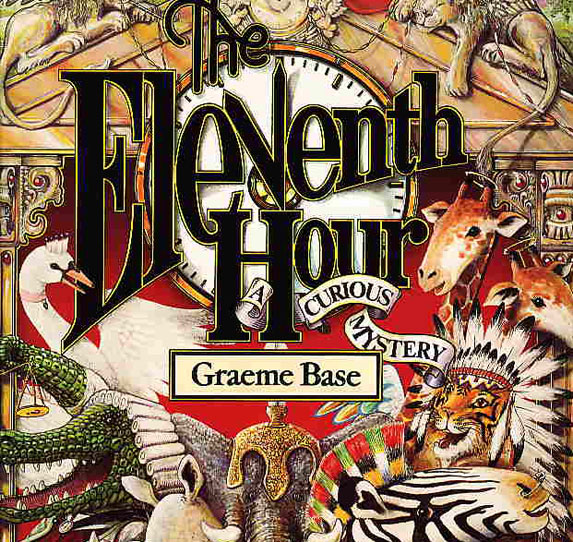
The Eleventh Hour is another award winning mystery picture book by Graeme Base. Set on the grounds of Horace the elephant’s elaborate mansion, Horace hosts a dress-up party for his eleventh birthday, inviting all of his friends; swans, alligators, rhinos, pigs, mice and more, to feast on a lavish spread, which regrettably, mysteriously disappears.
James Gurney, author of the Dinotopia series. In the year 1860, biologist and explorer Arthur Denison and his son, Will, set out on a sea voyage of discovery and adventure. When a powerful typhoon wrecks the ship in uncharted waters, Arthur and Will are the sole survivors. Washed ashore on a strange island called Dinotopia, they are amazed to find a breathtaking world where cities are built on waterfalls, people have found new ways to fly, and humans and dinosaurs live together in harmony. With new discoveries at every turn, Arthur and Will embark upon their own separate journeys to unearth the mysteries of Dinotopia. (You can find James' wonderful blog, here.)


William Joyce's The Guardians of Childhood picture books and chapter books develop fantasy "origin stories" for childhood figures such as Santa Claus, The Tooth Fairy, and the Man in the Moon. Ultimately, the series will consist of 13 books - six picture books and seven novels, for older kids. Pure imagination - childhood folklore and mythology at its best (and beautifully illustrated!)
 |
| Balloons lost on earth often floated up to the moon, carrying the hopes and dreams of the children who lost them. |
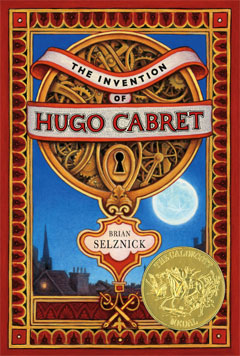
Brian Selznick, The Invention of Hugo Cabret website is here. The movie, directed by Martin Scorsese, has more of a Steampunk look than the book, but there is definitely a steampunk aspect to this story: the mysterious drawings, notebooks, keys, secret messages, and oddball contraptions (including an automaton) come togehter for a great adventure!)
And lastly:
Two classics, with some Steampunk style...
The Voyages of Dr. Dolittle
Doctor Dolittle heads for the high seas in perhaps the most amazing adventure ever experienced by man or animal. Told by nine-and-a-half-year-old Tommy Stubbins, crewman and future naturalist, the voyages of Doctor Dolittle and his company lead them to Spidermonkey Island. Along with his faithful friends, Polynesia the parrot and Chee-Chee the monkey, Doctor Dolittle survives a perilous shipwreck and lands on the mysterious floating island. There he meets the wondrous Great Glass See Snail who holds the key to the greatest mystery of all.
 |
| book by Hugh Lofting |
 |
| film version |
Commander Caractacus Pott is an inventor who buys and renovates an old car after gaining money from inventing and selling whistle-like sweets to Lord Skrumshus, the wealthy owner of a local confectionery factory. The car, a "Paragon Panther," was the sole production of the Paragon motor-car company before it went bankrupt. It is a four-seat touring car with an enormous bonnet (the car can also function as a hover craft). After the restoration is complete, the car is named for the noises made by its starter motor and the characteristic two loud backfires it makes when it starts.
 |
| book by Ian Fleming (yes the James Bond author) |
 |
| Car from the movie |


 books, by Martin Hanford, became a craze in the late 1980's. While I can't deny that this cartoon-style series is fun, see my recommendations below for some extra special choices...
 by Allan Ahlberg, illustrations by Janet Ahlberg (ages 4-8) Nursery rhyme characters sneak their way into gentle drawings - in the cupboard, on the stairs, in the forest...little ones will love this clever story! Also look for:
 by Graeme Base. (ages 4-8) This, the first of many original books by Base, is an elaborately illustrated alphabet book of paintings like no other you've ever seen! Packed with detail and layers and layers of objects matched to their corresponding letter on each two-page spread.
 , published in 1992. All the books have riddles by Jean Marzollo, in two-page spreads of objects hidden in photographs by Walter Wick.
 (newer series, ages 4-8) written and photographed by Walter Wick. These books not only have riddles, but also puzzles and brain teasers matched to the pages jam-packed with photos of objects to be found.
 (ages baby-preschool) Same as above, but for a younger crowd.
 (series, ages 5 & up) by Joan Steiner. These amazing books are full of photographs and riddles, but unlike Walter Wick's series, Steiner photographs three dimensional scenes that are made of everyday objects - like matchboxes, pretzels, crayons, and slices of bread, that double as trucks, chairs, a sidewalk, etc. Delightfully deceiving!!!
 (series, ages 2 & up) "To Look-Alike Land! We're blasting full throttle on a spaceship that looks like a THERMOS BOTTLE!" You've got to see it to believe it.